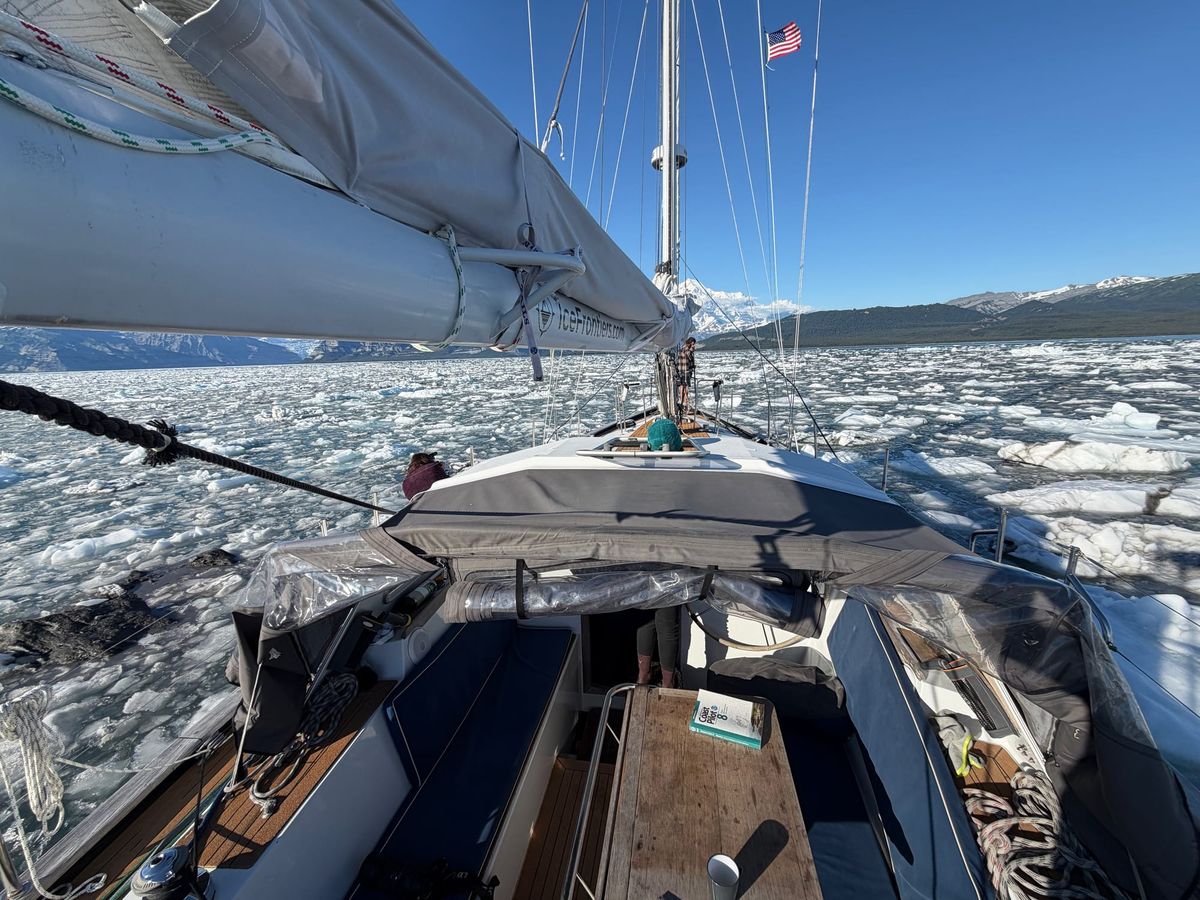
Sailing Prince William Sound
Prince William Sound looked pristine: clear water, empty anchorages, immense mountains and glaciers. It took a whale hundreds of miles later to make me wonder what we hadn’t seen — and whether I would know the difference between a healthy wilderness and a diminished one.

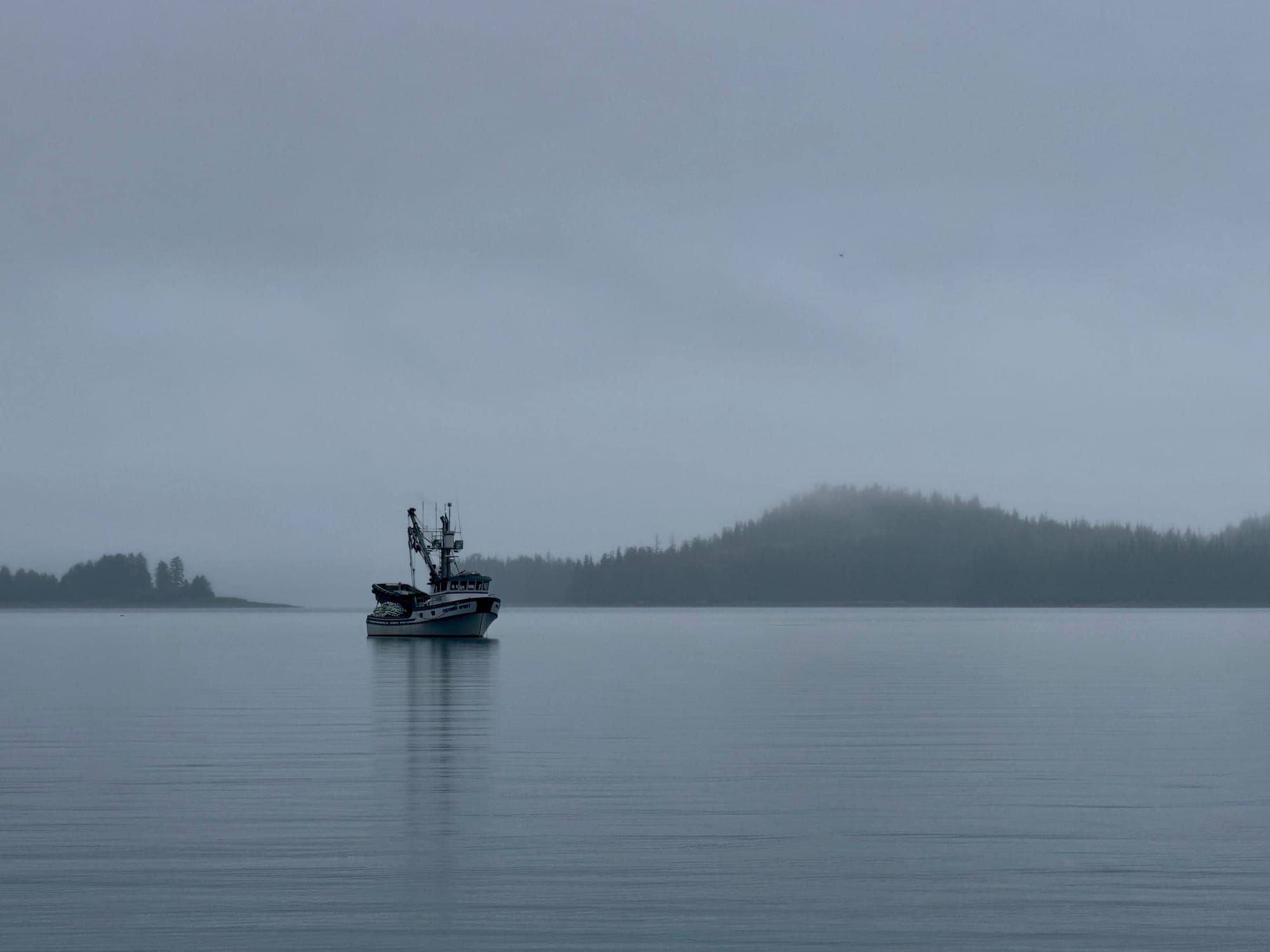
Somewhere between Icy Bay and Yakutat, we stopped for a whale. A fin, a tail, the boat idling while we watched. Nothing unusual about it, except that it had been a long time.
Standing there, I did the arithmetic without meaning to. The last time we had stopped like this was Kodiak. Which meant we had crossed the whole of Prince William Sound and stopped for nothing. I hadn’t noticed at the time.
That was the part that got my attention. Not that the sound was empty — that I had sailed through it empty and never once wondered where everything was.
Valdez was a familiar name long before Prince William Sound was. Valdez as in Exxon Valdez. I was a young adult in 1989 and I remember the news cycle. I didn’t care enough to find the place on a map. I knew it was much farther from home than the Amoco Cadiz, which had hit the coast of Brittany a decade earlier. But I knew it mattered — enough that almost forty years later Valdez still sounds familiar, while Cordova and Whittier sound exotic.
When we entered the sound, I expected a northern Rail d’Ouessant, the shipping lanes off Brittany. A line of tankers standing in and out. Cruise ships working Whittier the way they work Port Everglades. A flotilla of private boats enjoying the protected water and extraordinary scenery. Populated, domesticated, scarred — a worked coast, like Europe, like the lower 48.
The place was practically empty. We saw two cruise ships, mostly at a distance, never near the places we wanted to see. No tanker. A few fishing boats, hardly any recreational traffic. At first it was a nice surprise. No competition for anchorages. No one in the frame.
It was nice up to a point. After a while, the emptiness stopped being a matter of the surface. Coming from the Aleutians and Kodiak, it felt a little dull to see so few animals. No whales that I remember. No dolphins, no orca. No bears on the beach.
The discomfort came a week later, between Icy Bay and Yakutat. Until then, nothing had seemed to be missing.
We never discussed it. In Kodiak, we celebrated every marine mammal — stopped the boat, took pictures, watched until there was nothing left to watch. In Prince William Sound, we kept going. We did not wonder.
And the one thing I knew about the sound — the spill — somehow became a non-issue. There was no visible sign of it. Nothing that made me want to go out of my way to see Valdez, or stand off Bligh Reef where the tanker went aground. I’m not sure I wanted to know more. Most of the glaciers provided a simpler narrative. Beautiful. Stable, or retreating in ways that seemed almost orderly. Mountains, ice, solitude. The wilderness I had come to see.
I had never known the sound before the spill. I read about the AT1 orcas, now functionally extinct, and about the collapse of the herring fishery. But none of that was visible from the deck of the boat. Nothing I saw suggested that I needed to look harder. The mountains were immense. The water was clear. The anchorages were empty. Everything looked pristine, which was exactly the experience I was seeking when I decided to sail Prince William Sound.
Columbia Glacier was different. Something was obviously happening there. You had to go looking for it, navigating miles up the fjord through thickening ice, but once there it was impossible to ignore. The glacier had retreated so quickly that stranded ice still clung to the sides of the valley. The fjord was choked with ice wreckage. Ice cracked and moved around us. Eventually it became dense enough that we couldn’t get close to the front.
Columbia got in the way of the postcard. It made noise. It blocked the way in. Whatever its history or the causes of its retreat, it did not take much attention to understand that something enormous was unfolding in front of us.
Absence is harder.
A missing whale leaves no wake. A vanished school of herring doesn’t get caught on a line. There is nothing to navigate around and nothing to photograph. Without knowing how many animals should be there, you cannot even know that anything is missing.
And I didn’t.
Perhaps Prince William Sound is supposed to be quiet. Perhaps what we saw was the baseline of a healthy northern ecosystem, where large animals are rare and therefore precious, and Kodiak was the anomaly — weeks of whales and otters and bears distorting my sense of what Alaska should look like. Or perhaps we were sailing through a diminished place and accepting what remained as normal.
From the deck of a boat, the two look remarkably alike.
There are ways to tell them apart. Fisheries data. Population studies. Decades of observation by scientists and by people who have lived around the sound far longer than I have. They can measure what is there against what used to be there. I couldn’t. I arrived with no baseline except the places I had just come from.
I remember another absence. When I was a child, insects on the windshield were part of driving in summer — a nuisance by the end of a long trip, smeared across the glass until someone cleaned them off. At some point that problem largely disappeared, and I don’t remember noticing when.
A clean windshield tells you nothing by itself. Perhaps cars grew more aerodynamic. Perhaps the roads changed, or the way we drive. Perhaps there are fewer insects. The striking thing is how easily the absence becomes normal. A child today doesn’t look through clean glass and wonder where the insects went. Nothing is missing from a world they never knew.
That was my problem in the sound. I couldn’t tell what had disappeared because I had never known what was there. Even the Exxon Valdez didn’t give me that. The spill was history to me — something I knew had happened, not something against which I could measure what I was seeing.
But I could have wondered. That is the part I keep returning to. I had one fact about that water, and instead of pulling on it, I let the landscape hand me the simpler story: mountains, glaciers, solitude, wilderness. The emptiness was easy to accept because it asked nothing of me. It never had to mean a loss. It could always just be the way things were.
That is what troubles me now. Not that a dead sound and a living one can look the same from the deck of a boat. That I sailed through without needing to know which one I was looking at.
Related Posts
 Jean Peccoud
 Jean Peccoud