
Sailing Icy Bay Alaska: Elusive Fronts
Icy Bay was an aspirational waypoint when I left New Zealand. When we finally sailed into it, we discovered a landscape so new—and changing so quickly—that the glaciers seemed to defend their own fronts with wreckage.

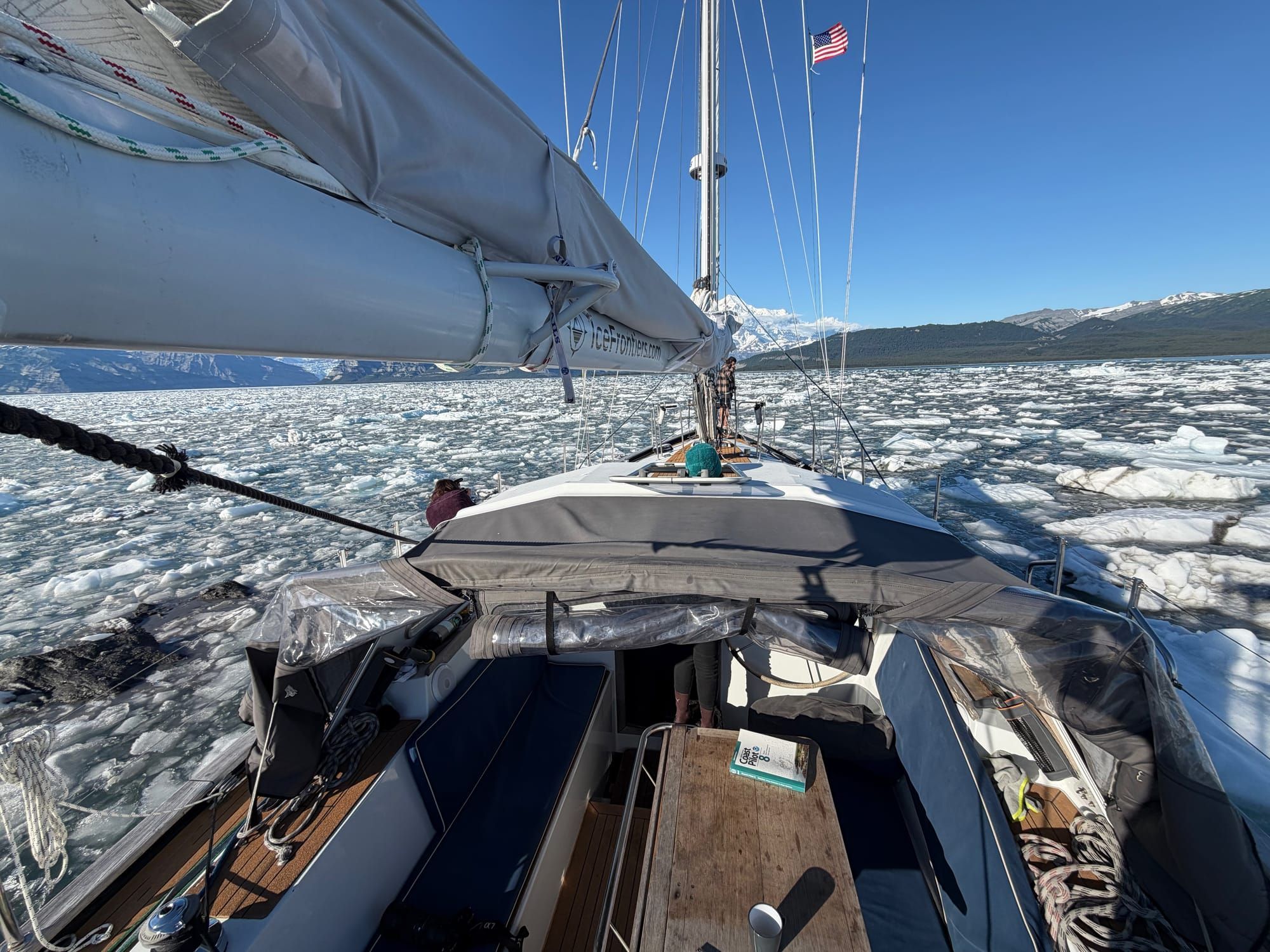
When I set sail from New Zealand in May there was one place I hoped to visit this season: Icy Bay. But I did not really expect it would be possible to do it this season. The place seemed too complicated both nautically and emotionally to be able to face during this first season.
So, I was looking at Icy Bay as an aspirational waypoint. A dot on the map that would justify coming back in future years. Today, we sailed Icy Bay, sort of.
The thing is Icy Bay does not really exist. Yes, it is shown on the chart. But it's a sort of geographic novelty or an accident of history. A little over a century ago there was no bay to sail into. Into the early 1900s a single tidewater glacier blocked the mouth and calved straight into the Gulf; the retreat that opened the water has run since about 1904, and Guyot alone has pulled back more than fifty kilometers in that time. Vancouver's people found the same wall of ice in 1794 and charted only an indentation in it — the coast had been frozen shut for centuries before it started to give. Everything I sailed through is the leftover of a glacier leaving. Thirty miles of it.
The place is eerily empty. Unpeopled — no settlement, no wreck, no built past — though it carries a Tlingit name, Lig̲aasi Áa. The vegetation is scarce as if plants were still trying to figure out what to make of this emptiness.
Quickly after entering the bay, the water started telling the story of this ongoing drama. When approaching a tidewater glacier, ice first usually shows up as isolated bergs of different sizes. The density increases as you get closer to the glacier. In Icy Bay, the first encounter with ice was a dense band of small pieces of ice. It felt like the outpour of a gigantic cocktail mixer. It was not totally clear what brought these bergy bits together.
Crossing the first band presented an interesting navigation challenge. Then a second band, and a third. Eventually, there was no more band, just bits and pieces of ice everywhere. The boat slowed. No more bangs from ice hitting the hull, just a continuous grinding sound of the boat moving through a continuous pack of loose ice. The pace slowed. Turning left or right to find expanses of empty waters became pointless. Progress now involved frontal shocks to push larger blocks on the side. At some point, this translated into vertical movement when the ice pushed the boat up instead of moving sideways to make space for the boat.
That's when we understood that Icy Bay was different. Yes, we could see some of the glaciers in the distance. But the floating ice between us and them would not allow us to get much closer.
That is the thing about Icy Bay nobody tells you. The glacier is coming apart quickly enough to defend its own front with the wreckage. The calving edge is out there — you can see it, you cannot get to it — and everything you can reach is what the edge has already thrown away. Glaciers in Icy Bay are like these animals who hide before they die. They spare visitors the sight of their death, leaving only open water, bare rock, and greening at the margins.
But despite this abundance of precaution, the leaving is not gentle. One arm to the east, in Taan Fiord, the front pulled back far enough by the 1990s to leave a mountainside standing with nothing under it. In October 2015 the slope let go — a hundred and eighty million tons of rock into the fjord, and a wave that ran up the far shore higher than the mast of anything that will ever anchor there. One of the tallest ever recorded. No one was in the fjord. No one saw it. The seismographs caught a signal and it took hours for anyone to work out what it had been.
We have come to accept glacial retreat as a fact of life, like aging. A week and a coastline back, we sailed in Prince William Sound. Harvard sits at the head of College Fjord and has been fairly steady for decades. A mile-and-a-half face, a couple hundred feet of it above the water, calving tons a day and still pushing forward. You hold station off it and watch a wall that reads as permanent. Across the same fjord, Yale is retreating and leaving bare rock. Yale retreats in a very predictable way. It's a version of Harvard with grey hair.
Icy Bay does not support this reassuring narrative. The glaciers of Icy Bay don't retreat. They collapse. They die of gunshots, not of old age.
So, we sailed in Icy Bay but did not have enough time to really grasp the magnitude of the events unfolding there. The ice we sailed through was the aftermath, the blood after the gunshot. I had kept Icy Bay as a waypoint that would justify coming back in future years. It still does.