
More Whales Than Boats
Samuel Peccoud first expedition to coastal Alaska. He reflects on seeing more whales than boats, standing his first overnight watch, and questioning what it means to explore wilderness responsibly.

Samuel Peccoud
The first in our Voices from the Frontier series. Samuel Peccoud joined his father, Jean, aboard Adak for a week of sailing out of Kodiak, Alaska — as, in his own words, "moral support, main fisherman on board, occasional dishwasher, and mostly here to keep morale high." This is what he saw.
I'm Samuel Peccoud, son of Jean Peccoud. He invited me to come to Alaska and join him for a week of sailing aboard Adak, the boat he bought this spring. I was maybe moral support, main fisherman on board, occasional dishwasher — mostly here to keep morale high. I'm not that helpful. I lower anchors.
As a kid, my dad would take me sailing on vacations occasionally, so I got some early exposure that way, and later I did a bit of crew work on a race boat in Seattle. But this is the furthest north I've ever been. I'd consider myself a pretty adventurous person, and this was a completely new experience — something I hadn't been exposed to at all. I also wanted to see the conditions my dad was living in, and to get to know him a bit, since he's redefined himself after moving away from home in Colorado.
I didn't have a ton of expectations. The weather was a lot less windy than I'd imagined — I expected more sailing and less motoring. And the scenery was far more beautiful than I'd pictured. There have been very memorable experiences along the way.
One that comes to mind: when we left Kodiak and traveled to Geographic Harbor, I was outside watching the water, and there was just life all around us. Whales breaching, splashing their tails to confuse the fish. Dall's porpoises appeared on the bow, zigzagging back and forth. And there were no boats — we saw more whales than boats along the way. That was remarkable. This ocean is very full of life.
In Geographic Harbor, I saw my first brown bear up close. They were scattered everywhere, roaming the beach, eating clams. We took the dinghy to the mouth of a river and watched them fishing for salmon. The power of this animal looking for its food is very unlike the way I look for mine at the grocery store.
At one point, sitting by the river watching them fish, one of the bears wasn't having much luck. He seemed to decide it might be easier to wander over to the people and see if they had anything interesting to offer. The thing about watching bears move along a river is you're never totally sure where they'll stop, where they'll step back into the water to fish. He started walking over, and over — and then all of a sudden you realize, okay, he's coming to us. He's not going back to fish. He sniffed the air, clearly very interested in what was in our backpacks. We came within about fifteen feet of a male grizzly who was getting some ideas. I was sitting there with the bear spray in my hand, a little nervous, because I didn't really know how to take the safety off — there's a little plastic blocker. I probably should have tested it beforehand.
Earlier — I think it was our first anchorage — we took the dinghy onto a beach. At first it looked untouched: pebbles, not much else. Then I started looking closer at the rocks, and I noticed a big piece of trash. A bucket, I think — that's what triggered everything. I thought, okay, there's a plastic bucket, what else is here? And then I realized that many of the things I'd taken for pebbles were actually pieces of plastic, just left on the beach. A good chunk of it was plastic. Not untouched at all — not the unremarkable beach in the middle of nowhere I'd imagined.
A lot of the pieces looked old, beaten by the ocean, but plenty you couldn't date. There was a lot of Asian writing on them. A lot of fishing debris too — a large net left on shore. I had a bucket in hand and trash all around, so one thing led to another and I started picking it up. When we were about to head back to the boat, I thought: do I bring the plastic with me, or leave it? And I realized there was no point taking it — where would it go after the boat? Back to shore. So I left it on the beach, all contained in the bucket. Maybe someone else would see it and think about it.
I did my first overnight sail — I don't know if you'd quite call it offshore, but it was a long passage, twenty-four hours from Geographic Harbor to Kenai Fjords. I had the nine p.m. to midnight watch. It was all dark, nothing around me. I remember the blackness. I remember feeling trusted to keep watch, and thinking it was pretty cool — trying to interpret the radar, looking at the map, seeing one other fishing vessel very far off. It had big lights, and I tracked it as we passed. It probably took an hour to leave sight. A very memorable experience.
Living aboard is very confined. There's not a lot of room to stretch your legs or get away from everything, so it takes patience, and knowing yourself — knowing when you need space and when you don't.
It was hard to process how different this was from all my other boating. There's just so much more life here. I've sailed Puget Sound, British Columbia, off the east coast near Boston — and it doesn't compare to up here.
It's conflicting to be somewhere so untouched, with so few people, and then to become the person touching things for the first time. It makes you wonder if you're part of the problem. I don't know if there's a good answer, but it makes you wonder.
It is a functioning remote place. There are a lot of commercial fishing vessels; just yesterday we passed what was probably a NOAA charting vessel. It doesn't feel like we're alone — it just feels like there's more space between everything. And while I'm on vacation enjoying all of this, it feels like no one around me is. Everything seems very functional; everyone seems hard at work — fishing, charting, the coast guard. Not many tourists. The ones we do see are on packed ferries, and even those feel like transit, not leisure. No leisure sailing.
The biggest surprise was that my dad gave up land, a home, to buy this boat. Seeing how it's not uncomfortable exactly, but it's not the comfort of a house — and that he chose to make this his home — is very surprising to me. It says something about his commitment to the project, his motivation. I don't fully understand where it all comes from, but I can appreciate the effort, because it is hard.
Back home I'd tell my friends, "Yeah, my dad lives on a boat now." It sounds impressive, very cool. But the day-to-day is hard. There's a cost to the coolness.
I don't fully know how I'd phrase what I'm doing here yet, when I go back and explain it. Obviously it's a vacation for me in Alaska. But Ice Frontiers is maybe a collective experience of high-latitude sailing — where people are pushed outside their comfort zone to confront the reality of climate change.
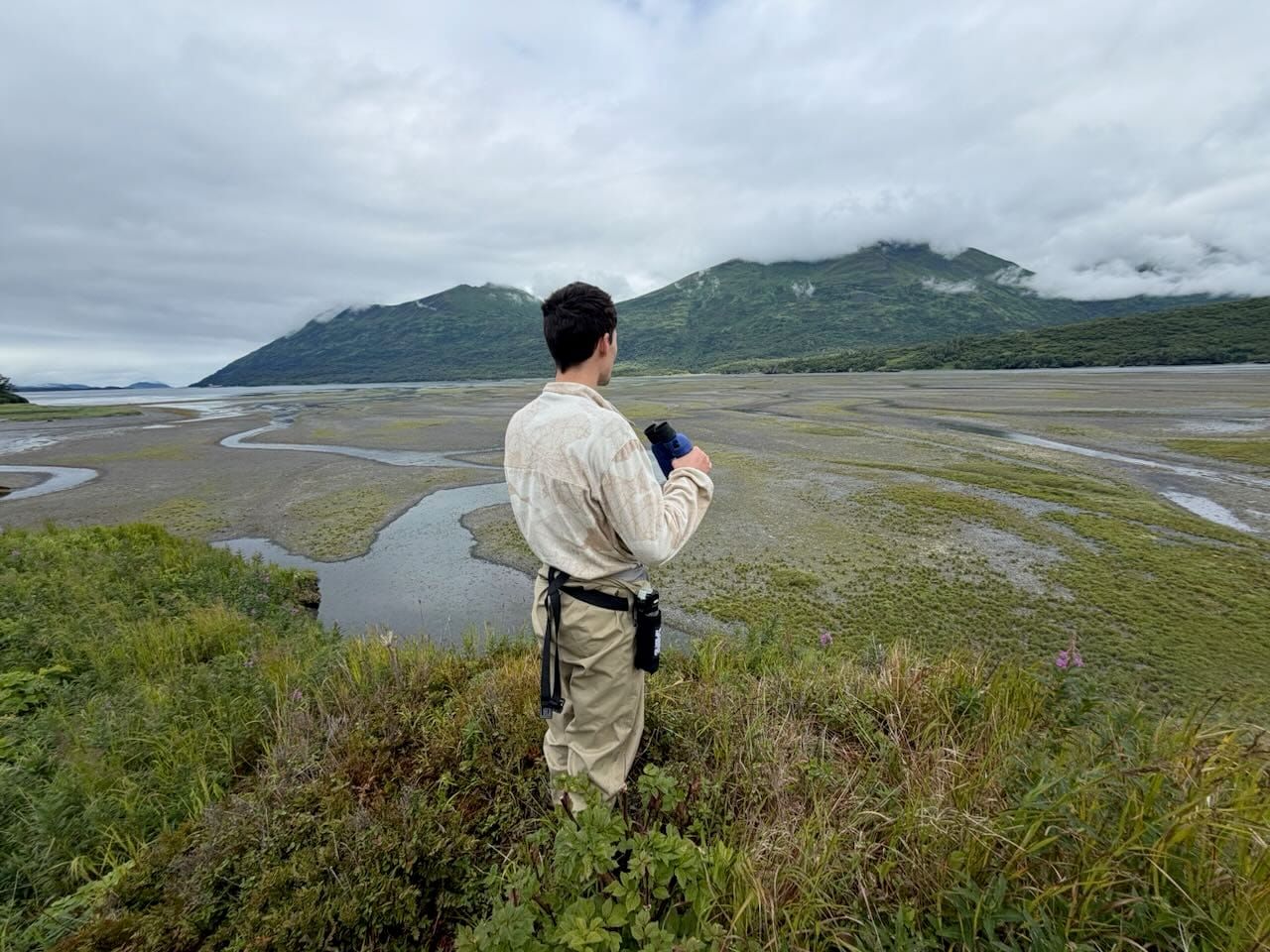
It's given me perspective on what remote places actually are, and what it means for there to be little human impact. I grew up in suburban Colorado; I've lived in Christiansburg, Virginia — places that are inhabited but not densely populated, where the land is clearly built for people. But I've never seen such a vast landscape so untouched. In most of the places we've been, it's not even clear that people have ever walked.
I think it's important to preserve remote areas so people can understand and gain perspective on their own impact. Without the before-and-after picture, you just see a gradient of landscapes without really understanding what changed. And with understanding comes action — then you can make meaningful action toward preserving the planet for the future.