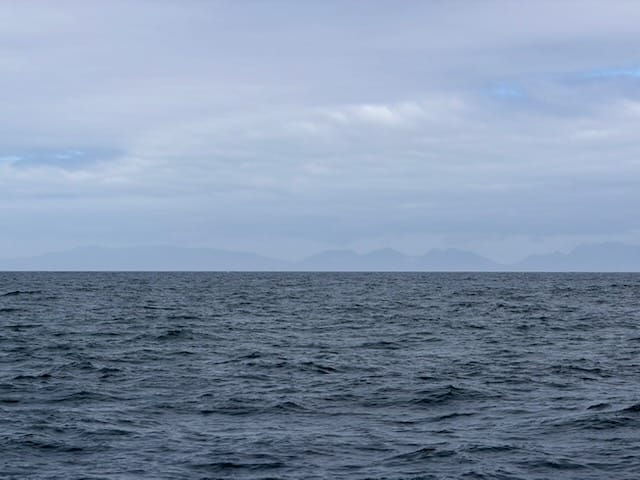
Frontier State
For 45 days, Alaska was a point on the map: the place where the boat would stop and we could finally sleep. Then we anchored in Makushin Bay, and the miles stopped being the problem. The closer we got, the more the place expanded, and every mountain asked the same question.

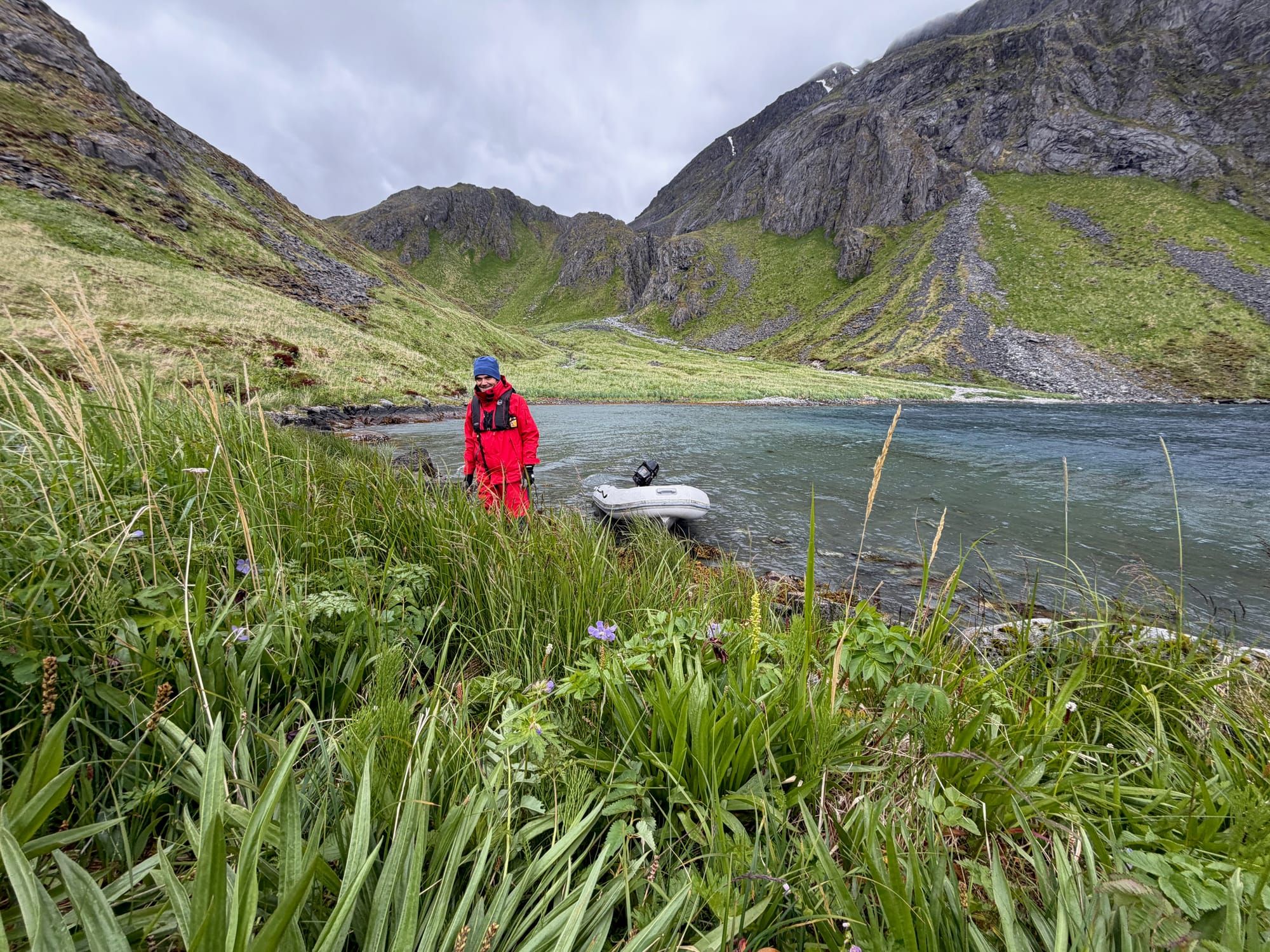
It took us 45 days to sail from Opua in New Zealand to Dutch Harbor in Alaska.
During that time, Alaska was a point on the map. It was a day in the calendar. It was an upcoming relief, like crossing the gate at the end of a marathon. This was where we could finally catch our breath. This was the place where the boat would stop moving, where we could afford a full night of sleep, do the laundry, handle the repairs, and celebrate the end of a long passage.
The rest of the season was supposed to be easy coastal sailing in mostly protected waters, never far from an anchorage or a harbor. I imagined a slightly colder and less crowded version of sailing in Brittany in summer.
That is not how it turned out.
I should have looked at the map more carefully, to better prepare myself for what I was going to face. The Aleutian chain includes about 300 islands spanning 1,100 miles. That is roughly the distance from Miami, Florida to Portland, Maine along the U.S. East Coast.
The distance had to be reckoned with a couple of days before arriving in Dutch Harbor. We sailed along several islands. We quickly realized we would not have the time to come back to them this year. The idea of sailing from Dutch Harbor to Adak, or even to Umnak, the next island down the chain, proved to be beyond the realm of possibility for this season.
Instead, we decided to focus on Unalaska, the island where Dutch Harbor is located. Unalaska is slightly smaller than Majorca, but its coastline is twice as long. Majorca has close to a million inhabitants. Unalaska has fewer than 5,000. Majorca is a major yachting destination. At most, there were six sailboats on Unalaska while we were there, two of them in long-term storage. We met the crew of every actively cruising boat but one.
We decided to explore Makushin Bay first, because it was close enough to Dutch Harbor. This body of water is about the size of the Golfe du Morbihan. But that is where the familiarity stops. We did not see another boat, and we are fairly sure there were none. We could only find a handful of safe moorings, not indicated on the chart, vaguely mentioned in the NOAA pilot books, occasionally described on social media.
The sea blends into alpine mountains. The slopes are steep, often covered in snow. The Makushin volcano ice cap dominates the landscape, even when it is hiding behind a thick layer of clouds, and it controls the winds in unexpected ways.
Mooring in Makushin Bay is exposed. And the wildlife around the boat — humpback whales, seals, otters — made it completely clear that we were not expected, and probably not desired.
Dropping the anchor in a place like this feels like asking for a favor. We did not take it for granted. In a promising anchorage, we hit the ground. The plotter said we should have had 18 meters of water under the keel.
Once the boat was settled, another question emerged: should we go ashore?
There is no obvious rallying point. No dinghy dock, no fuel dock, no bar to get a drink. Just the shoreline, mostly inaccessible, with an occasional beach. The wind, the isolation, the temperature of the water make launching the dinghy and running a few miles down the fjord feel like an expedition.
Arriving on a shore with no evidence of human presence creates its own challenge. Where do you go when there is no path? Where do you want to go? How do you get there? How do you put one foot in front of the other without twisting an ankle or breaking a leg in a crevasse hidden under a foot of deceptively soft tussock?
After two hours of hard work — the time it would have taken to climb 2,000 feet and walk five miles in Colorado — we realized we had gained 300 feet and covered three quarters of a mile. Not even in the right direction.
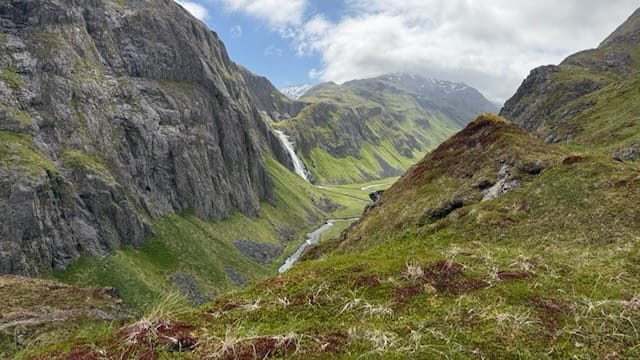
So the closer we got to the place, the more it expanded. What seemed simple to reach proved difficult or impossible to access. Every face, every summit is an invitation to imagine a path. The same mountains in Europe would come with established routes, each of them offering some form of social gratification.
In Makushin Bay, every feature of the landscape is an invitation to a personal, intimate journey. Looking at it, I found myself wondering how many people had ever visited this place, how many of those unremarkable mountains had never been climbed. I am fairly sure that more people reached the summit of Everest this year than have visited Makushin Bay in the last ten, let alone climbed anything around it.
From there, it did not take long to realize I could spend a lifetime in this bay. Exploring every cove. Inventing new paths. Climbing most of its mountains.
I could write a guidebook. I could set up a charter business and share what I had learned.
But this all too familiar playbook no longer feels relevant. Today, the challenge is not to domesticate the place. It is to respect its isolation.
It deserves to be revisited. I would like to come back, have more time, try a little harder to get inland. I am debating coming back in spring with skis. Snow would make the overland travel easier and the sailing harder.
In the end, we did not have it in us to reach the next anchorage we had planned to visit. We returned to Dutch Harbor and left Unalaska for Kodiak shortly after.
Looking back, I think I understood quickly what it means to cross an ocean. Sailing offshore is hard, but it is not complicated. Out there we were nowhere, and nowhere asks very little of you. Keep the boat moving. Keep the water out. Eat something. Sleep when you can. The world had been reduced to a hull, two bodies, and the next four hours. There was nothing to care about beyond that, and so we cared about nothing else.
I have never been less confused.
Offshore, the problem was distance. Six thousand miles is a problem I could solve by waiting. I put the miles behind me at six knots and eventually there were no more miles. It is simple arithmetic that even an exhausted sailor can perform.
In Makushin Bay, the miles were no longer the issue. Geographic proximity was no longer a problem.
But presence was.
When I looked at the mountains towering over the boat, when I caught a glimpse of the Makushin ice cap, when we sailed along dozens of other Alaskan islands, each of these places asked the same question: where do you want to go?
And when there is no path and no social gratification, that question is surprisingly difficult to face.
Related Posts
 Jean Peccoud
 Jean Peccoud