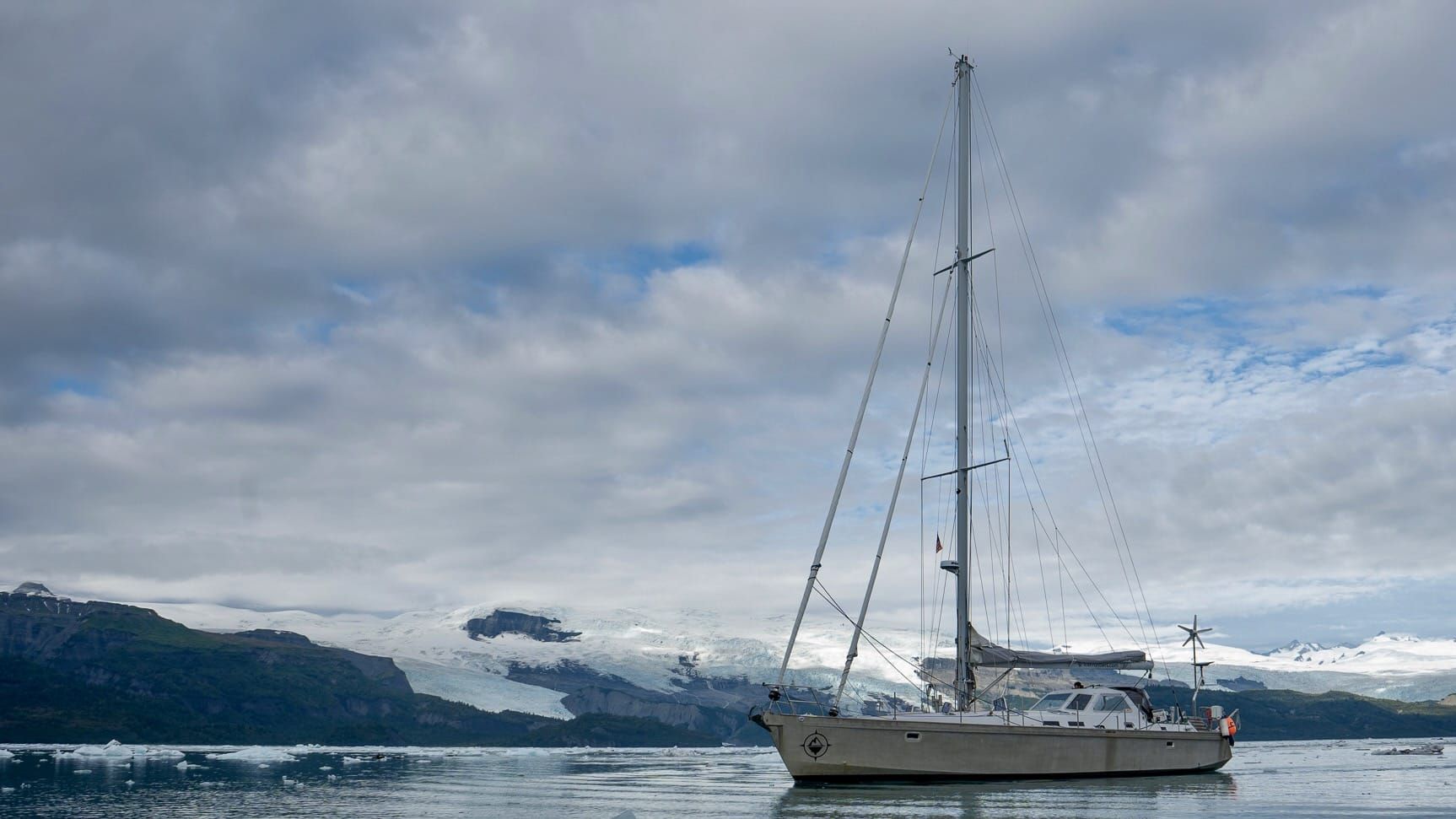
Meet Adak
Adak is the expedition vessel of the Ice Frontiers project. Between May and September 2026 she sailed 9,300 NM from New Zealand to Alaska and British Columbia, and she is being refitted this winter for a 2027 season in the Aleutian Islands and the Bering Sea.
This page tells her story and lists her equipment in full, for readers curious about the boat behind the project and for anyone considering sailing aboard.
After a successful first season, the project's next phase calls for a larger vessel, so Adak is also listed for sale with Yacht Sales West in Sidney, BC.
Built for high latitudes
Adak was built by META using its Strongall method, and the result is unusual even among aluminium expedition yachts. There is no conventional framework of ribs and stringers: the welded plate itself carries the loads, so hull and deck work as a single eggshell structure. The plating is graduated, from 20 mm in the bottom plates and 18 mm in the next strake to around 11–12.5 mm on the topsides and deck. This brings two practical advantages:
- Ice resistance. The thick, self-supporting plate spreads impacts instead of denting between frames. Many aluminium boats that have worked in ice show a pattern of dents; Adak came out of a season in Alaskan waters with no sign of impact or hull deformation at her October 2026 haul-out.
- A clean internal structure. With no internal frames to route around, hoses, wiring and new equipment are easy to run, which makes maintenance and upgrades simpler and cheaper than on a framed hull.
Her motoring range is exceptional. At 8 knots her 150 hp John Deere burns about 8 L/hr, giving roughly 2,000 NM from 2,000 L of fuel: enough to motor long ocean passages, and to work high-latitude coasts where the wind is light, contrary or blocked by ice.
The fin keel is fully welded and a skeg protects the rudder, so there is nothing bolted on to be lost. About 8 cm of continuous foam insulation lines the hull to below the waterline; with redundant diesel heating, it keeps her warm and dry in cold water. She carries a heavy ground tackle (55 kg Rocna anchor) with a stern anchor.
History
Adak was built in France in 1998 for high-latitude cruising: META built the hull to a Joubert-Nivelt design, and the interior was fitted in solid wood. She spent her early years in Europe, sailing the Mediterranean and the Caribbean, and is reported to have sailed to high latitudes under her second owner.
In 2015 she was bought by Ross Field, a Whitbread Race winner and veteran of five circumnavigations. Ross gave her a major refit at Berthon in Lymington, UK, including a new John Deere engine, new sails and a watermaker. In 2017 he sailed her to West Greenland on an attempt at the Northwest Passage, turning back north of Nuuk when the autopilot of the time could no longer steer reliably as the magnetic compass failed close to the magnetic pole. The voyage is told in Rebecca Hayter's book Wild Seas to Greenland (2021).
She was shipped to New Zealand in 2020, where her next owner upgraded the electronics, installed the generator and sailed her in New Zealand and the South Pacific. In 2026 she sailed 9,300 NM from New Zealand via New Caledonia, the Marshall Islands and the Aleutians to Alaska and British Columbia, where she is now wintering.
Inventory
Details are supplied by the owner in good faith. Buyers should carry out their own survey and inspections.
Vessel
|
|
| Name |
Adak (ex-Rosemary) |
| Builder |
META, France — aluminium blue-water specialists |
| Designer |
Joubert-Nivelt |
| Year built |
1998 (hull completed January 1998) |
| Craft Identification Number |
FRMET1591GA898 |
| Hull / deck |
Strongall construction, welded aluminium plate without internal frames: 20 mm bottom plates, 18 mm next strake, approx. 11–12.5 mm topsides and deck |
| Insulation |
Continuous foam insulation, approx. 8 cm thick, lining the whole interior and extending below the waterline about halfway down the bilge. Keeps the interior warm and limits condensation in cold water. |
| LOA |
16.26 m (53 ft) |
| Beam |
4.65 m |
| Draft |
2.5 m |
| Displacement |
17 t |
| Keel |
Fin keel with skeg, fully welded |
| Rudder |
Single rudder on skeg; cable steering to quadrant; emergency tiller |
| Helm stations |
1 |
| Fuel capacity |
2,000 L |
| Water capacity |
300 L in 2 tanks, plus water maker |
| Registration |
UK Part 1 registered; port of choice London |
| Location |
On the hard, Van Isle Marina, Sidney, British Columbia, Canada |
| Hull survey |
Full survey including hull, February 2026 (available on request) |
| Last paint deck |
2016 (undocumented) |
| Last antifouling |
March 2026 |
Engine & drivetrain
|
|
| Engine |
John Deere 4045TFM50, 150 hp, diesel (installed 2016) |
| Hours |
Approx. 2,400 at Nov 2026 |
| Drive |
Shaft, PRM 750A gearbox |
| Propeller |
Max-Prop 3-blade feathering |
| Cruise / max speed |
8 kn / 11 kn under power |
| Cruise fuel burn |
Approx. 8 L/hr |
| Fuel transfer |
Can pump between fuel tanks |
| Thrusters / stabilizers |
None |
| Last service |
March 2026. Fuel tanks emptied, cleaned, and inspected in March 2026. |
Electrical & Power
|
|
| System voltage |
24 V DC house system |
| House bank |
4 × 6 V Rolls S6-460 AGM, 11,040 Wh (2026) |
| Engine batteries |
2 × 12 V (2026) |
| Generator battery |
Separate 12 V (2026) |
| Charger |
Mastervolt |
| Inverter |
Victron Phoenix 800 W |
| Generator |
Fischer Panda 10000i, 10 kW |
| Hydro generator |
Watt&Sea 300 W |
| Wind generator |
D400 |
| Solar |
2x200W Solar blankets |
| Shore power |
220 V, galvanic isolator |
| Shunt |
Victron BMV 712 |
| Heating |
Eberspächer diesel heater, Refleks 60M 30 l day tank |
| Air conditioning |
None |
Water
|
|
| Watermaker |
Spectra Cape Horn Extreme, 50 L/hr, with Z-Ion cleaning |
| Hot water |
50 L calorifier (Ventus, 240 V) |
| Holding tank |
1, starboard head |
| Deck wash |
Salt water, in chain locker |
| Cockpit shower |
Hot and cold |
Navigation (B&G suite, upgraded 2022–23)
|
|
| Chart plotters |
B&G Zeus 3, plus Zeus 2 backup |
| Radar |
B&G Halo |
| Autopilot |
B&G NAC-3 computer (plus spare), Edge processor, T3 ram (plus spare ram) |
| GPS / heading |
B&G GPS compass + Precision-9 compass |
| Wind |
B&G WS320 wireless wind sensor |
| Depth |
P319 transducer |
| AIS |
B&G |
Communications
|
|
| VHF |
B&G V50 with H50 wireless handset |
| Handheld VHF |
Icom M94D (GPS, AIS) |
| Satellite |
Starlink high-performance dish |
| Wi-Fi / data |
PredictWind DataHub integrated with Starlink |
| Stereo |
Fusion Bluetooth |
Accommodation
|
|
| Cabins |
3 double cabins |
| Berths |
3 doubles + 2 singles (quarter berths); sleeps 5–8 |
| Heads |
2 manual heads, 2 showers |
| Headroom |
6–7 ft in cabins and saloon |
| Bed linen |
Included |
Galley
|
|
| Stove |
ENO gas cooker, 2 burners with oven. Certified in April 2026 |
| Refrigeration |
Fridge in galley; freezer in workshop |
| Gas |
2 aluminium cylinders; gas alarm with auto shut-off |
| Kitchenware |
Standard kitchenware included |
Rig
|
|
| Rig type |
Aluminium single-masted cutter, with inner baby stay |
| Standing rigging |
Complete refit in 2026 |
| Running rigging |
Dyneema (2017) |
| Spinnaker pole |
Carbon fibre |
| Furlers |
Furlex on genoa (2025) and staysail (2026) |
| Winches |
Manual |
Sails
|
|
| Inventory |
North Sails Radian Ultra mainsail, genoa and staysail — ordered, delivery spring 2027. Old North Sails headsails (genoa, staysails) 2016. |
| Reefing |
Three reefs on main |
| Spinnaker |
Included – condition unknown |
| Storm sails |
No storm jib or trysail |
Ground tackle
|
|
| Primary anchors |
Rocna 55kg. Spade 30 kg (needs confirmation). Also foldable spare anchor |
| Chain |
100 m main chain + 100 m spare (to be confirmed) |
| Windlass |
Yes, with chain counter |
| Stern anchor |
Yes |
Safety
|
|
| Life raft |
Ocean Safety, 8-person — service date April 2026 |
| EPIRB |
Ocean Signal rescueME — battery expiry 2036 |
| Lifejackets |
4 Offshore lifejackets with tethers, 1 coastal life jacket, 3 foam PFDs. |
| Fire extinguishers |
2 × CO2, 3 × foam — Pressure tested and serviced in April 2026 |
| Bilge pumps |
Manual (cockpit and forward); electric (aft, midship, and forward) installed in 2026 |
| Drogue |
Yes |
| Flares |
Offshore flare kit updated in 2026 |
| Other |
MOB equipment, hydraulic rigging cutters, offshore first-aid kit |
Tender & deck gear
|
|
| Tender |
AB Lammina 3 m aluminium RIB (new tubes 2022) |
| Outboard |
Suzuki 15 hp 2-stroke (2024) |
| Davits |
Yes |
| Canvas |
Bimini |
| Other |
Swim ladder, mooring lines including 2 80m lines and 2 100m floating lines, fenders, boat hook; wiring in place for a dive compressor |
Refit — Winter 2026–27
Adak is wintering ashore at Van Isle Marina in Sidney, British Columbia, where Philbrooks Boatyard is carrying out a refit. The work is scheduled to start in January 2027 and expected to be completed by the end of March 2027. The boat will be recommissioned and tested in April 2027.
The refit builds on the experience gained over 9,300 NM from New Zealand to Dutch Harbor, in Alaska, and British Columbia. It has been planned to prepare the boat for future high-latitude sailing expeditions in the Aleutian Islands and the Bering Sea in 2027 and Northwest Passage in 2028. It includes maintenance necessary after the 2026 season and upgrades to improve safety when operating in demanding environments with a short crew.
Deck structures
|
|
| Aluminium doghouse |
Welded aluminium doghouse over the companionway, with the roof extended to cover roughly the area of the current bimini so the cockpit table can be used under cover. Open aft, closed with a roll-up canvas panel. |
| Companionway |
New, easy-to-use, watertight companionway door |
| Aluminium stern arch |
Welded aluminium stern arch, avoiding stainless-to-aluminium contact on the hull |
| Engine ventilation |
Engine air intake moved up into the doghouse structure and engine-room exhaust moved to the stern arch, replacing the low deck intake and transom exhaust flagged in the survey |
Deck layout & autopilot
|
|
| Mainsheet |
Mainsheet and traveller moved to the doghouse roof. |
| Lines |
Other lines stay at the mast; cockpit winch sheets led from behind through turning blocks |
| Second autopilot |
Independent second autopilot |
| Remote controls |
Remote throttle and autopilot controls for docking and ice navigation |
Electrical
|
|
| Shore power |
Isolation transformer; shore power reworked for both 120 V and 230 V, protecting the aluminium hull from galvanic and stray current |
| Electric Panel |
New breaker and switch panel |
| Electric Distribution |
Connection of AC outlets to inverter. Installation of USB ports in cabins. |
Rig & sails
|
|
| Rigging |
Repair of issues identified during rig check. Replacement of aging hardware. Streamline deck layout. Work by Blackline Rigging, Sidney BC |
| Sails |
New North Sails Radian Ultra mainsail, genoa and staysail; 2016 headsails kept as spares |
Hull & paint
|
|
| Corrosion |
Inspection of the keel and hull interior, following up on the February 2026 survey, including the condition of the epoxy coating |
| Antifouling |
Last antifouling March 2026. Will be patched or redone based on condition determined by inspection. |