Planning SV Adak's Refit
After five months and 9,400 nautical miles, Adak is out of the water in Sidney, British Columbia. The winter refit will fix what failed, correct problematic aspects of her designs, and reinforce her high latitude identity.

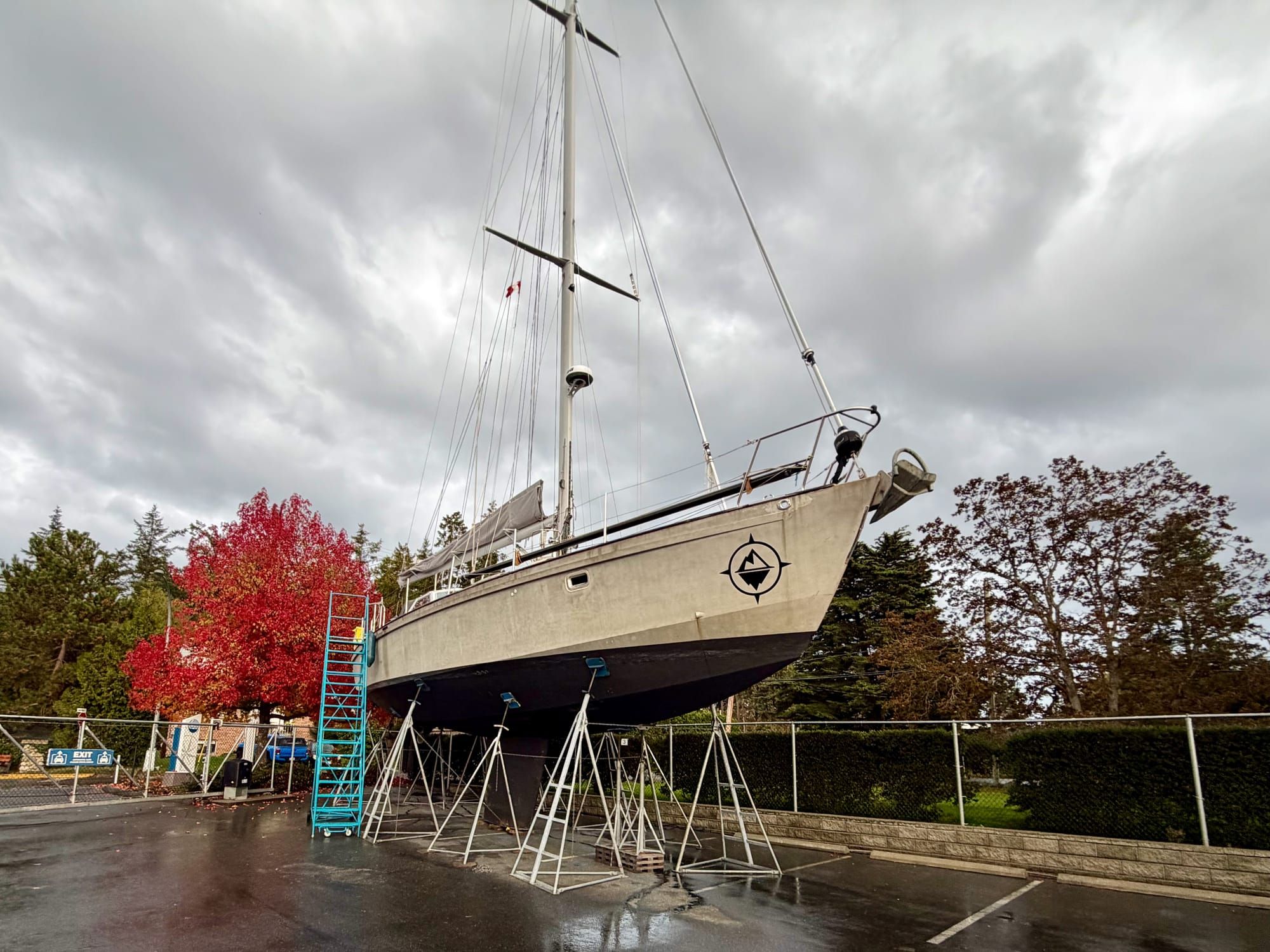
This week, we hauled Adak out of the water.
She’s now standing at the entrance of the Van Isle Marina yacht park in Sidney, British Columbia. After five months and 9,300 nautical miles that brought us from New Zealand to British Columbia through Alaska, the 2026 expedition has come to an end.
Bruises and scars
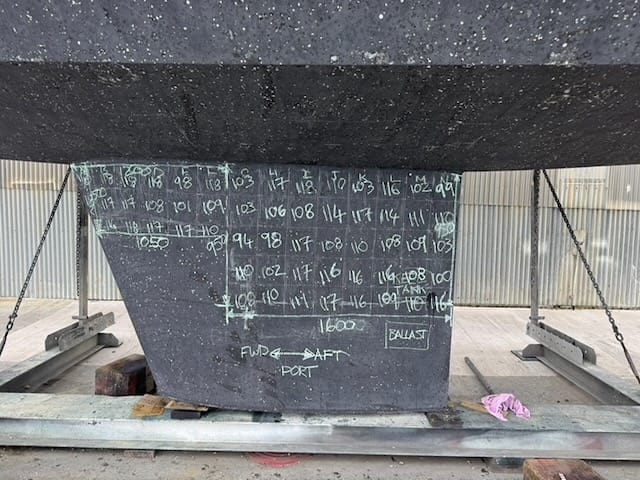
I was curious to see what was under the waterline.
Visiting expedition boats in France, I was struck by how much their hulls showed the history of impacts. I had never seen an aluminum expedition hull without them. Adak’s lines were clean when I surveyed her in February, but I could not tell whether that was because she had spent so little time in ice or because Meta’s Strongall construction is much thicker than most. Now I know.
The ice left traces, but they are nothing more than bruises. Near the waterline at the bow, it stripped the antifouling down to bare metal. I could not find any sign of hull deformation. She still has the lines I fell for in February.
She finishes the season with only one real scar, on the rubbing strake. I think it was a gift from a fishing boat that left Prince Rupert at the crack of dawn. We had docked a little too close to them, and the crew sounded pretty drunk when they left. I should have gotten up. I did not.
I heard a thump and had just enough time to see the fishing boat on her way out, far too close for comfort. A sailboat that can survive a collision with a fishing boat with just a scratch is a good boat. I apologized to her.
What the expedition taught us
I have learned a lot about Adak during these five months. I better understand her strengths and her potential. I have also experienced a number of her weaknesses firsthand and identified others that I am glad I did not get to experience.
Adak has many of the fundamentals of a high-latitude expedition boat: a strong aluminum hull, substantial displacement, a protected center cockpit, thick insulation, good heating systems, a powerful engine, and enormous fuel tanks. But she hasn’t really embraced that identity. She was marketed as a general-purpose cruising yacht, and when I came across the listing, it took me a while to recognize her high-latitude potential. The courtesy flags in the chart table show she spent her life sailing in the Mediterranean, the Caribbean, and the South Pacific. As far as I know, she spent only one summer in colder waters, in Greenland.
There is nothing wrong with that. She is a capable bluewater cruiser, and she has just demonstrated that she could feel at home in the icy waters of Alaska. But some design choices that are acceptable for general cruising become more problematic in cold climates and remote places.
We will take advantage of this winter to turn the lessons of the expedition into an even better boat. The goal is not to change her character but to enhance her high-latitude identity.
Fixing what failed
The first order of business is fixing what failed during the passage.
The mainsail started delaminating between New Caledonia and the Marshall Islands, and the headsails gave indications that they had reached the end of their useful life. So she needs a new wardrobe: main, genoa, and staysail. Nothing fancier than that. The new mainsail will have the third reef our current sail was missing. We will also rig the pole and use it with the genoa and the spinnaker that came with the boat before deciding whether to add another downwind sail.
The propulsion system has been a source of concern throughout the trip. The propeller shaft has been leaking oil, and a questionable repair could benefit from a more permanent fix. There are indications of movement between the gearbox and the engine, and engaging the propeller forward or in reverse makes more noise than we’d like. We will investigate these problems rather than assume the system is fine because it brought us home or broken because we don't understand it.
A rig inspection revealed a small crack in the mast above the D1 shroud attachment. We are figuring out what caused it, how best to repair it, and how to prevent it from recurring.
These are relatively straightforward decisions. Something is broken or worn out, and we need to fix or replace it. Other decisions are more complicated because they involve weaknesses in the boat’s design that have not necessarily resulted in failures.
Addressing design vulnerabilities
Keeping the water outside
The most important modifications concern water ingress.
The engine room ventilation intake is at deck level, facing the stern. The exhaust is on the transom, less than a meter above the waterline. A serious wave from astern could flood the engine compartment. This vulnerability had already been identified during the pre-purchase survey.
The companionway is also problematic. The center cockpit has limited drainage, and the companionway sits only about 20 centimeters above the lowest part of the cockpit. The three removable panels used as doors take time to install and are not watertight.
We were fortunate not to experience any particularly bad weather during the entire expedition. Yet we still had a couple of waves break into the cockpit and pour down the companionway into the cabin. I did not like that.
In more severe conditions, the consequences could have been much worse. The fact that we completed the passage without a serious incident does not make these vulnerabilities acceptable for the next expedition.
We plan to replace the companionway panels with a door that can be opened and closed quickly while keeping water from a flooded cockpit out of the cabin.
We will also replace the current bimini with an aluminum structure that extends the existing GRP doghouse. This structure will incorporates a redesigned engine ventilation intake. A new stern arch will carry the ventilation exhausts and the exhaust from the Eberspächer heater. Together, these modifications will eliminate the vulnerable openings on the transom and deck.
Improving visibility and deck operations
The steering position is another compromise that became apparent during the expedition.
The wheel is mounted on the bulkhead next to the companionway. This is a great location offshore in cold and wet weather: the helmsman is well protected from the elements. But it is a terrible location in close quarters, whether in a marina, an anchorage, or ice.
Being off-center creates different perspectives on port and starboard. The helmsman’s eyes are close to deck level, making it difficult to see anything near the boat. Standing on a toolbox to look through a hatch is hardly a satisfactory solution.
Moving the mainsheet traveler onto the roof of the new doghouse will free up space on the aft deck. We intend to use it for a second steering station with better visibility for close-quarters maneuvering.
The stern also needs attention. The existing davit makes launching and recovering the dinghy unnecessarily tedious and occasionally unsafe. The dinghy interferes with the swim ladder. We should not have to launch the dinghy to recover a man overboard. The stern arch will allow one person to launch and recover a larger dinghy safely, with its engine attached. A cradle will stabilize the dinghy during passages.
Finally, we will reassess the routing of lines around the mast and across the deck. Some lines cross or chafe, access to winches is not always convenient, and the current mainsheet arrangement has never been particularly comfortable.
The objective is to make the boat easier to operate with a small crew, or even single-handed.
Corrosion and electrical systems
On an aluminum boat, corrosion and electrical systems are intimately linked. A stray current from a poorly isolated circuit can quietly damage the hull, and shore power adds another potential source of trouble.
We will continue the work started in New Zealand to find and monitor corrosion, with particular attention to the bottom of the keel, where aluminum and lead can react with one another if the insulation is compromised and water gets in. We will clean the bilges thoroughly and investigate anything suspicious. We will also review the epoxy coating that separates the hull from the antifouling and seawater, and repair the areas where ice or other impacts exposed bare metal.
An isolation transformer will separate the boat electrically from the marina’s shore power and convert the North American 120V supply into the 230V she was designed for. Being able to use both safely is a basic requirement for a boat that crossed the Pacific in 45 days.
Two monitors will tell us what is happening below the waterline. A ground-fault monitor will detect leakage from the boat’s circuits. A hull-potential monitor will show whether the sacrificial anodes are doing their job. Too little protection is a problem, but too much can also damage aluminum.
While we are at it, we will rationalize the electrical system. The breaker and switch panels will move to a more accessible location, and we will remove the legacy wiring left behind by successive generations of equipment.
We will also install USB charging ports in every cabin and connect the AC outlets to the inverter. This should contribute to peaceful cohabitation among future crew members. No more competition for the only AC outlet under the chart table.
Nespresso machines, air fryers, and hair dryers are still banned from the boat.
A refit that keeps evolving
None of this started as a finished design. The specifications grew out of a simple question asked over and over: what actually bothered me at sea, and what will matter where the boat is going?
The passage gave me the raw list. The surveyor’s report added items I had learned to live with. Then came conversations with people who sailed with me this summer, with a naval architect who helped plan the refit, and ultimately with the people who would be doing the work.
We have been developing the specifications for about a month. The current version includes 146 items.
They have been living documents, so alive that we quickly reached the point where PDF files, emails, and spreadsheets started contradicting each other. I eventually had to track them down, parse their contents, and consolidate everything into a database with a web interface so that everyone could work from a common understanding of the project.
Some ideas did not survive this process. I initially considered installing a windvane for steering redundancy. But it would conflict with the stern arch, so a second electronic autopilot now appears to be a better solution.
Other decisions are still being evaluated. The paint is one example.
Adak’s paint and nonskid coatings are aging. A previous owner had already started removing the original paint on the hull to expose the aluminum. With so much structural work planned on deck, it may make more sense to complete that process than to repair and repaint individual areas. We would still need suitable nonskid where people walk and work.
This would not really be a paint job. It would be the removal of an aging finish that no longer serves much purpose. Adak would look more utilitarian, more like what she is becoming. Her lines would not change.
The feasibility of several other items is still being analyzed. Costs and schedules are being estimated. Ultimately, what gets done this winter will be determined by constraints of technical resources, budget, and scheduling.
Choosing where, and with whom
Where to refit was the first real decision.
Mexico was suggested, and it has obvious appeal in winter. But I chose British Columbia, a place I know that is also closer to home. I quickly focused on Vancouver Island, where there is a deep marine trades community, expertise with aluminum boats, and an urban environment that makes life during a refit simpler than in a larger city like Vancouver or Seattle.
Our first conversation with a yard farther up the island stalled. Responses were slow, specifications were poorly understood, and I had a general impression of a poor fit between the yard and the project. Other conversations revealed that the scope of the work exceeded the capabilities of some potential partners.
In October, I sent detailed specifications and drawings for the doghouse and stern arch to Philbrook’s Boatyard in Sidney. An estimate came back within a day.
More importantly, we had found someone who could not only complete individual tasks but also manage the project. Philbrook’s will coordinate with Blackline Marine, which is handling the rigging, and North Sails, which is providing the new sails.
The sail decision took the longest.
I collected quotes from more than half a dozen lofts in British Columbia, Seattle, New Zealand, and even South Africa. I changed my mind multiple times about fabrics, designs, and accessories.
For some reason, choosing sails felt like the most consequential decision of the entire refit. It probably isn’t. Perhaps it felt that way because it was the first major purchase I started working on, before I had a clear picture of the rest of the project.
Eventually, I chose the service more than the sails.
The local North Sails representative showed up multiple times, demonstrated that he could work with the yard and the rigger, and gave me confidence that he would stand behind the sails he would make for us.
I could compare specifications and prices, but I could not know exactly how the sails would perform until we used them. And if something went wrong, I would need someone willing and able to fix it.
That mattered more than small differences in price and features between competing proposals.
The same reasoning shaped my choice of boatyard. A project involving 146 items cannot be completely specified in advance. It cannot be completed as a series of 146 tasks without considering the overall goal of the project. There will be decisions to make along the way. The ability to manage the project together matters at least as much as the initial estimate.
Emptying the boat
Before the yard starts, everything comes off: lines, spares, tools, provisions, all of it. It goes into a heated indoor storage unit for the winter.
It is a lot of work, but it is a full reset. The yard gets an empty boat to work in, and in spring we will rebuild the inventory from scratch, with a proper system to track what is aboard and where.
Related Posts
 Jean Peccoud
 Jean Peccoud