
The pre-purchase survey
Yesterday, I reluctantly decided to replace Rosemary's anchor. It never came up in the survey. That decision helped me understand something I had missed at the time: interpreting a survey may be the most challenging and least understood part of buying a boat.

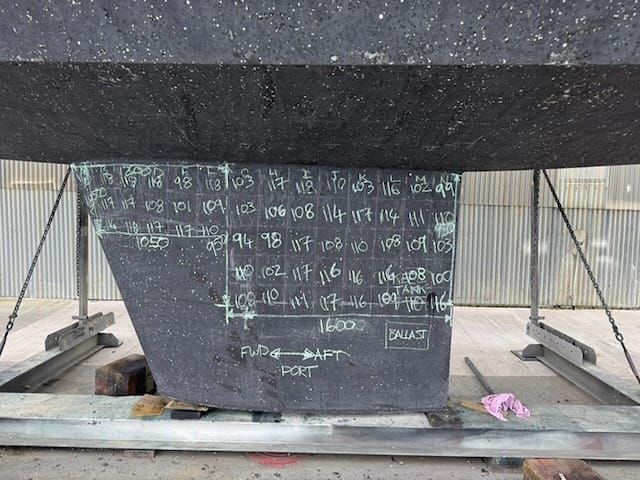
Yesterday, I reluctantly decided to replace Rosemary's anchor. It's a big deal. A bad anchor keeps you awake at night. A good anchor is not cheap. I had concerns about the anchor since the first time I saw her, but the anchor was not something that came up in the survey. So, I decided to sweep this item under the rug until I could no longer ignore the polite expressions of concerns from fellow sailors walking by Rosemary.
Having to deal with the anchor replacement while I am still struggling to fix issues that surfaced during the pre-purchase survey helped me better understand how the survey is shaping my perception of risks. Over the last six months, I have conducted several surveys in different countries. I have come to think that interpreting survey results is the most challenging and least understood part of the boat purchase process.
The Survey in the Purchase Process
A pre-purchase marine survey happens in the narrow window after an offer has been accepted but before the sale closes.
At that point, things get serious. The lead has become a deal. The buyer is willing to spend money on due diligence. And the broker and seller will need to spend time to support the process.
Everyone now has skin in the game, but the buyer is not on the hook yet.
Just when everyone would like to seal the deal, a stranger shows up to assess the boat and produce a report identifying major issues before they become the buyer's problem.
The survey is like an emergency exit. But the size of the exit depends on where you buy the boat. In the US, buyers can generally walk away without having to justify themselves. In France or New Zealand, it's a little narrower. Exit is only possible if major issues are found and the buyer and seller could not agree on a way to address them.
Survey's Discomforts
When an offer has been accepted, all parties project themselves into a rosy future. As a buyer, I could picture myself sailing into the sunset with my new boat. But I could also sense that the owners were projecting themselves into a boat-free future, while the brokers shifted gears as they anticipated the reward for their efforts marketing the listing.
So everyone hopes the survey will validate the deal. But good surveyors know their job is not to endorse a transaction — it's to uncover issues that may derail it. This is uncomfortable for everyone.
When I flew to New Zealand from the US in January to survey Rosemary, I remember thinking: I hope there is nothing wrong with this boat. I had already surveyed a boat in Florida, spending days and a great deal of money before walking away. I felt enormous self-imposed pressure to accept the boat no matter what.
Every broker is nervous before a survey. They won't acknowledge it because they need to project confidence in the boat — but they are. And they always minimize the findings. It's always minor. Always easy to fix.
For the owner, it's really difficult not to take the results personally. Every owner who has cared for a boat for years at great expenses believes their boat is flawless. Having a stranger assess it is invasive and brutal.
The experience is so uncomfortable that some buyers waive the survey, arguing they can assess the boat themselves. That may be acceptable for a small, inexpensive boat — but it's not really an option for larger ones. Many insurers will require a survey before issuing a policy. If you have to produce one anyway, it's smarter to do it before closing than after.
Selecting Surveyors
The selection of the surveyor has a major effect on the quality of the survey. To keep things simple, it's tempting to find someone close to the boat — easier to schedule, no travel expenses. The broker will often offer a few names they've worked with before. I've used referrals like that in the past, but I'm not sure it was smart. Even when the broker has no intention of influencing the survey, it doesn't take long to see that they and the surveyor are used to doing business together. Those referrals probably matter to the surveyor's livelihood. So I sometimes wondered whether that quiet conflict of interest was shaping what ended up in the report. One way to avoid this is to bring a surveyor from out of town — someone who has no existing relationship with the broker or the local market. When surveying Rosemary in Opua, I brought in a surveyor from Auckland, three hours away.
It's also important to make sure the surveyor is qualified to evaluate the specific boat under contract. This is less obvious than it sounds. Unlike doctors or lawyers, marine surveyors are not licensed — anyone can call themselves one. What matters is their credentials and experience. In the US, the two main professional organizations are SAMS (Society of Accredited Marine Surveyors) and NAMS (National Association of Marine Surveyors), both of which require a minimum of five years of experience and a written examination. Internationally, the equivalent is IIMS (International Institute of Marine Surveying). Affiliations vary by region, so it's worth checking what the recognized standard is wherever you're buying. These credentials are a reasonable baseline — but not a guarantee of competence. A seasoned surveyor without formal accreditation can still outperform a card-carrying one.
More important than the letters after their name is their specific experience. Some surveyors specialize in powerboats or commercial vessels. For a bluewater sailboat — and especially an aluminum hull — you want someone who has surveyed many boats of that type. Ask directly: how many aluminum boats have you surveyed? What offshore vessels have you worked on? The wrong specialist will miss things not out of negligence, but simply because they don't know what to look for.
Finally, while every survey has a lead surveyor, it's worth bringing in specialized trades to review specific systems: the engine, rigging, electrical, and for an aluminum boat, corrosion. These specialists will catch things a generalist simply cannot — and that additional layer of scrutiny is where some of the most important findings come from.
Working with the Surveyor
Before the survey begins, have a conversation with the surveyor about scope: what will be covered, in what order, and how much time it will take. A thorough survey has two distinct phases — one in the water to test the boat's systems under real conditions, and one out of the water to inspect the hull. How deep that hull inspection goes depends on how the boat is hauled. A quick look in the sling is very different from a proper inspection on a hard stand with time to walk around and probe. Make sure you agree on this upfront, and flag any systems that need particular attention.
One thing worth knowing: the survey tends to go more smoothly without the owner present. It's easier for the surveyor to be candid — and for you to ask uncomfortable questions — when the person who built or maintained the boat isn't standing next to you taking it personally.
Whatever you do, be there yourself. I've heard of buyers who skip the survey entirely and just read the report afterward. That's a mistake. A report is a document. The survey is an education. After spending a few days going through a boat with an expert, you understand her in a way no written summary can replicate — her quirks, her strengths, the things that will keep you up at night. That knowledge doesn't show up in any report. It stays with you.
Using the Survey
The role of the survey is to reveal risks — not to validate a purchase. No survey will tell you a boat is without problems. There is no pass/fail outcome. It's not a box to check and forget. It's information you will have to live with, and once you have it, you can't un-know it. This may be one of those cases where ignorance is bliss — until it isn't.
The first thing the survey forces is a decision: do you still want the boat? But it also changes how much the boat is worth. Many boats are marketed as ready to sail, and it's easy to make an offer without fully accounting for what a refit will cost. The survey has a way of correcting that optimism quickly.
The survey is the buyer's property, and in many markets there is no expectation that it will be shared with the owner or broker. In others, the sales contract includes an obligation to disclose it. I have always chosen to share mine. It helps with negotiation, and on the occasions when I walked away, it gave the owner something useful — a clearer picture of what they were selling and what the next buyer would eventually find anyway.
The survey will also follow you to your insurer. Underwriters commonly request it when evaluating applications, particularly for boats over twenty years old. The policy that comes back may include conditions — specific items that must be addressed as a requirement of coverage.
And then, after closing, the survey simply lingers. The new owner has to decide what to fix first, what to fix eventually, and what to quietly ignore. That process of interpretation — living with the findings and making judgments about risk — never really ends. It just becomes part of owning the boat.
Are You Sure?
Getting a boat surveyed is a little like introducing someone you're dating to your friends and family. You're already pretty committed, but you want some assurance — maybe some validation that a neutral third party will share your enthusiasm. They never do, because this is not their relationship. After the expected "I'm so happy for you" come the "Are you sure?" Eventually, parents and friends will stop short of making a decision that isn't theirs to make. All they can offer is a perspective.
A survey is an expert's perspective on the boat you are falling for. And like any perspective, it is limited. No survey can test everything. When we surveyed Rosemary, we brought in an ultrasound specialist to detect possible corrosion in the aluminum hull. We had booked them for half a day. All we could cover were the regions around the fuel tanks — a high-risk area for aluminum corrosion, but far from the only place it could take hold. We simply decided to leave the rest unknown. The survey is also a snapshot in time. The absence of corrosion on the day of the survey is no guarantee that the same areas won't corrode in the future.
So when the buyer becomes the owner, they quickly begin building a list of issues that need attention — things the survey never mentioned, things that reveal themselves only once you start living with the boat. Within weeks, you can move from picturing yourself sailing into the sunset to wondering how a vessel with this many outstanding safety items is still floating in the marina.
Are you sure? Hell no! But you do it anyway. That's not a failure of due diligence. That's what an informed decision actually looks like.
Related Posts
 Jean Peccoud
 Jean Peccoud
 Jean Peccoud
 Jean Peccoud
See also
https://www.mdsci.co.nz: Steve Bates surveyed Rosemary. Combined Surveys Rosemary Read Rosemary full survey. It is very thorough.