
Waitangi Day
Standing in Paihia, next to the treaty grounds, I encountered a national day shaped by remembrance, restraint, and an unresolved shared history — one that quietly challenged the triumphalist narratives I’ve grown used to elsewhere.

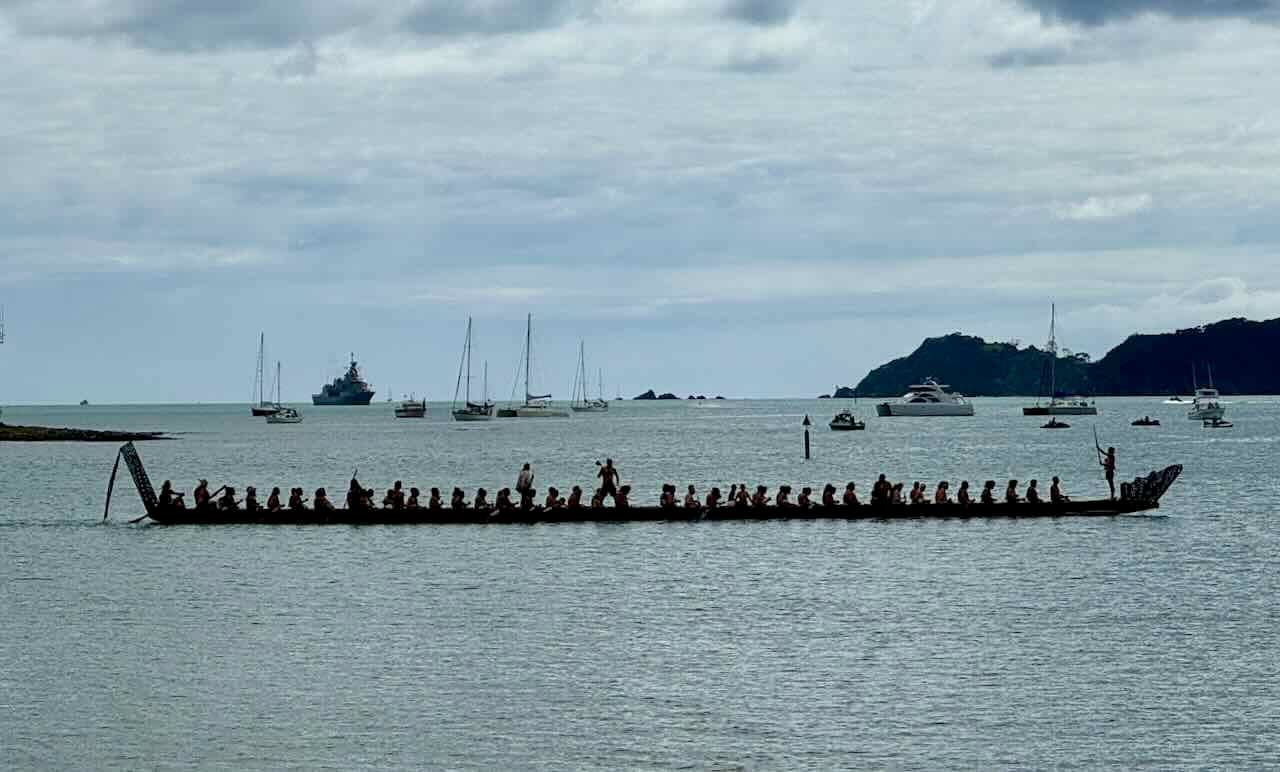
Friday was Waitangi Day (6 February), New Zealand’s national day, officially marking the founding of the nation. Until last week, all I knew about Waitangi Day was that it meant a long weekend. I was in Paihia, right next to the Waitangi grounds where these events unfolded, and that proximity mattered. This wasn’t history I had gone looking for, or a celebration I had joined from the outside. It was history pressing in on daily life — on the land, the water, the conversations, the rhythm of the place — and slowly making itself felt.
Waitangi Day marks the signing of the Treaty of Waitangi in 1840, an agreement between representatives of the British Crown and many Māori rangatira that is often described as New Zealand’s founding document. Less visible, but present everywhere I was staying, was 1835 — the year Māori chiefs signed the Declaration of the Independence of the United Tribes of New Zealand, asserting sovereignty before formal colonization.
I went. I joined. I watched Waitangi Day with the eyes of a European immigrant who has spent thirty years in the United States, growing increasingly uncomfortable with the narrative this nation chooses to remember about its founding — what it highlights, and what it decides to ignore.
What struck me first was the tone.
There was gravitas. Almost the opposite of celebration. Nothing like the Fourth of July, with its fireworks and victory narratives. Waitangi Day felt closer to remembrance than to triumph. It was more joyful than the November 11th commemorations in France, yet like November 11th, it was not a moment of national self-congratulation, but a pause — a collective acknowledgment of where people come from, and of what cannot be cleanly resolved.
What struck me even more was who was hosting.
The Māori were not being “included.” They were clearly the hosts. Others — Pākehā, visitors, newcomers — were present in a space that was not theirs to frame. That reverses something deeply ingrained in the American idea of inclusion, where the dominant culture invites others into its story. Here, the invitation ran the other way.
I tried to imagine Independence Day in the United States being hosted by Native Americans. Not symbolically. Not ceremonially. Actually hosted. The thought alone exposes how far that idea sits outside the American imagination.
Nothing I saw suggested that history had been resolved. This was not a “happily ever after.” The tensions were visible, sometimes palpable. But what impressed me was the restraint — the willingness to hold an unresolved common history in public, rather than rushing to smooth it over or convert it into a victory narrative.
Standing there, I found myself wondering whether something in the colonial playbook fractured by the time Europeans reached the far end of the world. New Zealand was one of the last colonies, at the edge of the map. I don’t know enough to claim that anything was done right here — that would be absurd. But I had the impression that domination alone was already being recognized as problematic, insufficient, perhaps even dangerous. The Treaty itself seems to acknowledge that something more than conquest was required to build a nation.
I am well aware that this is not my history, and not my place to explain it. I don’t know what I’m talking about in any authoritative sense. I don’t want to oversimplify a story that isn’t mine, let alone offend by pretending to understand it. What I can say is that it made a strong impression — a positive one — and that it left me wanting to learn rather than to judge.
It also made me hopeful, in a restrained way.
If societies can learn — slowly, incompletely, painfully — from their own failures, then perhaps there is a path away from pure domination. After centuries of trying to extract without restraint, maybe we can converge toward models that acknowledge limits, even if they never fully resolve the tension between the desire to grow and the need to hold back.
Waitangi Day did not offer solutions. What it offered was something rarer: a shared willingness to remember without pretending history is behind us, closed, or resolved. It seems to express a willingness to stand on the edge of an unstable equilibrium — one worth preserving, even though it does not offer the consolation of a simple narrative.
That, at least, feels worth paying attention to.