
Moving In
Before I could plan passages, I needed to be able to plan menus.

I purchased Rosemary on March 25th, six weeks ago. But I still have not moved aboard.
People are surprised that I am still in an Airbnb when I have a bed waiting for me at the marina. I questioned the choice myself. Why did I keep postponing moving in? I wondered if some unexpressed anxiety was keeping me on land.
But this week, I understood why I needed to keep Rosemary at arm’s length before moving aboard.
If I had rushed in, I would have become a guest in a space shaped by previous owners. By working on her from the outside first, I could keep enough distance to understand what needed to change before I could inhabit her.
Like with a house, there is a short window between move-out and move-in when you can truly clean a boat. Not wipe-down clean. Actually clean. No gear in the way, no reason to avoid a corner, no excuse to live with what is already there.
There is a moment — after the tradespeople leave and the tools return to their boxes — when attention shifts away from technical systems and toward the possibility of a home.
So this week, I cleaned.
I started at the bow, with the forward cabinet in the forward cabin. Under the windlass. Yes, the windlass motor is inside the cabin — I do not think I will make many friends by hoisting anchor while someone is sleeping in the berth under it.
This became an extreme version of deep cleaning. The kind that requires a headlamp, a toothbrush in a few places, and the willingness to venture into spaces nobody has looked at in a very long time.
Rosemary is a big boat. She has countless nooks where dust, grease, oxidation products, and moisture quietly hide and accumulate.
So the campaign progressed aft. One room at a time. One compartment at a time.
I decided the bilges and technical spaces could wait. Otherwise the project would never end. But the work felt right — the kind of labor that earns you the right to call a place home.
Then came the bedding.
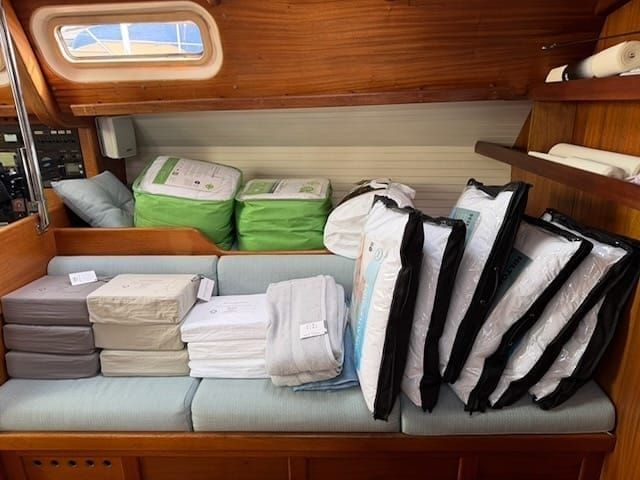
Matt had left a generous supply: sheets, comforters, pillows. I ran eight loads through a 22-kilogram industrial washer at the marina. Eight. The largest laundry operation I have ever conducted.
I laid everything out in the salon, trying to deduce which sheet belonged to which berth. I made up two beds. Sent a picture of his cabin to my first guest. Then I stepped back.
Something was wrong.
I could not name it immediately. But I knew.
Then came the galley.
Old pots and pans. A collection of silverware. Plates. Cleaning products of uncertain vintage.
I made a genuine effort. I held each object and tried to imagine a future with it.
Some things had crossed too many oceans — not worn in a romantic way, just worn out. Others could not be cleaned to a standard I would accept in a kitchen. And the logic of the assortment — what had been kept, what paired with what — was not mine.
It belonged to another life.
I made a decision.
The bedding and the kitchen had to go.
I want to be clear about something: when it comes to the rigging, navigation equipment, or anything related to how Rosemary moves through water, I have been deliberately cautious. I am new to this boat. I do not yet have the experience to second-guess what is already there. I have been watching, learning, deferring. I give myself a year before forming strong opinions about the technical systems.
But the interior is different territory.
This is the home replacing the one I left six months ago.
For the next few years, I will spend most of the year living aboard. I will host people here. I will cook for them. The boat needed to feel like home — not like a furnished rental I was too polite to rearrange.
So I drove to Briscoes.
I bought bedding. I standardized the berth configurations, matched the colors, chose quality over the cheapest option available.
Then I bought a proper set of cooking utensils. Just like cooking is how I built a community when my kids were still at home, cooking will bring people together on Rosemary.
Standing in the store, I realized something simple: Before I could plan routes, I needed to be able to plan menus.
Leaving the store, I brought three full carts of houseware to my car that I had to rearrange everything just to close the trunk.
I am not entirely comfortable with this.
Discarding functional objects — things that technically still worked — feels wasteful. Expensive. Difficult to justify for a voyage supposedly about taking less.
But I keep returning to the same distinction:
Functional and emotionally adequate are not the same thing.
I can tolerate a great deal of discomfort on this trip. Discomfort is part of the point.
What I cannot afford is to feel, in the place where I sleep, cook, host, and think, like a guest in someone else’s life.
When we stay in an Airbnb, we accept sleeping in someone else’s sheets and eating from someone else’s plates. That may even be part of what makes those places feel temporary, foreign, impossible to fully inhabit.
But when we buy a home, nobody expects us to keep sleeping in the previous owner’s bed.
Rosemary feels like home now.
The sheets match.
Related Posts
 Matt Coutts
 Jean Peccoud