The Resilience Lab
Boat work is exhausting and uncomfortable, but it reveals something deeper: resilience is not about control, it’s about learning to live with uncertainty.

I don't like boat work.
It exposes my ignorance. Tasks that would be simple in a house or on a car turn into a contortionist performance. Every muscle is sore by end of day. My brain flatlines.
My physician put it plainly at my last physical: too much boat work, not worth it.
I didn't agree then. I do now.
But I don't think I would be sailing without a story I want to tell, without a hypothesis I want to test.
Refitting the boat reminds me of setting up a laboratory. I didn't get into science to set up labs — nobody does. It was always a means to an end. A story to tell. A hypothesis to test.
The lab is where ideas confront reality. Friction is what transforms some hypotheses into knowledge that can, sometimes, transform the world.
So I have come to think of the boat as my new lab. A lab where I also sleep.
The hypothesis: improving operational resilience leads to improving existential resilience. Sailing in challenging waters may be a good way to learn how to face uncertainty — of any kind.
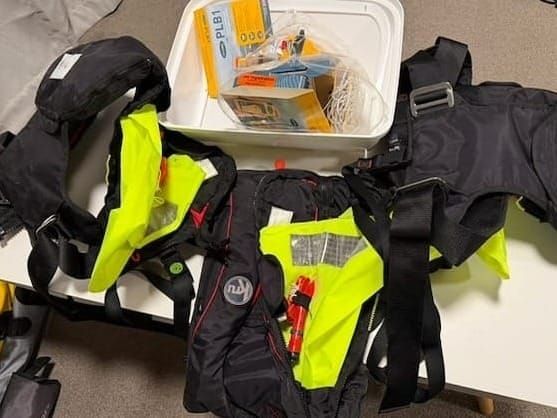
We have fancy life vests, also known as Personal Flotation Devices. They inflate automatically when someone falls overboard. They include a radio beacon that calls the ship via VHF when activated, displaying the man-overboard position on the chart plotter. And a personal locator beacon that sends the position to a satellite, which relays it to the nearest coast guard to initiate search and rescue.
PFDs are critical for everyone's safety.
So I had them serviced by a specialized company in Auckland. I bought spare parts. I felt very safe. Relieved, even, that I could outsource my safety to professionals.
That feeling did not last.
After the boat was registered in the UK, it got a new MMSI number — the VHF equivalent of a phone number. The beacons need to be updated with that number. So I unpacked the recently serviced PFDs to extract them.
That's when I realized the devices were not properly installed.
They were inside the pouch. But they were not attached to the PFD. I'm not even sure they wouldn't have interfered with inflation.
It took me a while to accept what I was seeing.
Then it clicked — in my head and in my gut.
I saw myself in the water, the PFD struggling to inflate, the beacon floating away for a few seconds before sinking.
I fell overboard and almost drowned when I was a teenager. The questionable rigging really shook me.
It's a familiar pattern.
This boat is full of systems I don't fully understand. Most of the work has been outsourced to professionals who juggle ten jobs at once and will not live with the consequences of failure. And there are systems that haven't been touched in years — possibly decades.
When was the last time the emergency tiller was tested?
Preparing for a passage is mostly preparing for catastrophes. And paradoxically, the more you prepare, the less safe you feel.
The PFD, serviced by professionals and never opened, felt safe. Then something didn't behave as expected, and I had to look deeper. Layers appeared: layers of complexity, layers of systems that can fail, layers of trust that collapse under scrutiny.
A technical problem tied to an unlikely scenario quickly becomes something much more existential.
The boat is not a tool I will use from 9 to 5. It is a system I will live in for months, in some of the most remote places on Earth.
We cannot wait to have everything tested, reviewed, and understood before casting off. At some point, we have to accept the uncertainty we cannot eliminate, learn to live with it, and deal with bad surprises as they arise.
That is the experiment.
At some point, a lab is no longer an external entity you work on. It becomes a place you work in.
You remember the content of every drawer. You memorize the protocols. You organize your days around the rhythm of your experiments. And instead of being a burden, it fades into the background — letting the data surface and tell its own story.
At some point, the boat may become a place I work in. I will move around it more gracefully. I will remember where things are.
And maybe, one day, it will stop feeling like a burden. It will disappear, become second nature, and let me focus on listening to what the places we visit have to tell.
Related Posts
 Jean Peccoud
 Jean Peccoud