The Postcard Experiment
I asked hundreds of climate scientists one simple question: what is your personal experience of climate change? The campaign statistics were strong. The silence was deafening.

When you are worried about a persistent cough, you go to a doctor. You don't just want a printout of your white blood cell count; you want a human being to help you interpret the symptoms you experience, collect data in the lab, and help you understand what that means for your life. The connection between the data and the patient experience is an integral part of diagnosis.
I am worried about the climate. So, I approached a few climate scientists with the same logic. These are the doctors of our planetary systems. I assumed that because they spend forty hours a week — and often much more — immersed in the data of change, they would be the most likely to have the words to describe it. I didn't want their latest predictions. I had a simpler ask: What is your personal experience of climate change? How does it feel? Send me a picture and a sentence or two.
They did not seem to understand what I was asking. That got me even more worried, but also curious. May be the question was not as simple as it sounded at first. So, I ran an experiment.
I used LinkedIn Sales Navigator to identify 213 people with Climate Scientist in their job title and ran an automated outreach campaign. The numbers were encouraging: 49% of connection requests accepted, 41% reply rate. People were engaged and supportive.
But here is the friction point: despite over 100 positive interactions, only one person could provide a personal postcard. I expected a flood of anecdotes. Instead, I hit a wall of silence so thick it felt structural.
One scientist drafted a deeply moving post, then messaged me to say they couldn't hit publish. They were afraid — not of the science being wrong, but of the death threats that might follow. Others explained that their institutional positions forbade them from speaking personally about this topic. Most unsettling were those who found the project fascinating but realized, with a shock, that they didn't know how to answer. These are people whose entire waking lives are dedicated to the study of planetary transition. Yet when asked how it felt to live inside that knowledge, they drew a blank. They had never thought about it.
The combination of goodwill and silence felt terrifying. If the professionals of climate change cannot talk about it, perhaps no one can. If the people with the most information lack the framework to verbalize the human experience behind the data, then the rest of us are probably left to live this like patients who don't have the language to describe their symptoms — let alone understand the underlying condition.
Talking about the experience of a changing world may be seen as a sign of weakness, a political provocation, or a professional lapse. We have languages for many kinds of difficulty: relationships, finance, careers, health. But we don't seem to have a framework for houses submerged by rising sea levels, winters without snow, or devastating wildfires. Because there is no easy narrative of salvation, it is socially safer to sweep these experiences under the rug.
I'll be honest: writing this makes me nervous.
Over the years, I published more than 100 articles describing how molecules interact in living cells. Social sciences lie way beyond my scientific comfort zone. So I struggle to call this a research project. It feels too soft, impossible to quantify.
While I love data to publish scientific articles,I don't want more data about the climate. I don't even want to think about it, because the more I know, the more I struggle to resolve the tension between the social norms I have to abide by, my personal values, and my growing awareness of what we are facing.
I vividly remember the COVID years, when all professional travel came to a stop. I really enjoyed the lockdowns. The relentless pressure to attend professional events suddenly stopped. No more early morning drives to the airport. No more sleepless nights in sterile hotel rooms. No more days away from the people I love. My quality of life improved as my carbon footprint dropped. I felt a sense of alignment I hadn't known I was missing. I was hopeful that virtual meetings would outlast the outbreak. I was so disappointed when they didn't. The pressure to resume professional travel returned — but the physical tension I felt in my chest heading to the airport was much harder to accept than before. It used to be unpleasant. Now it felt wrong. While still being unpleasant.
The public discourse on climate change is almost entirely scientific. We document. We model. We predict. And we hope — genuinely, fervently — that if we make the predictions dramatic enough, knowledge will finally trigger a change in behavior.
But assuming that more information changes behavior is not scientific.
Consider the smoker. Every smoker knows tobacco causes cancer. They don't smoke because they lack data; they smoke because of a complex web of stress, social habit, and emotional regulation. Printing the facts in larger letters doesn't close that gap. If anything, the warning produces anxiety, and the person reaches for a cigarette to calm the very anxiety it triggered.
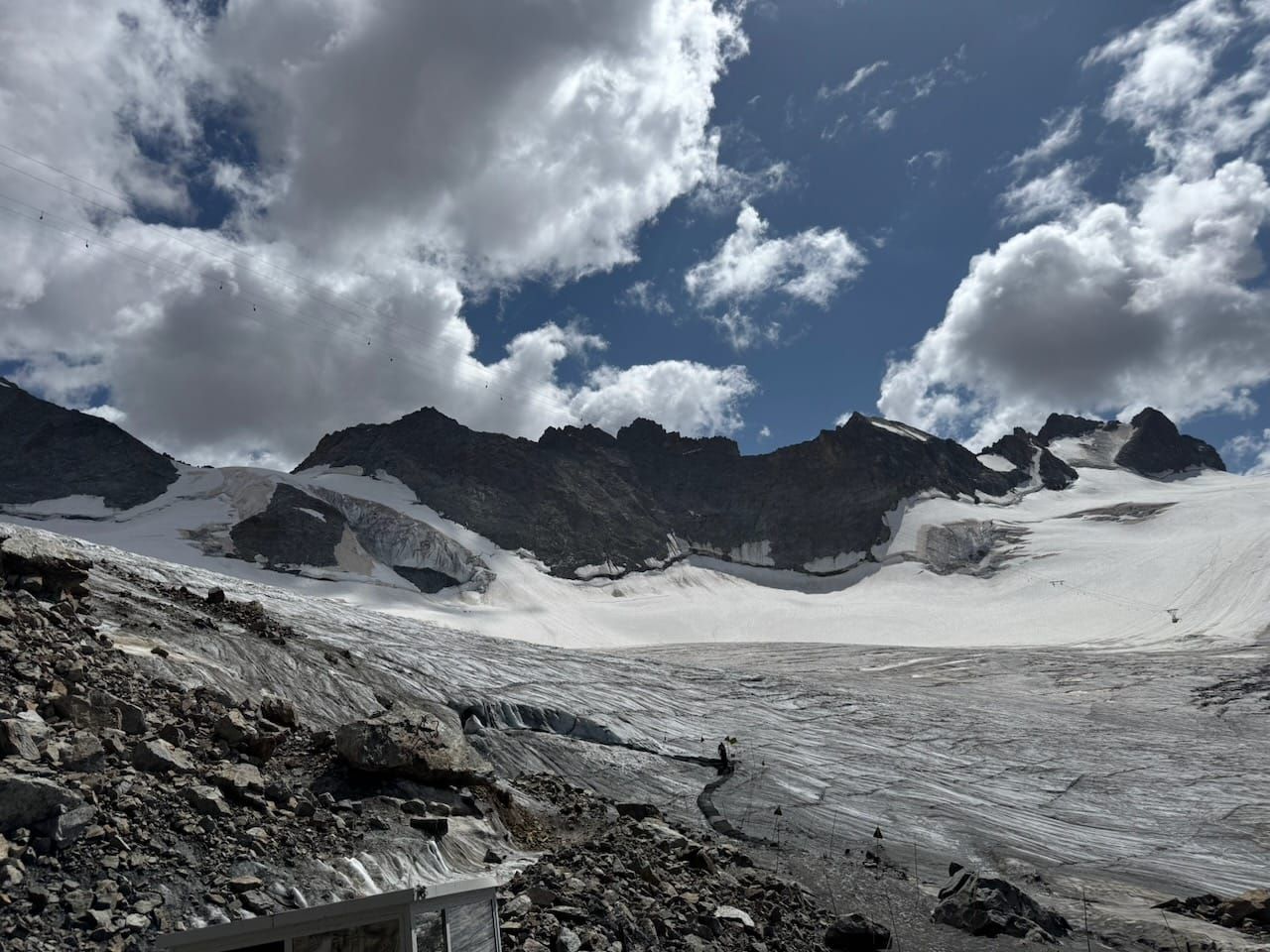
There is no direct line from data to behavior. Between them sits something we rarely discuss: how the data makes us feel, and what we tell ourselves about it. Standing in front of a retreating glacier, the same scene can lead to very different places. One person feels grief and concludes that all is lost — and disengages. Another feels love for what remains and decides it's worth fighting for — and acts. Same data. Opposite outcomes. The difference isn't information. It's the emotional and cognitive path that information travels.
We are trying to address climate change while skipping the human experience. We are trying to build a sustainable world while ignoring the humans who are supposed to live in it.
After reaching out to hundreds of people, I finally have a handful of "Living with a Changing Climate" postcards. These aren't data points. They are moments where people dared to step out of the safety of data, knowledge, and solutions to make this a personal matter. One postcard is worth more than a thousand pages of white papers because one line in a postcard requires an "I." It requires a person to say: This is where I stand, and this is how it feels.
I am waiting for your postcard.
Related Posts
 Jean Peccoud
 Jean Peccoud