The Calm Before The Storm
Trump said it. He was talking about something else. But the words landed differently — after Artemis, before a cyclone, standing alone on a beach at the edge of the Bay of Islands.
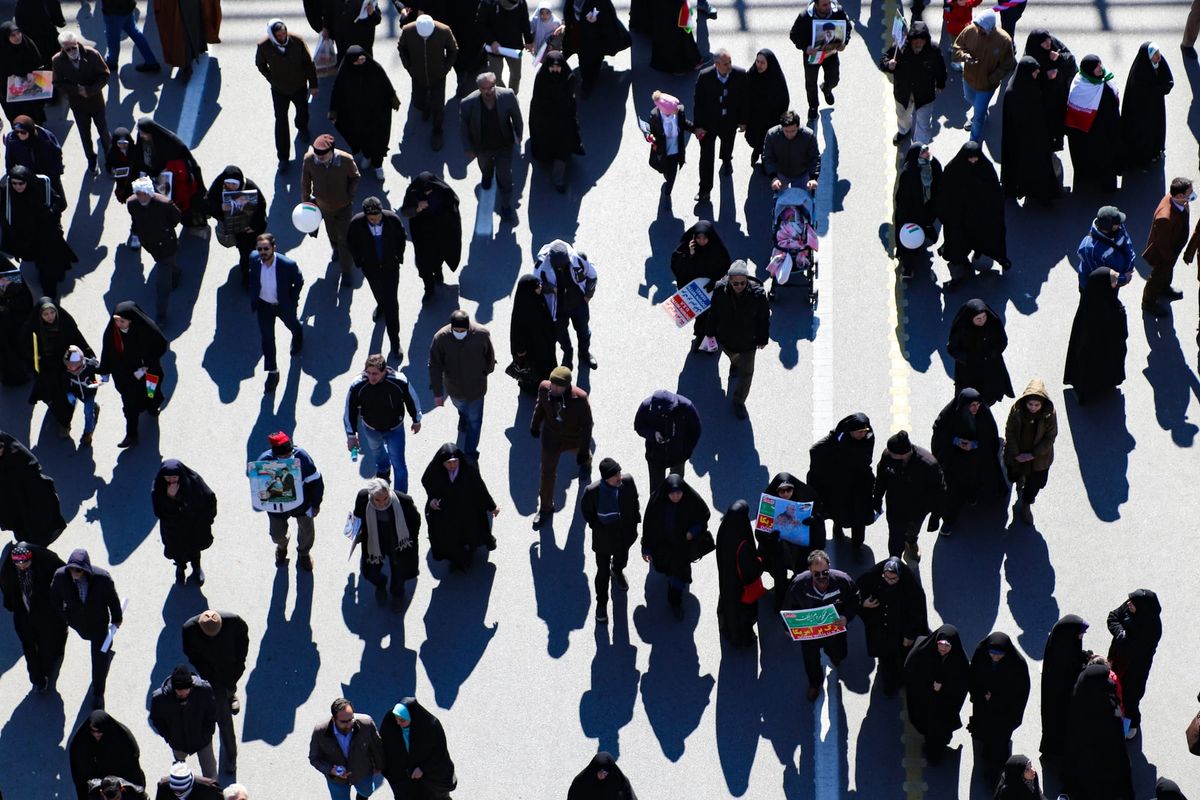
“An entire civilization will die tonight, never to be brought back again.”
That was Donald Trump this week.
Artemis II launched this week. Astronauts fly by the Moon for the first time in fifty years, and we were asked to celebrate.
I could not.
The heavily scripted expressions of enthusiasm broadcast from space were difficult to watch. Not because the achievement isn’t real, but because the celebration reveals something uncomfortable about where we still think we are: a civilization with the time and surplus to dream outward, to expand, to reach. A civilization that still believes the next frontier is up.
I remember the Apollo program. I was a child, watching from France. I remember the pride. The sense of collective possibility. It felt like the beginning of something.
Are we still this civilization?
Something has shifted, quietly but irreversibly. Climate change did not arrive as an event. It dissolved a premise. The idea that we could keep expanding—materially, geographically, indefinitely—without consequence.
We are no longer early in the story.
And so the question lingers: what exactly are we celebrating?
That we can still do what we did fifty years ago?
That we can repeat a gesture from a time when the constraints were not yet visible?
It doesn’t feel like ambition. It feels like continuity without reflection. Like a story we keep telling because we don’t yet know how to tell another one.
“An entire civilization will die tonight, never to be brought back again.”
He was talking about something else.
But the sentence lands differently now.
Cyclone Vaianu is expected to make landfall during the night.
I drove to Kerikeri to stock up on essentials, in case roads close and power goes out. The forecasts were urgent. The town was quiet.
I needed to resolve that tension.
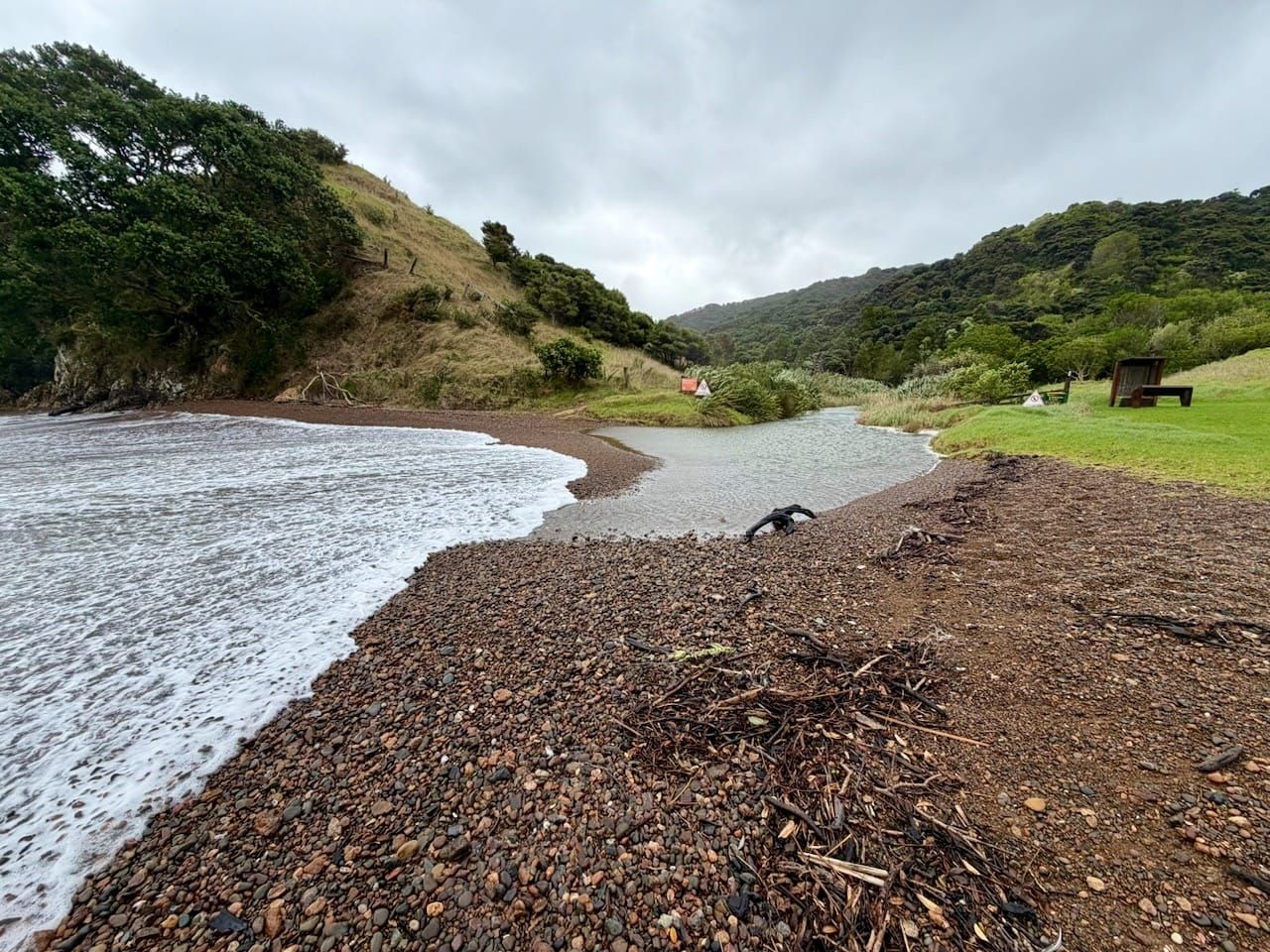
So I drove out to Rangihoua Heritage Park, at the far edge of the Bay of Islands. I expected wind, waves, some visible sign of what was coming. I told myself I would turn back if it felt unsafe.
For half an hour, I didn’t see a single car.
At the end of the gravel road: light wind, light rain, low clouds. The light and the mist did the rest. It was the calm before the storm.
Rangihoua is where the first Christian missionaries arrived in New Zealand, in 1814. The site presents the encounter between Māori and settlers as a story of goodwill—people of good intentions finding common ground. There is truth in that framing. And there is also something it leaves aside.
Standing on the beach where the first mass was celebrated, I felt the weight of what isn’t said. About who had to absorb whose system of values. About what gets called accord, and what disappears in the retelling.
I stood there for a long time.
Alone.
I wondered what it would mean to be a missionary today.
Not someone bringing a belief system.
Not someone arriving with answers.
But maybe someone who believes that change begins at the level of the individual. That a single shift in what a person values is not trivial—that it matters.
Because our institutions are not going to resolve this for us.
The speed at which the United States has shed any claim to moral leadership is still difficult to grasp. The international frameworks we built feel increasingly like abstractions—present, but disconnected.
What remains is us.
Individual citizens, deciding what we accept, what we refuse, what we are willing to give up.
Learning to say no more.
Learning to see restraint not as loss, but as the only form of ambition that still makes sense.
I think about Voltaire, Jean-Jacques Rousseau, and the others who lived in a time when institutions no longer matched reality. They didn’t fix the systems. They shifted what people believed was possible.
I don’t know if we are at that kind of threshold.
I’m not sure anyone ever knows while standing in it.
I got back in the car.
The storm was still hours away.
On the drive back, I put on The Future by Leonard Cohen.
Democracy came on.
It felt like the only weather report I needed.
Related Posts
 Jean Peccoud
 Jean Peccoud