
The Boat is Up. The Mast Down.
On March 30th, Rosemary came out of the water at the Bay of Islands Marina. The hull was dirty, the rigging had to go, and the mast ended up below the keel. The world felt upside down — but then again, we are in New Zealand.

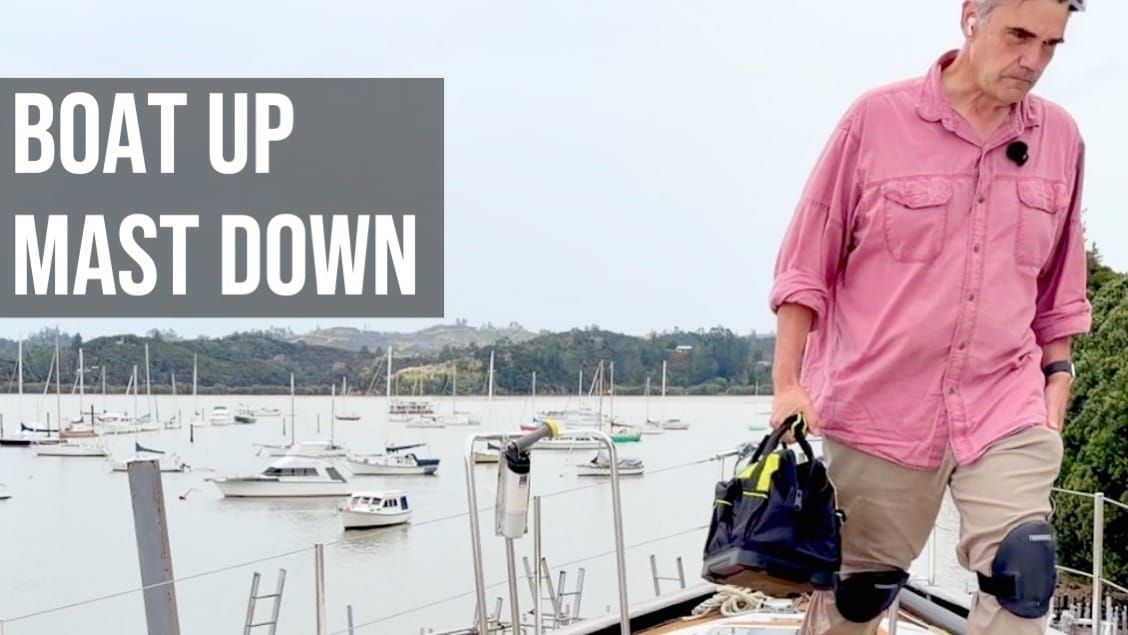
On March 30th, Rosemary came out of the water at the Bay of Islands Marina.
Hauling a boat out during a prepurchase survey is fun.
Hauling your boat out is not.
Haul out
When the travel lift hoisted her clear of the surface, I expected a clean hull. We had pressure-washed it just a month earlier, during the survey.
It was anything but clean. The growth was back — barnacles, weed, a general coating of marine life that had wasted no time making itself at home. The Bay of Islands is beautiful, but it is also extraordinarily fertile water. Warm, nutrient-rich, the kind of environment where things grow whether you want them to or not. The oyster farms scattered across the bay are not a coincidence. Whatever makes those oysters thrive makes everything else thrive too, including the entire ecosystem living on her hull.
This is exactly why antifouling paint exists. The coating discourages growth — not perfectly, not forever, but enough to buy you some time. And at the scale of a Pacific crossing, enough matters. Growth creates drag. Drag costs speed. Over a thousand miles, that cost is measured not in fractions of a knot but in days — additional days at sea, additional days of provisions consumed, additional days of weather to navigate. We will repaint the hull before departure. This is not optional.
De-Rigging
Replacing the standing rigging is also not optional, though for different reasons.
Our insurance underwriters have boundaries: rigging approaching ten years old is a liability they are not willing to carry. You replace the rigging, or you sail at your own risk.
The frustrating part is that stainless steel rigging looks fine right up until it isn't. This was something I learned: stainless steel can rust. Not on the surface — on the surface it looks immaculate — but from the inside out, where the individual strands of the cable corrode invisibly. There is no reliable way to inspect it. You cannot see what is happening inside. What looks like perfectly good rigging may be quietly failing.
A rigging failure offshore is not an inconvenience. If the forestay lets go, the mast comes down. A fallen mast, still attached to the boat by its remaining wires, hammers against the hull. It can hole the boat. It can sink the boat. So we need to replace everything — including the forestay that had been installed less than a year ago, because the underwriter is not interested in negotiating exceptions. It feels wasteful. But you have to think of how the conversation would go if you had to file a claim. "Did you change the rigging? Oh, I don't see the forestay in this invoice. Sorry, you did not hold you end of the bargain. You're on your own".
Watching a boat being de-rigged is not something I expected to find unsettling.
The sails came down first. Some of the webbing showed wear, so the sails went off to the sail loft for repairs. Then we turned to the mast — which meant first extracting everything running through it: cables for the radar, the VHF, the GPS. A significant amount of wiring for a column of aluminum. I was quietly grateful that the wind instruments are wireless.
The boom came off first. It is a manageable thing — shorter, lighter, horizontal when it starts and horizontal when it lands. A straightforward problem with a straightforward solution.
The mast is a different matter.
One of the riggers went aloft to strap it, to give the crane something to hold against before we started disconnecting the stays and shrouds. Then they came off one by one — the forestay, the backstay, the shrouds on each side — and with each one, the mast grew less stable. The base began to move. It had to be managed, kept from swinging, kept from loading the remaining connections unevenly. There was a controlled urgency to it.
Ropes guided the mast as it lifted free, steering it toward its landing spot on the pavement, where a piece of wood waited to cushion the base. Getting it horizontal from there required its own careful process — the base had to be lowered without letting it slip — and then it was done, the mast resting on a series of wheeled cradles to protect the fittings and the fragile metal.
From a distance, it looked like a sophisticated choreography without music. Precise, coordinated, each person knowing their role and their moment. It was genuinely beautiful to watch.
Standing closer, it was terrifying.
It felt like going to the hospital for surgery. You prepare as best you can, you hand yourself over to people who know what they are doing, and then you have to let go. All this haulout and de-rigging felt like preop. And now, it's like I am under while the team is cutting and stitching.
It requires a lot of trust. It's not my process anymore. It is theirs — the riggers, the yard, the sail loft. My job is to stay out of the way and believe that Rosemary would come back together on the other side, better than she was when this started.
I am still not entirely sure she will.
Rain
The weekend brought heavy rain. The kind of rain that makes you reconsider getting out of bed because you know leaving the house will be miserable as soon as you step outside. The kind that feels like someone higher up is draining a gigantic bathtub over your head.
The hole in the deck where the electrical cables had run into the mast — taped over after the cables came out — was not gap-proof. The tape would have been good enough to prevent a fly from getting in the boat. It was not designed as a dam. Water came through it. And then there was water in the cabin, coming in from above, on a boat that is specifically designed to keep water out. Nothing is more depressing than a small leak on a boat. This was not a small leak.
I plugged it with a wooden plug, the same way you would plug a thru-hull fitting below the waterline to prevent the boat from sinking. Only this one was in the deck. On a boat sitting in a boatyard. In the rain.
The whole thing felt like punishment: the rain, the leak, the bare deck, and the mast below the keel. A boat on land is a strange and vulnerable thing. A boat on land with water coming in through the top, while you stuff a wooden plug into her deck with a hammer feels like a wreck.
The world felt upside down.