Revisiting Vanuatu
A night watch between New Caledonia and the Marshall Islands brings back memories of a young man, a place he hadn't chosen, and a debt he has never fully settled.
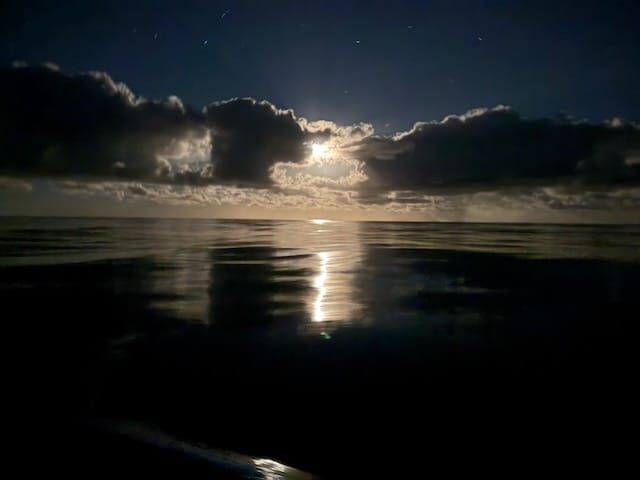
S 20°37.895 E 166°51.104 — 11 pm to 3 am watch
On the way from Noumea, New Caledonia to Majuro, Marshall Islands, the winds are pushing us through the Loyalty Islands. Tomorrow, we will be entering Vanuatu's territorial waters.
We will sail within miles of the Saraoutou Research Station, where I spent eighteen months in the early 1990s fulfilling the obligations of French national service. I was assigned this position by the administration because they had a coconut breeding program to run and I had a graduate degree in genetics.
I arrived weeks after defending my PhD dissertation, expecting an extended vacation in a tropical paradise. Walking the plantation by day, cocktails by the pool at six, breathtaking dives on weekends — that was what I had mentally prepared for. I should have read the fine print, not that it would have made any difference.
Things took an unexpected turn early. The trip was long, a little too long. A twelve-hour flight to Bangkok, then ten more hours to Sydney. The goal of the second day was to reach Port Vila, the capital of Vanuatu. The Airbus made a quick stop in Noumea before the final leg to Vila. Noticing that only six passengers remained on the plane when we took off, I started getting worried. A second night in Vila, where my first earthquake woke me at 3 am — I lay in the dark feeling certain it had all ended prematurely. But the hotel stayed standing, and the next day I boarded a six-passenger prop plane to Luganville, the only town on Espiritu Santo Island.
After a thirty-minute drive, I reached Saraoutou.
The place had limitations. Electricity ran from 6 am to 8 pm. Phone access was available only during business hours in Luganville. No television. Any order took between six weeks and six months to arrive. The only doctor in town was a French medical student. The road network was limited to the south and east coasts, leaving most of the island accessible only on foot.
This felt very remote to me. And it probably was.
Everything I had taken for granted as essential to modern life was unavailable. I experienced a debilitating withdrawal for a few months. Eventually, I had to change my perspective. Instead of looking outside for what was beyond reach, I started looking at what was available locally. And since I had no idea what to look for, I had to rely on the locals to teach me.
I learned the language. I tried to be helpful. They eventually shared some of their secrets. They told me how stupid it was to go spearfishing by day. Spearfishing should be done at night, when there is no moon, with a flashlight — many fish sleep, and others come out. It would never have occurred to me that diving a coral reef in shark-infested waters when it's so dark you can't tell which way is the shore was a good idea. But it works.
At some point, Marie-Louise became my guide, the gateway to learning more about the place and the people. The journey was fascinating. Vanuatu is a deeply compartmentalized country that makes travel very difficult — it was never about seeing everything there was to see. It was about learning to see what there was to see where I was. It was about learning a different way to relate to the land.
Eventually, I had fulfilled my obligations to France. I considered staying, looked at options, applied to jobs. In the end, I got on a plane back to France.
I was young and naïve. I made promises I could not keep. I arrived in France wondering if I was leaving a child behind.
I am still ashamed of this betrayal.
I am not ashamed of the stupid romantic promises.
I am ashamed of the asymmetry.
I could get away.
She could not.
I could withdraw from a situation I created.
She could not.
I could escape the consequences.
She could not.
And since then, I have moved from city to city, across countries, across continents. I went where the opportunities were, just as our ancestors explored the world before setting up colonies, or moved west to claim new territories. I never stayed more than ten years in one place, never set roots anywhere, because I knew I would eventually leave. I now live on a sailboat, a contraption designed to provide shelter without ever stopping anywhere.
I hear talk of continuing this expansion — toward the moon, then Mars. The fantasy of unbounded movement endures. The appeal of going further to avoid consequences is extraordinarily seductive. Perhaps because movement so often allows us to externalize costs others must absorb
But as I sail toward Vanuatu, I think of a young man who, for a moment, thought he had lost everything, and who eventually learned to adapt to the limitations of a place he had not chosen. In that process, he experienced a form of alignment that may be a large part of what drew him toward a monastic life he never chose.
The COVID lockdowns offered a second chance at something similar. Confined to my neighborhood, I started to see it differently — its rhythms, its textures, its people.
After the pandemic, I started thinking seriously about what it would mean to stop — to buy a small farm, or a local business, to insert myself into a place and a community in a way that couldn't easily be undone.
But in the end, I chose the path that kept the exit open.
I have always chosen that path.
I never had the courage to root myself intentionally in one place, accepting its limitations as the price of discovering its riches.
As I try to find a way out of this emotional and ethical maze, I find comfort in the Labyrinth Song by Asaf Avidan.
Related Post
 Jean Peccoud
 Jean Peccoud