
First Impressions from New Zealand
They are physical and immediate: strong wind, a cool maritime summer, and the realization that the Pacific is more than a route, but a vast commitment.

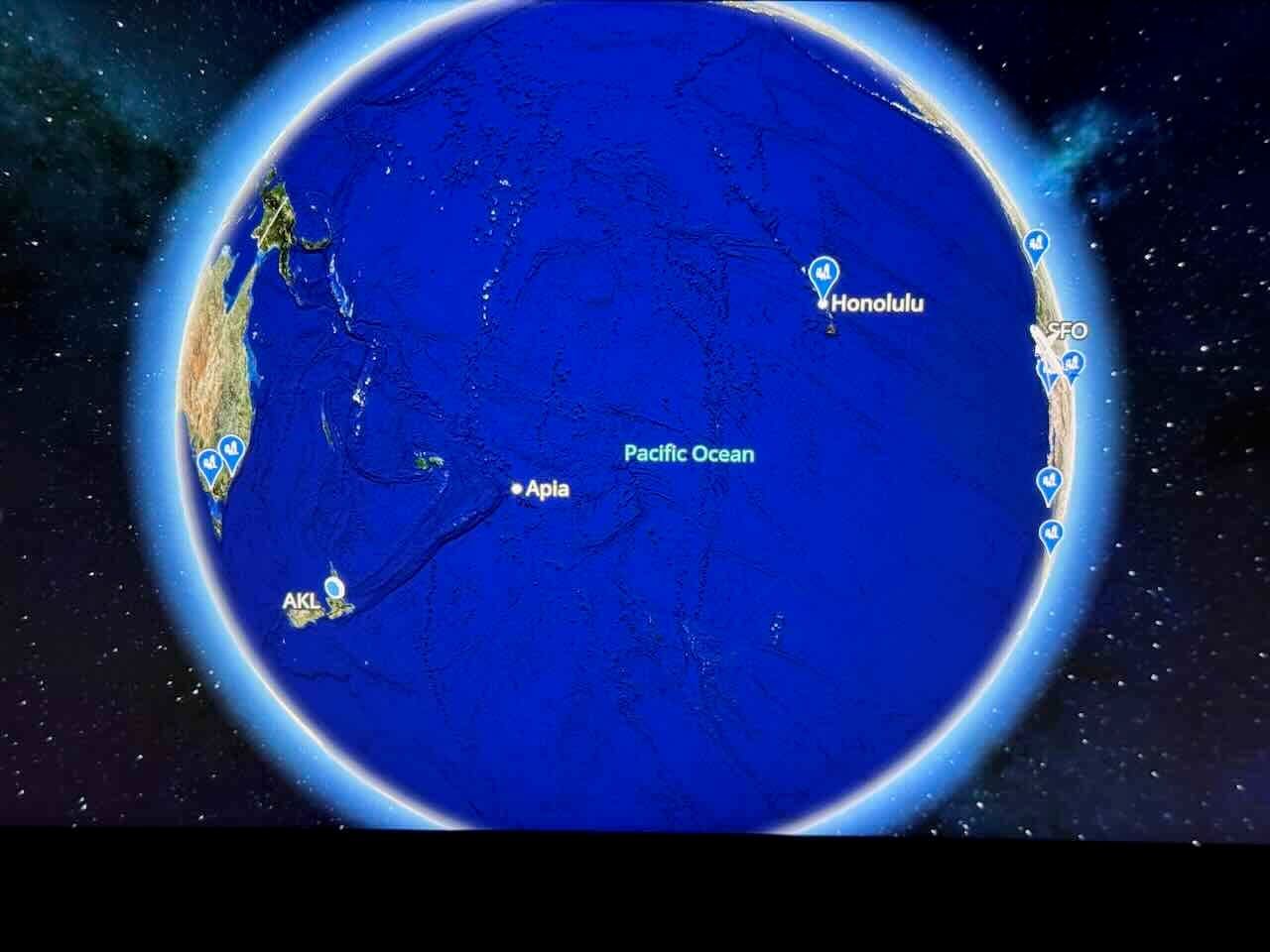
The moving map leaving San Francisco is deceptively calm. A blue arc across a globe, a handful of waypoints, a neat digital promise that you’ll get from one side to the other. But when you look at it from the other end—standing in New Zealand—that same map becomes something else entirely. It’s no longer a route. It’s a void.
That’s a lot of water.
Flying compresses it into hours. Sailing stretches it back into what it really is: weeks of exposure, commitment, and the absence of easy exits. Seeing the Pacific rendered as almost nothing but blue rewires your sense of scale. It’s not just distance—it’s the lack of alternatives. No shortcuts, no plan B once you’re committed. Just weather systems, latitudes, and your ability to live with them.
Stepping out of the airport, the second impression arrived immediately: wind.
Twenty-five knots, gusting to thirty-five. Enough that you need to lean forward to walk straight. Not dramatic, not theatrical—just there. Persistent. Physical. More intense than I expected. New Zealand doesn’t ease you in gently. The wind feels like a statement: this place is shaped by forces, not convenience. Even on land, you can sense that everything here—boats, houses, trees—has been built with the assumption that the wind will show up and stay.
What struck me most was how honest it felt. This isn’t chaotic or tropical violence. It’s organized, muscular, and unapologetic. The kind of wind that doesn’t ask whether you’re ready—it simply expects competence.
Then came the temperature, which caught me even more off guard. It’s summer, yet the air barely reaches twenty degrees Celsius. I had unconsciously placed New Zealand in the same mental subtropical category as Louisiana or Florida—sun, warmth, an easy seasonal rhythm. Instead, it feels cooler than England. The explanation is deceptively simple: there is no warm continent feeding heat into the air. New Zealand is surrounded by ocean in every direction, and water acts as a massive thermal buffer, capping summer warmth and smoothing out extremes. Add steady wind with a long memory of colder southern latitudes, and sunlight no longer guarantees comfort. This is a maritime summer—bright but restrained—where exposure matters more than temperature, and where warmth is something you manage rather than assume.
Looking back across the Pacific from here, it’s hard to imagine sailing it in a few months. Not because it feels impossible, but because it feels too large to hold in a single thought. Right now, the idea presents itself as one monolithic act: sailing back. And that’s overwhelming. Everyone who has done it knows that it doesn’t work that way. It breaks down into weather windows, routines, fatigue, small decisions repeated thousands of times. But at this stage, the brain hasn’t chunked it yet. So it looms.
What I feel is not fear so much as recalibration. A quiet internal correction: this is bigger than I expected.
That feels like the right first impression to have here. New Zealand doesn’t reward underestimation. The Pacific certainly doesn’t. If anything, letting it loom a little—letting the scale and the climate register—feels like part of the initiation.
In time, the wind will stop feeling aggressive and start feeling informative. The water will stop looking like an obstacle and start looking like a medium—something you move through rather than fight. The return passage won’t become easy, but it may become thinkable.
For now, I’m content to stand on this edge of the map and let the reality sink in.