
Yacht Delivery: What Does That Mean?
From time to time, boats need to be moved, not cruised. The undertaking is never trivial.

Boats are not meant to stay where they are built.
A yacht may need to be moved from the shipyard where it was launched to the region where its owner plans to cruise. A used boat may be purchased on the other side of the world and need to be repositioned to a new home port. Some yachts migrate seasonally—winters in the Caribbean, summers in the Mediterranean. Others are moved for practical reasons: reaching a shipyard capable of a major refit, or accessing specialized maintenance.
Whatever the reason, owners eventually face the same problem: how to move a boat intentionally from one place to another.
There are four main ways to do this: cruising, delivery, shipping, and trucking.
Boat relocations can be regional—using coastal routes, such as moving from the Mediterranean to the Atlantic in Europe—or they can involve long offshore passages, including ocean crossings. They apply equally to sailboats and motor yachts.
Cruising is when the owner moves the boat themselves, at their own pace, combining the enjoyment of sailing with the gradual progression toward a destination. That approach is outside the scope of this article.
Here, we focus on methods for relocating a yacht with transportation professionals, where the movement itself is the project.
Yacht Delivery
Yacht delivery generally refers to hiring a professional skipper and crew to sail a yacht to a new location.
A delivery crew typically consists of a paid skipper with extensive offshore experience—often tens of thousands of miles—and formal qualifications such as RYA Yachtmaster Offshore. The skipper may be joined by additional crew members who are experienced sailors, sometimes paid, sometimes building sea time toward their own certifications.
The primary objective of a yacht delivery is not speed, performance, or adventure. It is to protect the asset.
A delivery skipper is not trying to break passage records or arrive as fast as possible. The goal is to bring the boat to its destination safely, with minimal wear and tear, and to avoid unnecessary stress on the hull, rig, sails, engine, and onboard systems.
This shapes every decision. Conservative weather windows. Early reefing. Avoidance of marginal conditions. Fewer stopovers. Longer, uninterrupted passages when appropriate.
There is an inherent tension in this model. Delivery crews are usually paid by the day, which creates pressure to keep the passage moving. Yet pushing harder to shorten the schedule increases risk—and the likelihood of equipment damage or failures that can become far more expensive than a few extra days at sea.
Yacht deliveries also come with practical limitations. Weather windows are often seasonal. Crossing oceans during hurricane season or mid-winter may simply be unreasonable. Schedules remain uncertain because the skipper must retain the freedom to wait for suitable conditions.
And while a delivery aims to minimize wear, it cannot eliminate it. Miles accumulate. Engine hours increase. Sails are used continuously rather than selectively. Preparing a boat for offshore passages may require maintenance that could have been deferred if the yacht had remained close to shore.
A delivery is efficient—but it is never neutral.
Can the Owner Participate in a Yacht Delivery?
For an owner, joining a delivery can be a once-in-a-lifetime opportunity to get to know their boat and build offshore experience. It can also be fraught with challenges.
The first issue is command clarity. Can the owner genuinely step back and act as crew—or even as a passenger—without exerting pressure on the skipper? In practice, the line can be blurry.
Risk perception is another source of friction. An experienced skipper may consider offshore conditions routine and conservative, while an owner encountering them for the first time may feel exposed or unsafe. These mismatched perceptions can strain decision-making.
There is also role confusion. The owner's presence can subtly shift expectations. A delivery crew may be expected to teach, to host, to entertain, or to operate like a charter crew—roles that are incompatible with the discipline of a delivery.
Most importantly, the mission itself can drift.
What begins as a relocation project can slowly morph into an adventure cruise: stopping at islands, sightseeing, lingering in ports. A delivery skipper will typically minimize landfalls, as each stop increases cost, complexity, and risk. An owner may not intuitively understand this discipline and mistake a delivery for a cruise with a skipper.
Delivery skippers handle this challenge differently. Some refuse owner participation altogether. Others evaluate owners on a case-by-case basis. Some companies explicitly offer delivery passages that include offshore instruction; others do not.
Much depends on experience—on both sides.
Other Means of Yacht Transportation
Shipping
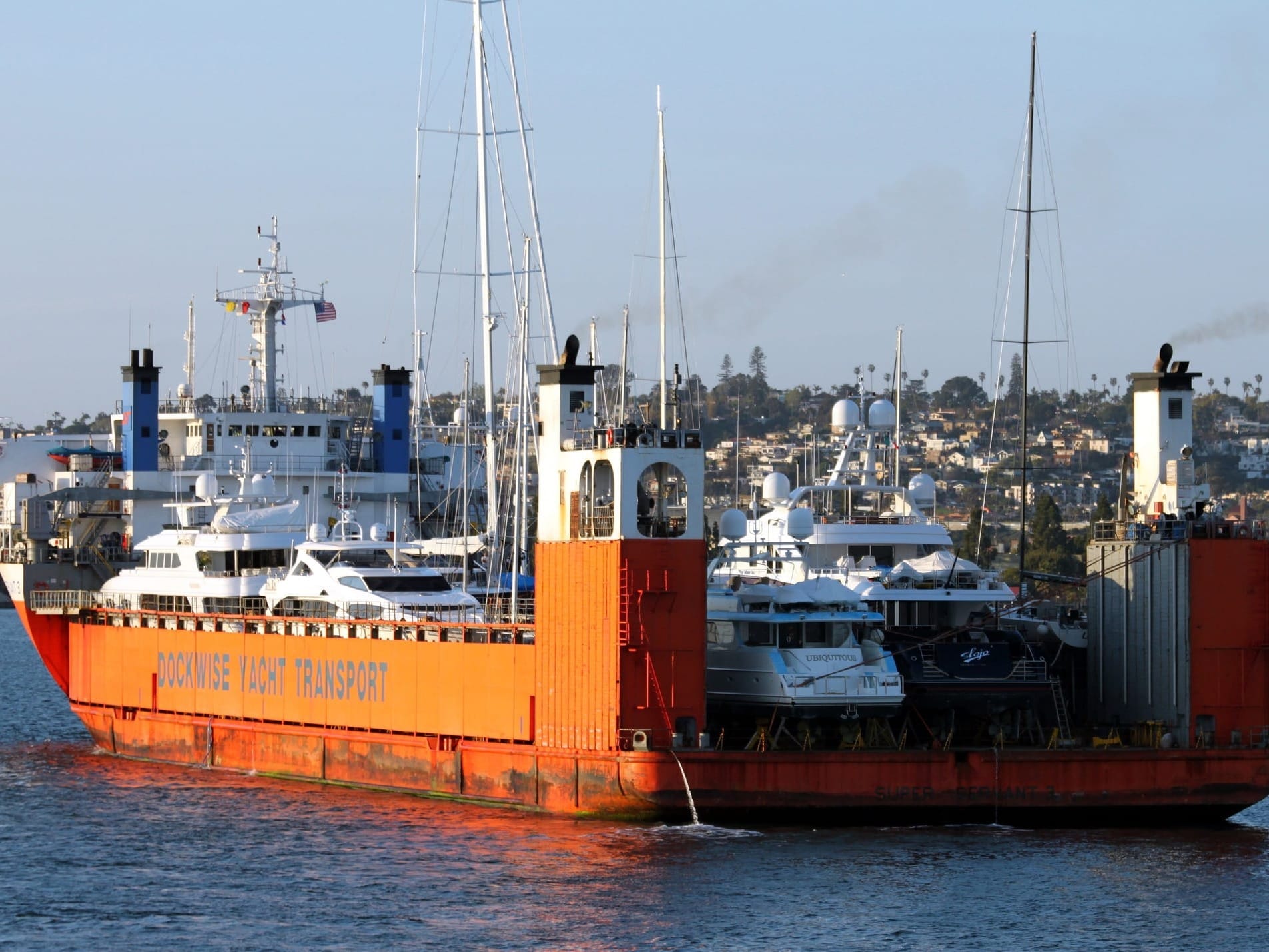
Shipping a yacht means loading it onto another vessel for transport. While it sounds counterintuitive, it is a well-established industry.
Depending on the yacht’s size and configuration, the mast may need to be removed and the boat craned onto a ship’s deck. In other cases, specialized semi-submersible ships take on water, float the yacht aboard, and then lift it clear by pumping out ballast.
Shipping minimizes wear and tear and is generally very safe. It is often more expensive than delivery and tied to fixed schedules dictated by shipping lines.
Trucking
In some situations, moving a yacht by land is the most sensible option.
In Europe, trucking a boat from the French Mediterranean coast to the Atlantic may be preferable to sailing around the Iberian Peninsula, with its exposure to storms, traffic, and—more recently—orca interactions in the Bay of Biscay.
In the United States, moving a yacht coast to coast by sea is a long and complex undertaking. Even the Panama Canal involves significant mileage, delays, and seasonal weather risks. Trucking, by contrast, offers predictability.
This option is generally most practical for smaller yachts—typically under 40-45 feet—due to road and permit constraints.
Conclusions
Moving a boat is never trivial.
It carries financial implications, affects availability and sailing plans, and forces owners to confront uncomfortable questions. Why move the boat rather than cruise it gradually? Why does relocation feel so forced, so inefficient, so disconnected from the idea of seamanship?
Relocating a yacht introduces friction. It is rarely elegant. This helps explain why so many boats end up stranded in the “wrong” place—listed for sale in regions with little market interest, simply because their owners could not find a viable way to bring them back home.
When I first considered buying a boat in New Zealand, the need to move her was a major deterrent. It felt like an unnecessary complication, almost a dealbreaker.
Over time, that perception shifted.
The passage proved manageable. And more importantly, I began to see it as an opportunity—not only to learn the boat, but to learn something about myself. Bringing her back to Canada with a delivery skipper offers a rare chance to experience long offshore passages in a structured, professional context.
It will show me how I respond to distance, fatigue, uncertainty, and responsibility.
And from that, I will begin to form a clearer vision of the kind of sailing—and the kind of relationship with the boat—that might follow.
| Method | What it means in practice |
|---|---|
| Cruising | The owner sails the yacht themselves, moving gradually toward a destination while prioritizing enjoyment and flexibility. Cruising is not a transportation service and is outside the scope of this article. |
| Yacht delivery | A professional skipper (and crew if needed) sails the yacht to a new location. The objective is to protect the asset while exposing the boat to real offshore conditions. Systems are tested, weather windows are conservative, and schedules remain flexible. |
| Shipping | The yacht is transported as cargo on a specialized vessel. This minimizes wear and tear and offers predictable timing, but involves fixed schedules, higher costs, and no real-world testing of the boat. |
| Trucking | The yacht is moved overland on a trailer. This is often the most predictable option for regional relocations or smaller boats, but comes with size limits, de-rigging requirements, and logistical complexity. |
Choosing between yacht delivery, shipping, or trucking depends on cost, timing, risk tolerance, and whether the owner wants the boat to arrive merely transported—or truly tested.
Related Posts
See also
- Yacht Delivery Solutions: The content of this article was influenced by conversations with Nico Curbishley.
- DYT Yacht Transport: Shipping company specializing in superyacht transportation.
- La Route des Bateaux: French trucking company specializing in yacht transport.