
Viewing at the Dock
A quiet first encounter at the dock becomes something larger: not excitement, not certainty, but the sudden awareness that once something becomes real, responsibility follows.

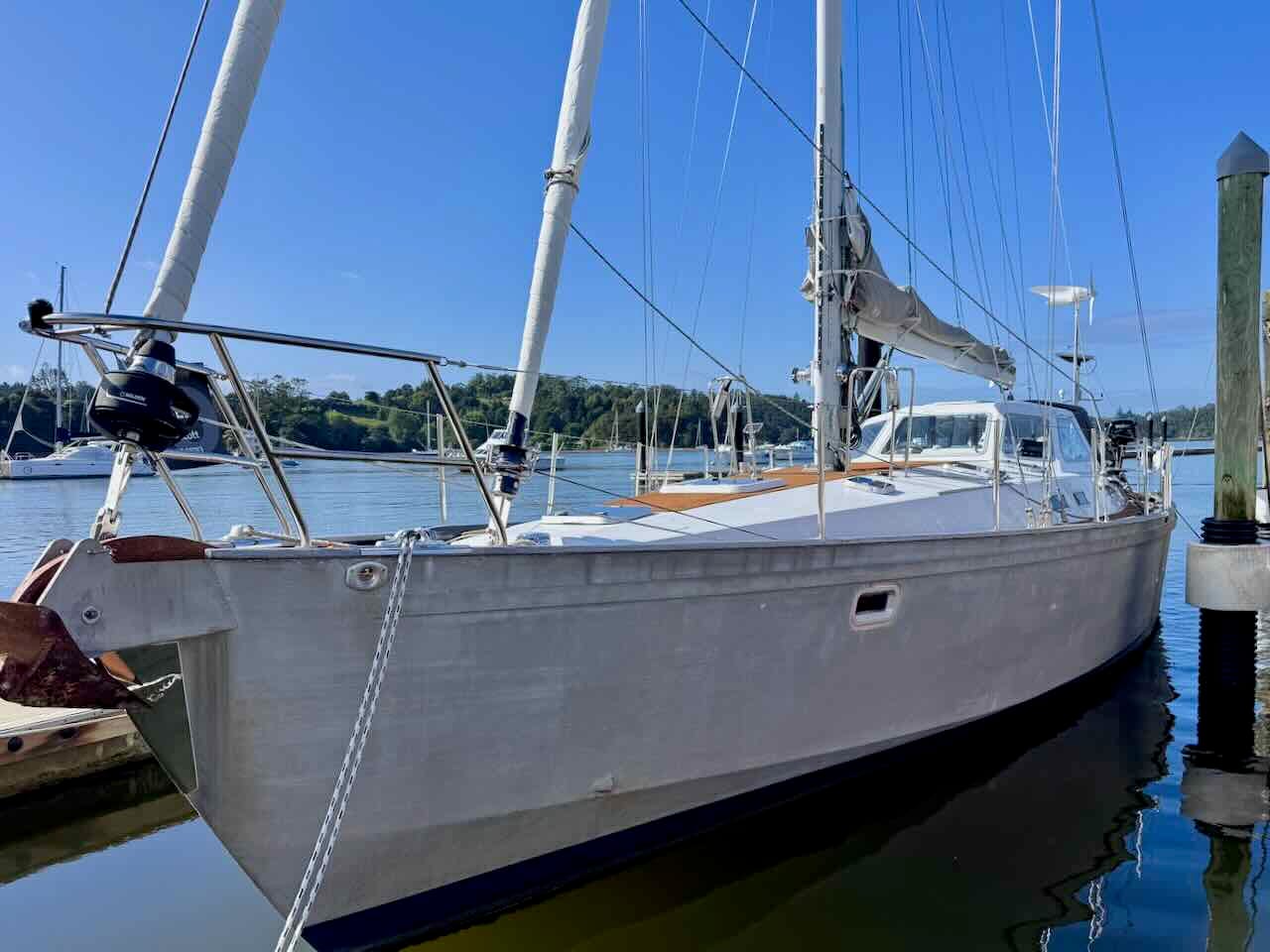
The day after I landed in Auckland, I drove north to Opua, where the boat is located—a three-hour drive. I did not expect to see her until Thursday, the day of the sea trial.
Instead, I was given an unexpected gift.
Tommo, the broker, welcomed me and immediately took me to her dock. Minimal chit-chat. He knew I had come to see the boat, not him. He stayed just long enough to give me access, then left me alone with her.
"Take your time. Stay as long as you need. Come back tomorrow".
No hovering. No sales pitch. Just the keys, a nod, and the quiet permission to meet her.
He had also forwarded me a series of videos prepared by the previous owner for the captain taking care of her while she was on the market. They were straight-to-the-point walkthroughs. Not marketing performances—more like a handover. Watching them, I could tell how much the boat meant to him, and how difficult it was to let her go. The videos were technical and restrained. They assumed some understanding of boats. And yet, they were unmistakably emotional.
Over several days, I came back in blocks of a few hours at a time. I walked through the boat slowly, repeatedly. I listened to her. I opened every compartment I could find. I tried to understand where things lived, how spaces related to one another, how the boat had been organized and used. I wasn’t looking for flaws as much as for coherence.
I kept coming back to the same impression: this boat makes sense.
As I moved through her, I kept thinking: Nice. Smart. Why? Oh—I see. This was a boat designed by smart people who were clear about her mission.
She is almost thirty years old, and she carries history with her. But it is the history of being loved by people who understood sailing, what she meant, what she was built for. Nothing felt neglected. Nothing was out of place. There was no obscene display of wealth. Systems were where you would expect them to be. Choices had been made deliberately, by people who knew what they were doing. None of her three owners had burdened her with nonsensical refits.
And yet, the deeper I looked, the more ignorant I felt.
Each visit left me with a growing sense of mystery. There was so much more to understand than I had anticipated. Eventually, I had to accept a simple truth: there is no way to truly understand a boat like this in a few days. You can inspect, observe, take notes—but understanding only comes from time underway, from small and larger failures, from routine that builds trust.
I would have to decide whether to buy her without understanding her.
The best I could hope for was the assurance that she was worth knowing intimately. But that kind of intimacy would take years to develop.
That realization carried something else with it: responsibility.
This boat has been designed, maintained, and sailed by people who brought real expertise to her—people who came to her after years of experience acquired while racing at the highest level. At some point during those quiet hours on board, the question shifted. It was no longer Is this boat good enough for me? It became Am I good enough for this boat?
Would I rise to what she demands? Would I be a worthy link in this chain of custody? Or is there someone else—more skilled, more ready—who would do her better justice?
The intensity of that feeling surprised me. It wasn’t excitement. It wasn’t doubt, either. It was the sudden awareness that stepping into this role meant accepting responsibility.
It reminded me of the moment I first saw the ultrasound of my oldest child.
Before that image, a child was still a fantasy. A pregnancy test. A data point. A vague predictor of a hypothetical future. A possibility. The ultrasound changed that instantly. There it was—real, visible, no longer abstract.
The reaction was immediate and unambiguous: Oh shit. What are we doing? I am not ready for this.
It was the weight of responsibility. The realization that something precious had been entrusted to you, whether you felt ready or not. The sense that your life was no longer entirely your own. A child had still felt abstract—almost like a line on a résumé. After the ultrasound, it felt like this: This is my life now.
Standing on the dock, looking at the boat, I felt something very similar. Not clarity. Not confidence. Just the quiet understanding that once something becomes visible, responsibility follows.
And life doesn’t stay the same after that.
There is no manual for it.
Related Posts
Recent Posts
See Also
- Tommo Collicot's profile on the 36° Brokers site.