Uncomfortable Miles
Working on climate change has not reduced my carbon footprint — it has increased it. In the quiet hours of jet lag, I wrestle with the uncomfortable tension between engagement and purity, intention and combustion.

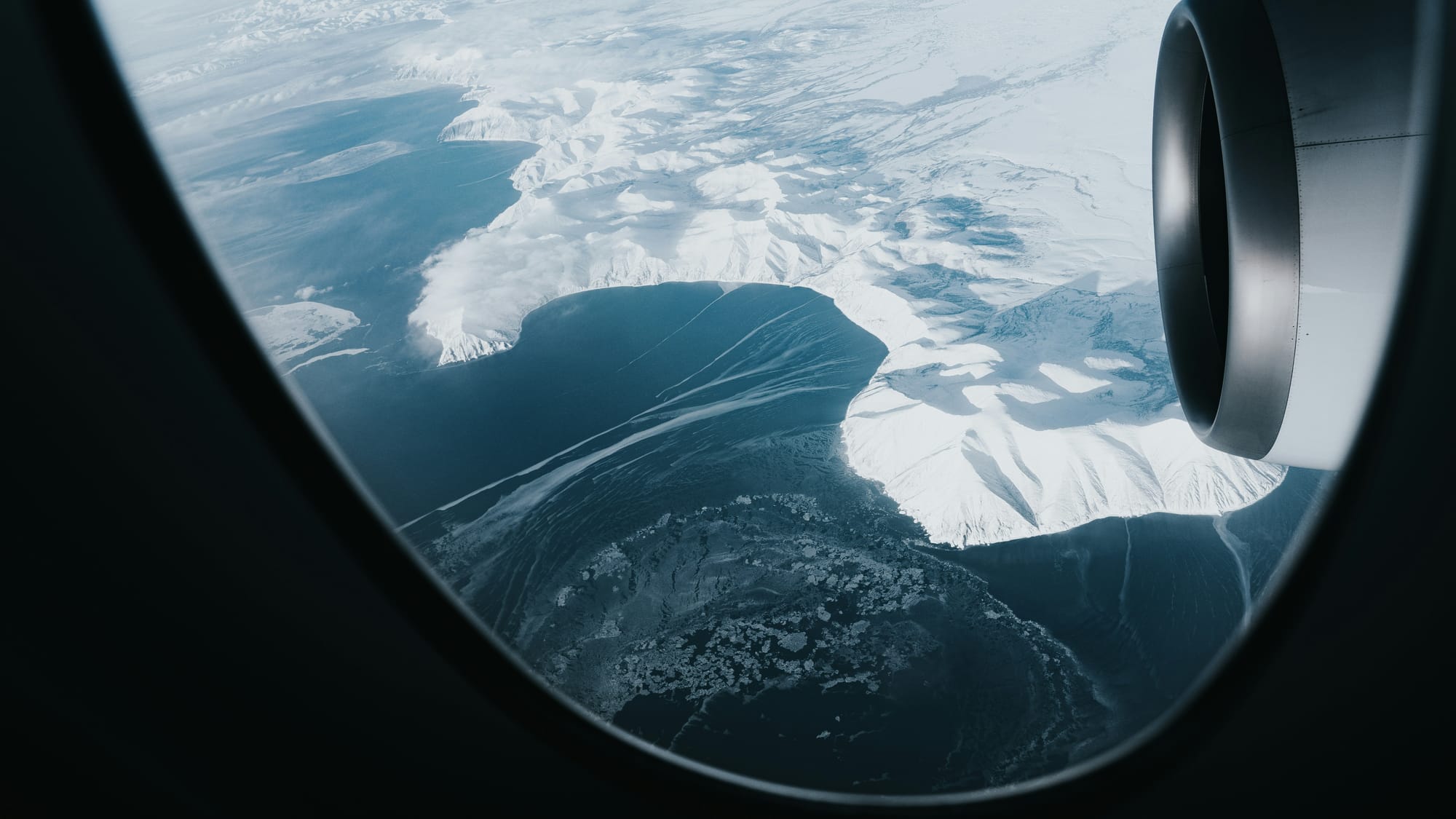
I woke up at 2 a.m. in England.
I am still struggling to digest the twelve hours of jet lag from New Zealand, which I left only a week ago. Hours spent in darkness trying to fall back asleep have a way of letting unresolved issues resurface.
I obviously care about the climate. I left a comfortable academic career. I stepped away from institutional security to work on questions of resilience, responsibility, and uncertainty in a warming world.
I know what I left behind.
I am still unsure what I am building.
I look for validation everywhere — small signs that I am on the right track, indications that I made the right choice.
Instead of validation, I face my own contradictions.
I do not think I have ever flown as much as in the last three months.
- France in December for training and boat visits.
- New Zealand in January to evaluate Rosemary.
- The United Kingdom in February for certifications.
Ice Frontiers now involves stakeholders on three continents, spanning twenty time zones.
Even at 2 a.m., the paradox is obvious enough to make sleep impossible. By working on a global project addressing a global challenge, I am leaving behind a tangible carbon footprint. I may have the best intentions, but miles emit CO₂ that intentions alone cannot absorb.
If I were required to pay the full carbon cost of these flights upfront, the financial burden of simply setting up the project might make it impossible to begin.
I tell myself this is the setup phase. Starting anything is expensive. Perhaps, down the road, this will lead to a more sustainable lifestyle. Sailing is environmentally friendly, right?
There is likely a mixture of truth and wishful thinking in that hope.
Maybe, eventually, I will live in a way that is more environmentally conservative than living alone in a 2,000-square-foot house in the United States. The truth is that I do not know. I may never be able to estimate my real impact on the environment.
I seriously considered other paths.
Staying in one place has always been attractive to me. I loved the COVID years, which relieved us of the pressure to fly around the world to be seen at professional events. There is little I enjoy more than spending days without leaving my house, not going farther than my feet can take me.
- I considered buying a small farm.
- I considered opening a small artisanal bakery in a remote Alpine village.
- I even imagined a monastic life devoted to praying for the world without ever leaving my cell.
Withdrawing into a quieter, local life would almost certainly have led to a smaller footprint. It would have been morally comforting. No jet lag. No 2 a.m. insomnia over emissions.
But I might have woken up with a different question: can a global problem be addressed only through local withdrawal?
There is no clean position.
Each path carries uncertainty. Each carries a compromise. Each carries some form of guilt — for not doing more, for not doing better, for simply existing at the expense of others.
I accrue a debt I cannot measure. There is no carbon banker keeping me accountable. There is no credible way to calculate whether whatever emerges from this project will ever “offset” its cost.
So, there is no morally safe position.
Withdrawal may be too comfortable.
Engagement may be a form of denial.
Both carry weight. Risk. Uncertainty.
So I drag these miles with me. I try to remind myself that my frequent flyer status is neither a badge of honor nor a reliable measure of guilt. The miles are part of the cost of choosing to act within a system none of us designed.
The discomfort is real. It should be. If working on climate change feels frictionless, something is missing.
Every mile I fly remains an open question.
Related Posts
 Jean Peccoud
 Jean Peccoud
Recent Posts
 Jean Peccoud
 Jean Peccoud