Not Experiencing the Climate
A winter that never arrived. A snowpack collapsing below anything on record. We experience weather, not climate — until something breaks. And by then, it may already be too late.

The Colorado ski season never really started this year. The lack of snow could not be ignored, even by non-skiers. It was a dry, warm winter.
At first, it felt like a missed opportunity — a season that never quite materialized. For those of us who orient our lives around winter, it felt more like heartbreak. But at some point, you cut your losses and tell yourself that next year will be better.
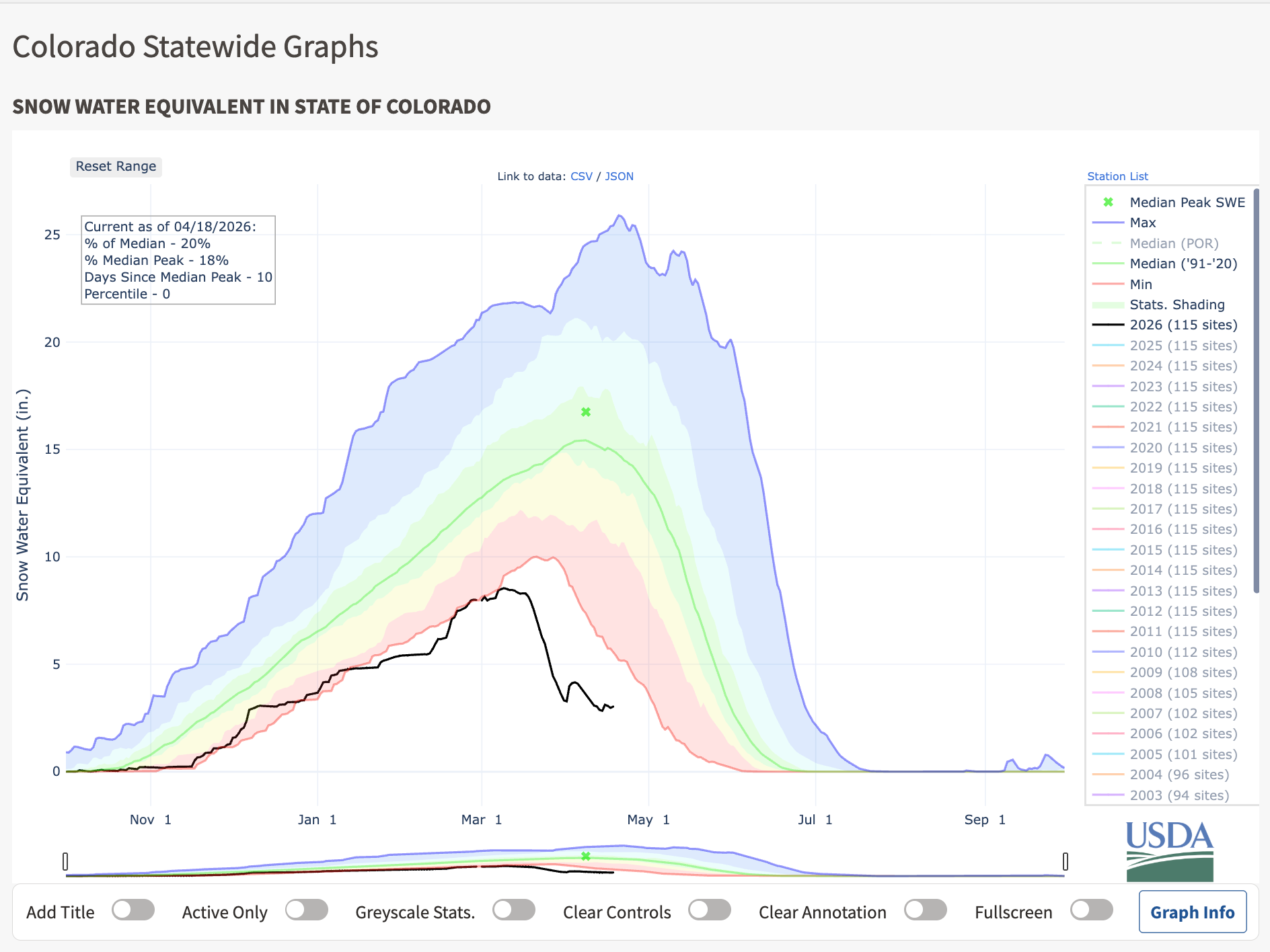
This winter starts to look different when you look at the snowpack data published by the USDA.
The year began dangerously close to the lowest levels ever recorded. By January, it had already fallen below them. And then, in March, the snowpack collapsed — far below anything on record.
I shared this chart in a climate science group on Facebook. I thought I was looking at climate. Someone told me I was only looking at weather.
For a moment, I wondered if I had made a rookie mistake.
Climate is not something we feel. It’s a statistical construct — decades of weather compressed into averages, variability, and extremes. By that definition, a single season is just weather.
And yet, something feels off about dismissing it so easily.
When an entire season falls below everything we have observed before, it's not longer noise. The boundaries themselves are shifting.
There are ways to make that signal disappear. You can zoom out in space — point to the Alps, where the ski season was excellent this year. But that move — zooming out until the signal disappears — comes at a cost.
It produces smaller numbers that are impossible to feel. The difference between 1.5°C and 2°C does not change how you dress in the morning. And yet it determines the conditions of life on Earth.
Recently, I asked people a simple question: what is your personal experience of climate change?
Most struggled to answer.
That comment on Facebook helped me understand why. We are not wired to perceive climate. We don’t feel statistics. We experience weather — the day, the storm, the good season, the bad one.
Climate only becomes visible at the edges, when something lands out of the range we expect.
And that’s the part that scares me.
Because we behave the same way in our own lives.
We ignore the slow signals. The small deviations. The things that don’t quite feel right but are easy to explain away. Another drink. Another expense. Another silence. Another season that didn’t quite work.
And then one day, it breaks.
A divorce. A heart attack. Bankruptcy.
We act when the system fails, not when it starts to drift.
It’s not a personal flaw. It’s how we are built. But it doesn’t bode well when the system we are drifting through is planetary.
I had underestimated how hard climate is to perceive.
It doesn’t live in our senses. It lives in charts and computer models.
Which is why ice matters.
Glaciers and sea ice integrate weather over years, decades, centuries. They accumulate the signal and make it visible in a way that we can actually perceive.
A retreating glacier doesn’t argue. It leaves a void.
You don’t need statistics to understand absence.
Maybe that’s why we need to go see them.
To remember what they were.
To see what they have become.
To carry that image with us.
So that we don’t tell ourselves it’s business as usual.
So that we remember what it looked like when it wasn’t.
Related Posts