
Le Glacier du Tour
The Glacier du Tour was the first glacier I ever set foot on in 1979. A recent photograph made me realize that the icy world that shaped that memory is rapidly disappearing from the landscape above Le Tour.

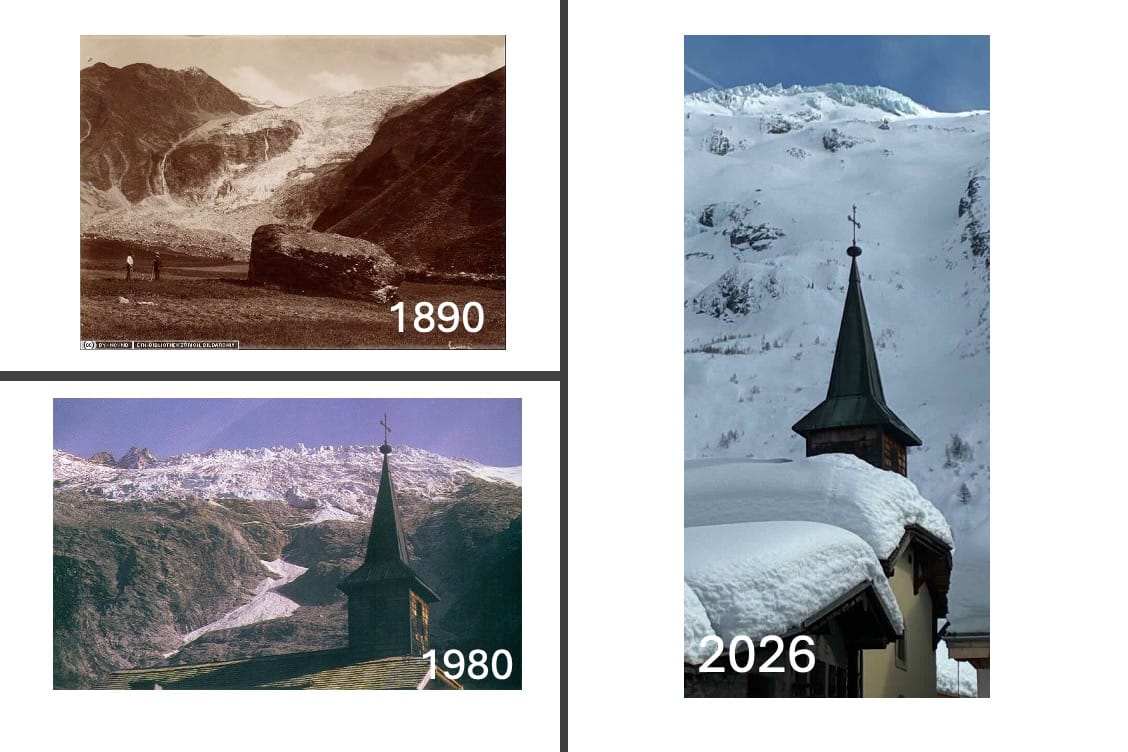
Recently, a friend sent me a picture from her spring break vacation in the Chamonix valley (the 2026 photo). I immediately recognized the Glacier du Tour.
This glacier is very special to me. It is the first glacier I ever set foot on, during the summer of 1979, after finishing ninth grade.
Unlike the more famous glaciers in the Chamonix valley—such as the Mer de Glace or the Glacier d’Argentière—the Glacier du Tour does not descend all the way into the valley. It has always hung above the village, suspended between rock and sky.
I was relieved to see that the glacier could still be seen from the valley. In fact, I was pleasantly surprised. The abundant snowpack makes it difficult to see exactly where the glacier ends today, but it is clear that little ice remains below the seracs along the ridge.
Since I have not been back since 1979, my memory is closer to what appears in the 1980 photograph. At that time, a broad blanket of ice covered the slope. It felt like an invitation to exploration. Standing at the edge of the glacier, it was easy to imagine that if you kept climbing, there would be a different world up there—an icy world so large it seemed to overflow into the valley.
The small rim of ice that remains today sends a very different message.
Looking at the picture, I felt an unexpected sadness. Not the shock of seeing something suddenly destroyed, but the quiet realization that the place that gave me such a formative experience is no longer what it used to be. The glacier seems to be withdrawing, hiding behind the ridge like an animal retreating into its den.
What once felt like a complex world of ice movement now feels like a historical record—something distant, almost as difficult to relate to as the photographs of the glacier during the nineteenth-century Little Ice Age.
I wonder what it feels like to live in the village of Le Tour today, now that its namesake glacier is slowly disappearing from view. It used to feel like an outpost at the edge of an ice frontier. Today it is a small hamlet with a large parking lot, serving hikers in summer and skiers in winter.
Perhaps the magic is still there for those discovering the place for the first time.
But for those of us who remember the glacier spilling down the slope, the landscape now tells a quieter story—one of mourning for a time when exploring icy worlds was a formative experience a teenager could have a couple of hours from home.