How Big is The Pacific?
A 6,000-nautical-mile voyage from New Zealand barely reaches Alaska — a distance that spans Two maps reveal the true scale of the Pacific.

When I flew back from New Zealand in February, I remember watching the flight map slowly creep toward Hawaii. Even at jet speed, it felt like it was taking forever to get there. It’s a long flight, about 12 hours. But Hawaii sits in the middle of the Pacific. You’d think it’s just around the block.
Maybe. But it’s a very big block when, six hours into the flight, you are nowhere near Hawaii.
Thinking about sailing to Hawaii from Opua, I was struck by a simple thought: that’s a very long way for a first stop.
For months, I kept recalculating the distance of the voyage I am preparing. I used Google Maps, Savvy Navvy, and Garmin Navionics. No matter how I approached it, the numbers always felt too large to be correct.
- New Zealand to Hawaii: ~4,000 NM (7,400 km)
- Hawaii to Alaska: ~2,000 NM (3,700 km)
- Opua to Valdez: ~6,000 NM, give or take — about 11,000 km
Each time, the numbers felt off. Too large to be correct. Too large compared to distances I am more familiar with.
But they are correct.
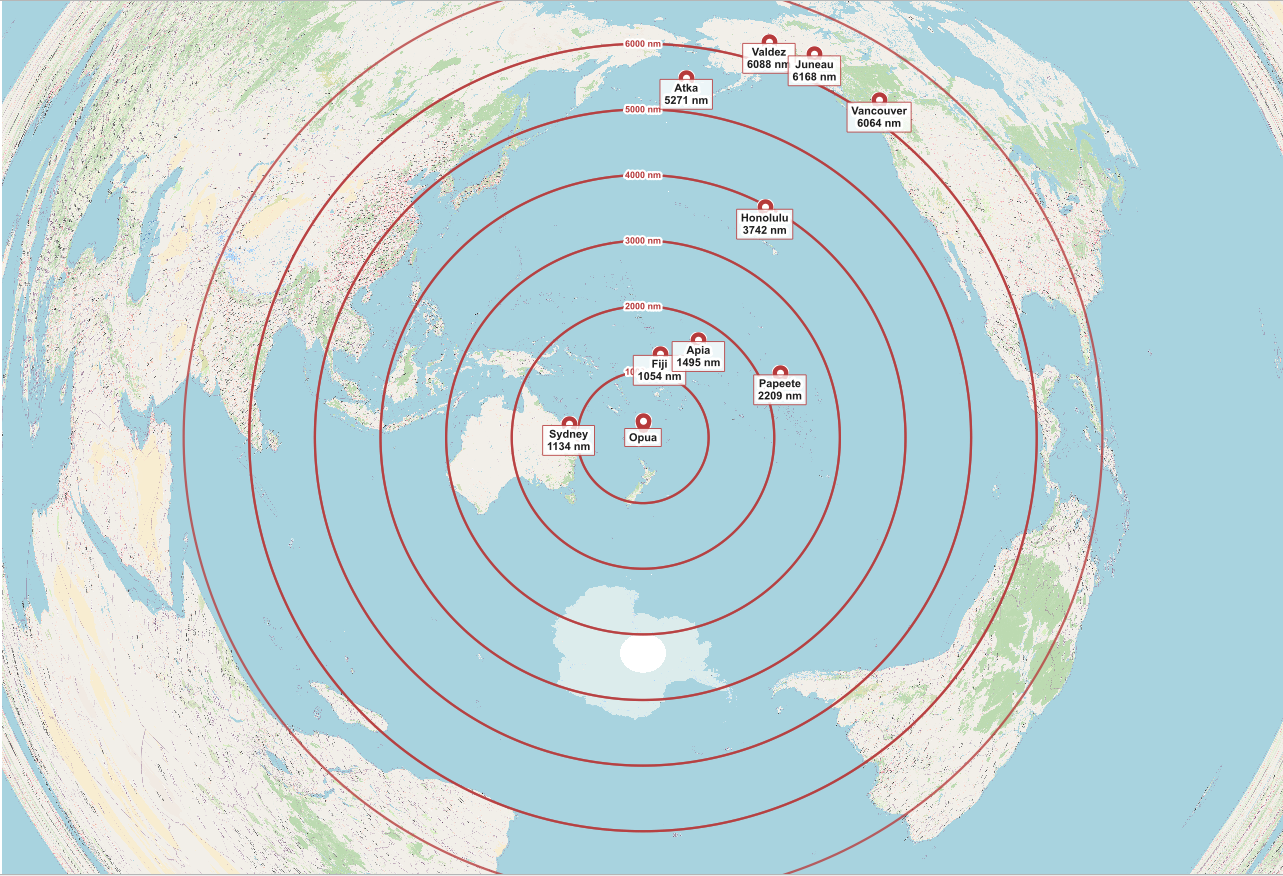
So I drew it. I had to see these numbers to believe them.
The map above is centered on Opua, where we will depart from. The circles show distances every 1,000 nautical miles. I also labeled some landmarks: Fiji, Apia in Samoa, and Papeete in Tahiti. These could be stopping points on the way to Hawaii if the boat or the crew needed a break.
And then I added a few locations we may visit in Alaska later this year.
There is no escape between Hawaii and Alaska.
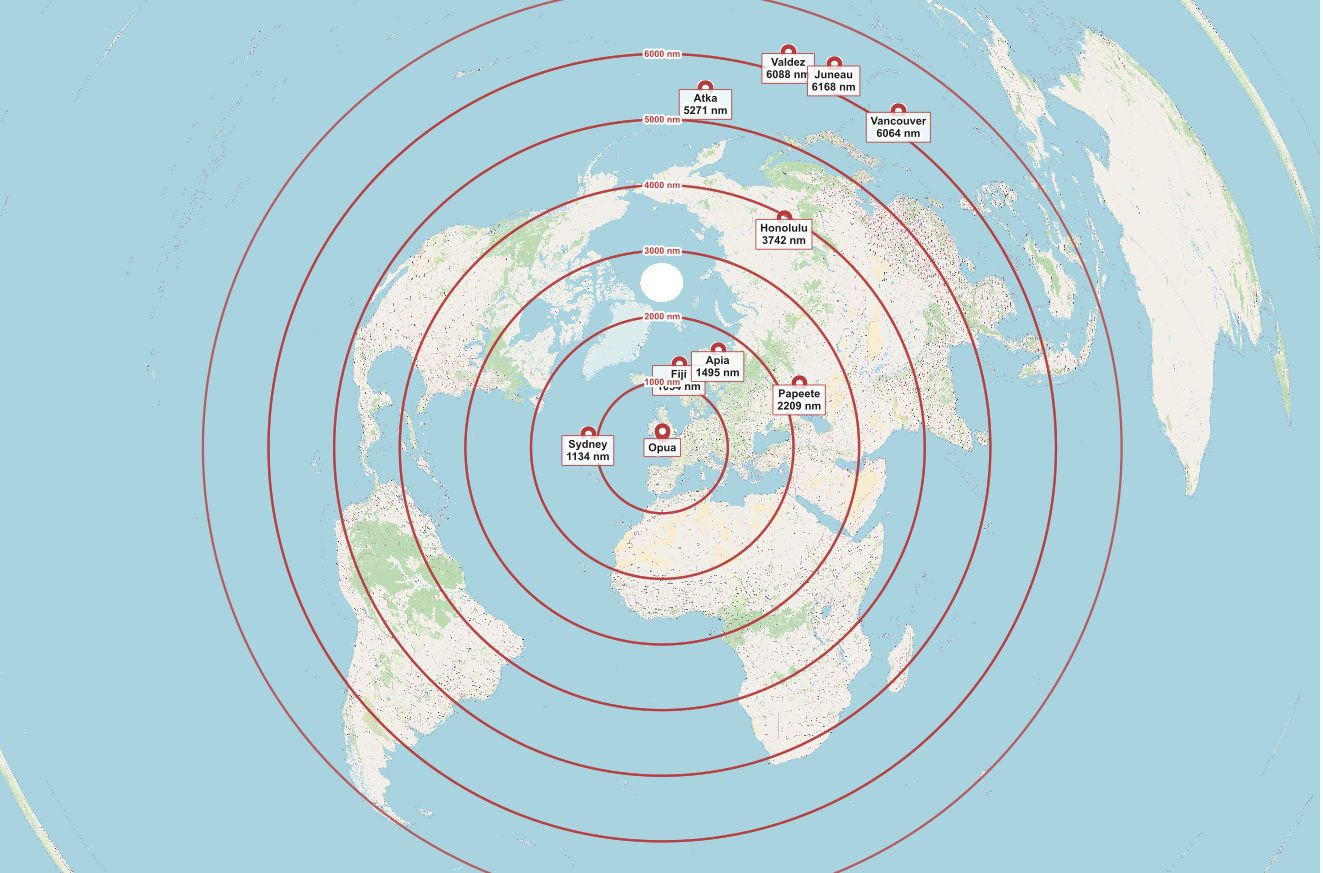
The second map uses the exact same circles and landmarks, but centered on Brest, at the western end of France.
There is a reason for that choice. When I was looking for a boat in December, I focused on this part of the world. From Brest, arctic waters are remarkably close: Iceland, Greenland, and Svalbard. And there are stepping stones along the way — the British Isles, the Faroe Islands, Norway. The ocean there feels structured, connected, approachable, manageable, and inviting.
Four thousand nautical miles from Brest brings you to Brazil, Angola, or India, depending on the direction. Six thousand nautical miles takes you to Buenos Aires, somewhere between South Africa and Antarctica, Singapore, or even close to Hawaii.
It is striking that Anchorage is about 4,000 NM from Brest, but nearly 6,000 NM from Opua. It does not feel that way.
Six thousand nautical miles from New Zealand barely reaches another continent.
It feels closer to Opua because it's just across one body of water, which sounds simple.
This is a very large body of water.
The Pacific covers about 32% of Earth’s surface. All land combined covers about 29%. One ocean is larger than all the continents combined.
Starting from Opua and starting from Brest offer very different perspectives.
Brest sits not far from the geographic center of landmasses. From there, a 6,000 NM circle crosses continents and civilizations. It feels rich, known, and connected. Six thousand nautical miles from Western Europe crosses most of the known world.
From New Zealand, the same distance barely reaches another continent. It only crosses emptiness.
I did not fully grasp the scale of the Pacific until I started putting these numbers together — checking, rechecking, drawing maps — and trying to make peace with a quiet cognitive dissonance between the distances I am used to and the space the Pacific offers to someone with a boat.
And now I find myself wondering what it will feel like to cross it.
Six thousand nautical miles of open ocean. Hardly any land. No stepping stones to reassure me as I make my first offshore passages. Just time, weather, and the slow movement of a boat across the surface of the planet.
It is difficult to imagine. I am still working on accepting these numbers. When we cast off, I will have to trust that moving at the slow pace of a sailboat will eventually get us to a place where there is land, food, and people.
But it may also be an opportunity — to let go, to focus, to recenter.
At some level, a long offshore passage is an act of faith.
Related Posts
 Jean Peccoud
 Jean Peccoud
Recent Posts
 Jean Peccoud
 Jean Peccoud
 Jean Peccoud