Fuel Management Offshore
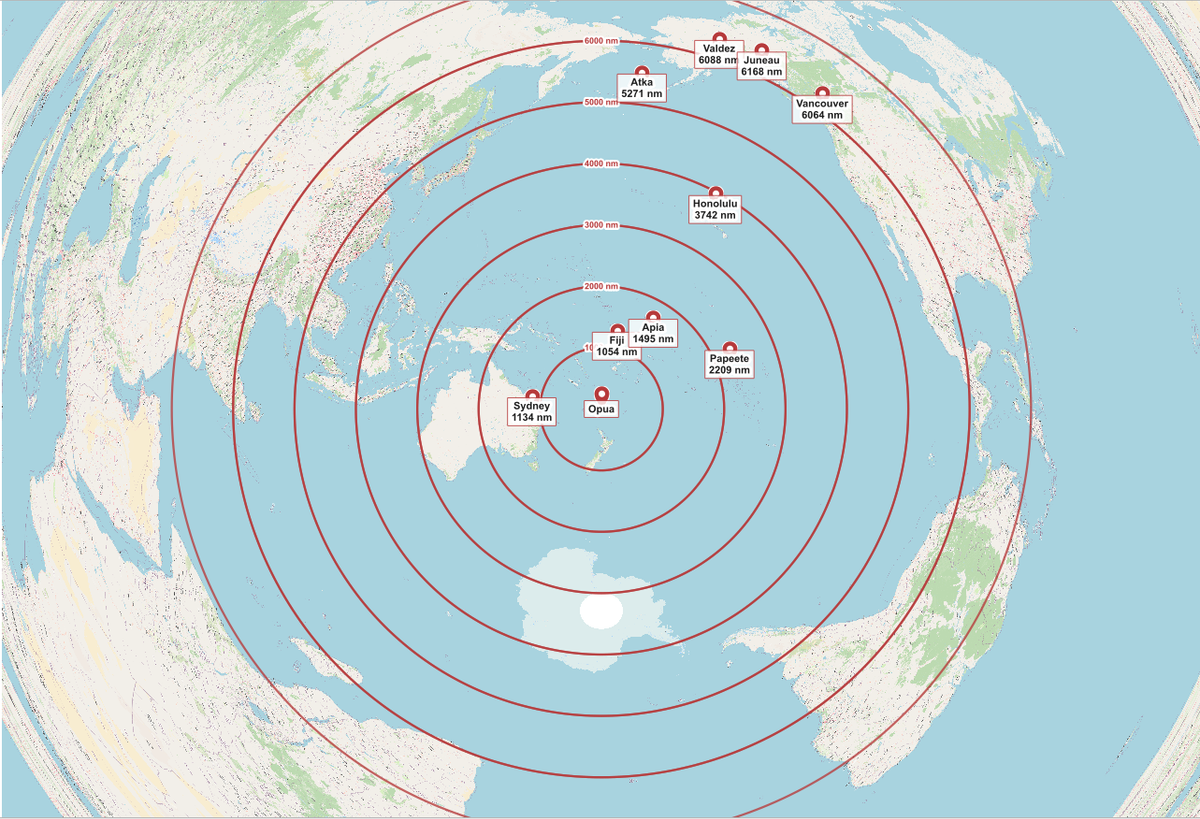
Learning to manage fuel is a core part of flight training. Offshore sailing has no equivalent discipline — and on a 1,800nm passage from Noumea to Majuro, I found out what that costs.

Learning to manage fuel is a core part of flight training. As an instructor, I taught students to read power curves — maximum power, best economy, range at different settings. Before any cross-country flight I checked their fuel calculations: expected consumption to destination, to the alternate, reserve on arrival, whether topping up would push them over max weight. In flight, I watched them lean the mixture to hit the numbers. The discipline was non-negotiable. Fuel exhaustion is one of the most preventable causes of aviation accidents. It is also, consistently, one of the most common.
Even my old truck has advanced fuel management tools. It tracks consumption in real time, gives range estimates, and warns me forty miles before I'm walking. If I miscalculate anyway, I call AAA.
Adak has a complex fuel system: 2,000 liters across three main tanks — two laterals and one in the keel — plus two day tanks, fed by a turbocharged John Deere developing 150 hp, a large and capable engine by sailboat standards. I arrived aboard expecting something like aviation discipline. I found a different reality. The engine manual offered no power curves, no fuel flow figures at any RPM. One gauge didn't work. None showed evidence of calibration. There were basic engine instruments in the cockpit — temperature, oil pressure — but no fuel computer, and no integration with the navigation system.
Everyone told me this was fine. In sailing, the culture treats fuel management as a secondary concern because the engine is auxiliary — the wind is the plan, diesel is the backup. It gets you in and out of the dock. That's about it.
On an expedition boat, this is the wrong framework. Many expeditions — the Northwest Passage being the obvious example — require motoring hundreds of miles between refueling points. And diesel on a boat like Adak isn't just propulsion. While many bluewater sailboats have turned to solar, expedition boats typically rely on diesel to charge the batteries through the engine or a generator. The batteries run navigation, communications, lights, autopilot. The watermaker runs off the same system. Diesel also keeps you warm. Running dry doesn't mean you lose the engine. It means you lose the boat's ability to function — incrementally, then completely, with no one coming to help.
The passage
We thought we left Noumea with 2,000 liters across three tanks — 1,000 in the keel, 500 in each lateral. If I'm honest, I'm not entirely sure I topped them off. We've since learned that 100% on the gauge doesn't mean the tank is full. But I didn't care about the details. I felt I had far more fuel than I needed.
1,800 nautical miles to Majuro. Very little wind. We first used the engine freely — any time boat speed dropped below 7 knots, we motored at 2,000 RPM. We had 2,000 liters. We had plenty. The boat felt powerful. We were making big waves and felt so proud to have so much engine under us.
Halfway, that feeling started eroding. The gauges seemed to be moving faster than they had. And before we knew it, all three tanks were in the 10–20% range. The math that had felt comfortable started feeling constrained.
That's when we started thinking about fuel management — and realized how much we didn't know. We had no baseline to tell us whether we were two days from empty or five. We didn't know if the gauges were linear. We had no idea about fuel flow at different power settings (Yes, I read the engine manual at sea, not before leaving).
And we didn't know how low we could run the tanks. What would happen if one ran dry? Would air enter the fuel line and kill the engine? Bleeding a diesel fuel system mid-passage was not an appealing prospect.
Two decisions followed.
First, we experimented with the fuel lines. Diesel engines draw more fuel from the tank than they burn; the excess returns to the source tank. We redirected that return line into the keel tank, drawing simultaneously from the keel and one lateral. We ran it for a few minutes, then stopped — unsure of what we were doing. The next morning, the lateral was empty and the keel tank had risen. We had accidentally primed a siphon, which had continued running overnight. Unintended, but useful: instead of three tanks approaching empty, we had one tank with real depth. Air ingestion risk dropped. The psychological effect was immediate.
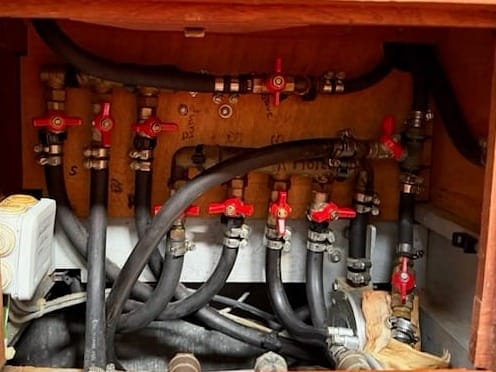
Second, we stopped burning fuel casually. Not an emergency — a recalibration. We sailed when we could sail. We motored when we had to. We did not exceed 1,600 RPM because that's when we were starting wasting energy in producing waves without any speed gain. The math started to close.
We made Majuro.
Refueling
Another mistake I made leaving Noumea was assuming fuel would be available at the other end. There is no marina fuel dock in Majuro. Sailors with small tanks walk to a gas station with jerrycans. If you need 200 liters, this is annoying. If you need 2,000, it's not an option.
There is commercial bunkering infrastructure — for cargo ships and fishing fleets. This is not a place where you swipe a card and walk away. I needed a quote, sourced not from anyone local but from a broker in San Diego. Once issued, I prepaid the order. On bunkering day, walking near the fuel terminal, I realized I had bought fuel from a broker with no local presence. The local operator, once located, informed us we needed a bunkering permit from the port authority. The port authority sent us to the EPA, who needed to monitor the operation to ensure no spill. Then back to the boat — waiting, waiting, waiting — while the local operator searched for a 2-inch fitting to connect to the underground pipeline.
We filled the tanks slowly, then slower still, until they were actually full. 518 gallons. 1,960 liters — uncomfortably close to our total capacity.
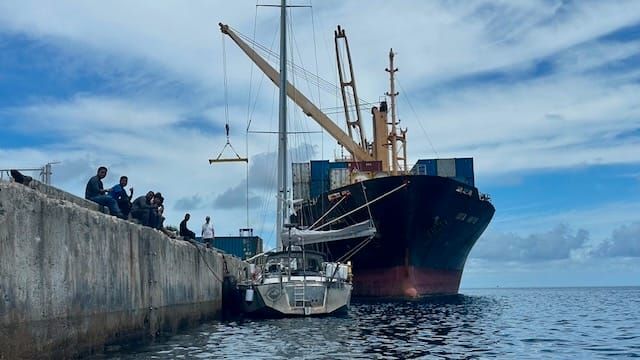
As the process unfolded, we became a local attraction. Nobody working that dock had seen a sailboat stop for fuel. Their regular clients are large cargo ships, like the one refueling beside us. Curious, I asked how much it was taking on.
60,000 gallons.
I had never confronted fuel on this scale before. Not as physical reality — the hose diameter, the pipeline infrastructure, the sheer operation required to service a vessel that size. And not as an ethical one.
We had burned through our supply carelessly, lulled by the feeling of plenty, and ended up dependent on a system built for an entirely different order of consumption. Five hundred gallons is roughly what I use in six months refueling my truck. But that experience is sanitized. You swipe, use your points, check your phone, grab groceries. You never see the fuel. The car and the family have what they need for the week and you move on.
In Majuro, the process took days of preparation and half a day of hard labor. Diesel seeped from the ground. The hoses were heavy. Nothing was hidden. It was industrial, physical, present.
Confronting it, I felt guilty. Part of me had enjoyed pulling it off. But something deeper had shifted. I had not resisted the seduction of a big engine attached to a big tank. The engine and the tanks are justified — this is an expedition boat, not a weekend cruiser. But I had lost sight of how they were meant to be used, and I paid for it. The fuel cost $5,000, a bill I won't forget quickly. Beyond that temporary discomfort is a deeper one: the feeling of having been careless. The boat got into trouble. The project lost moral authority.
Standing on that dock next to a ship taking 60,000 gallons, I understood something I hadn't before. The illusion of plenty is universal. It is the logic of the whole system. In Majuro, it became visible — to myself, at least — by needing 518 gallons I had no right to waste.
Related Posts
 Jean Peccoud
 Jean Peccoud
 Jean Peccoud