
New Zealand to Alaska Sailing Routes
Sailing from New Zealand to Alaska means navigating across hemispheres, seasons, and weather systems. We chose an unusual route through New Caledonia and the Marshall Islands to leave tropical waters quickly and reach the North Pacific storm track before hurricane season intensified.

New Zealand and Alaska are about 6,100 nautical miles (11,400 km) apart in a straight line, from Auckland to Anchorage. Sailing there takes longer: our route from Opua to Dutch Harbor via New Caledonia and the Marshall Islands measures about 5,700 nautical miles (10,500 km) on the chart, and came to more than 6,000 miles in practice.
Most people sailing from New Zealand to Alaska in a single season eventually run into the same problem: the calendar.
Cyclone season in the South Pacific typically runs from November through April, which means departures from New Zealand usually happen in April or May. In the North Pacific, hurricane season officially begins in June, with occasional early activity appearing even sooner.
Few sailors want to spend weeks crossing tropical waters while hurricane activity is increasing around them. As a result, there is a relatively narrow window when the Southern Hemisphere cyclone season is winding down while the North Pacific season has not yet reached full strength. Interestingly, the reverse transition at the end of the year is much less forgiving.
The challenge is simple: how do you get from New Zealand to Alaska while making the best use of that window?
The Hawaiian Route
The route most sailors suggest is Fiji and/or Tahiti, then Hawaii, then Alaska.
The advantages are obvious. The legs are shorter, the ports are well developed, and support infrastructure is readily available. Many sailors complete this route successfully every year.
The problem, at least for a boat trying to reach Alaska in a single season, is the wind.
Most of the easting required to reach Hawaii is made against the trade winds. Trade winds have a reputation for comfortable sailing, but that reputation assumes you are sailing with them, not into them. Spending weeks close-hauled in 20–25 knots of wind is a very different experience.
There is also a timing issue. A boat can spend weeks in the Southern Hemisphere before crossing the equator, delaying its arrival in the North Pacific just as hurricane season begins to gain momentum.
The route works. The question is whether it is the most efficient way to reach Alaska within a single season.
The Japanese Route
Another route sometimes suggested is through Japan and then along the Aleutian arc toward Alaska.
It is a fascinating route culturally and geographically, but it is a project in itself rather than a straightforward delivery strategy.
The route is longer, making it difficult to complete within a single season. Reaching Japan early enough to avoid the developing typhoon season would generally require leaving New Zealand earlier than many sailors would consider prudent. At the same time, the Aleutians are still emerging from their winter weather pattern.
The challenge is that the favorable windows do not overlap particularly well.
Add multiple international clearances and the practical complexities of cruising in Japan, and the route becomes something different from a simple passage. It becomes an expedition with its own objectives. That may be exactly what some sailors want, but it is a different proposition.
The Direct Route
We chose a route that very few sailors seem to consider.
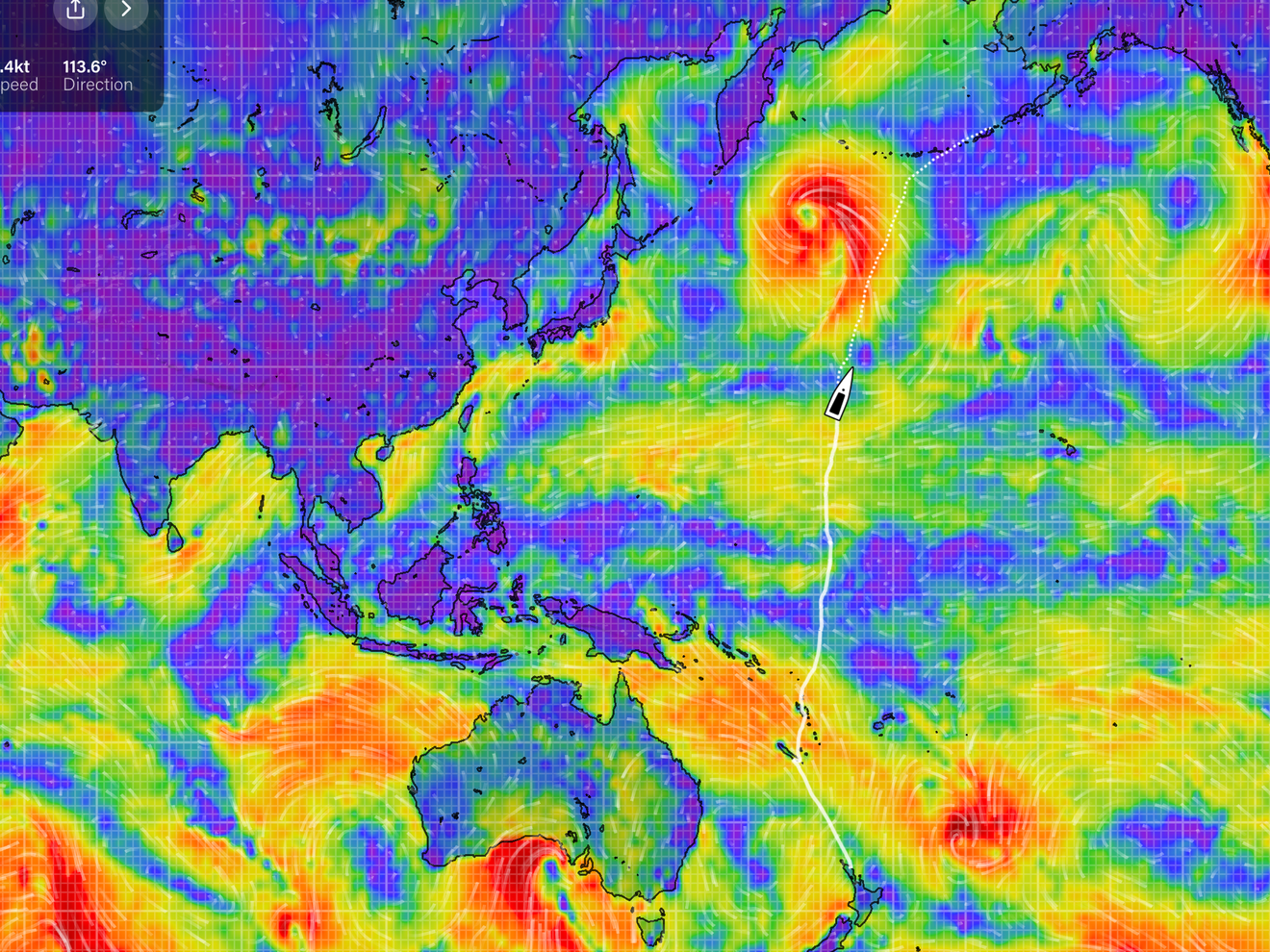
New Zealand. New Caledonia. Majuro in the Marshall Islands. Dutch Harbor in the Aleutian Islands.
| Leg | Distance |
|---|---|
| Opua → Nouméa | ~880 nm (1,630 km) |
| Nouméa → Majuro | ~1,800 nm (3,300 km) |
| Majuro → Dutch Harbor | ~3,000 nm (5,600 km) |
| Total | ~5,700 nm (10,500 km) |
[END MARKDOWN CARD]
The logic was simple: leave the tropics as quickly as possible.
Instead of spending weeks working east against the trade winds, we would head north, exit the hurricane belt before the North Pacific season became active, and then use the prevailing westerlies to carry us east toward Alaska.
Nouméa was the natural first stop. At roughly 880 nautical miles from New Zealand, it was close enough to identify problems before committing to the longer legs ahead.
From there, Majuro lies almost due north. The passage through Vanuatu is particularly enjoyable because the mountainous islands create large areas of protected water and interesting coastal scenery.
Majuro, the capital of the Marshall Islands, was effectively our only practical option for fuel and provisions before Alaska.
From there, the route continues north until it reaches the North Pacific storm track. Depending on timing, the optimal route may even follow the Aleutian arc westward for several hundred miles before arriving in Dutch Harbor.
We received significant pushback when discussing this route with other sailors.
Some argued that the 3,000-nautical-mile leg between Majuro and Dutch Harbor was simply too long. Others worried about crossing regions where tropical systems can organize, making weather forecasting more uncertain.
Before committing, we decided to pressure-test our assumptions by commissioning a climatology study from Weather Routing, Inc. Their analysis concluded that, at this time of year, the route was reasonable.
So far, the voyage has unfolded largely as expected.
The passage between New Zealand and New Caledonia was the most demanding. We spent several days on a broad reach in 25–35 knots of wind with seas approaching four meters. We moved quickly, but it was an energetic start.
Between Nouméa and Majuro, the opposite problem emerged. We encountered very little wind. We ran the engine for more than 200 hours and burned nearly 2,000 liters of diesel—hardly a point of pride on a sailing voyage.
The surprise came in Majuro itself, where refueling proved considerably more complicated than expected.
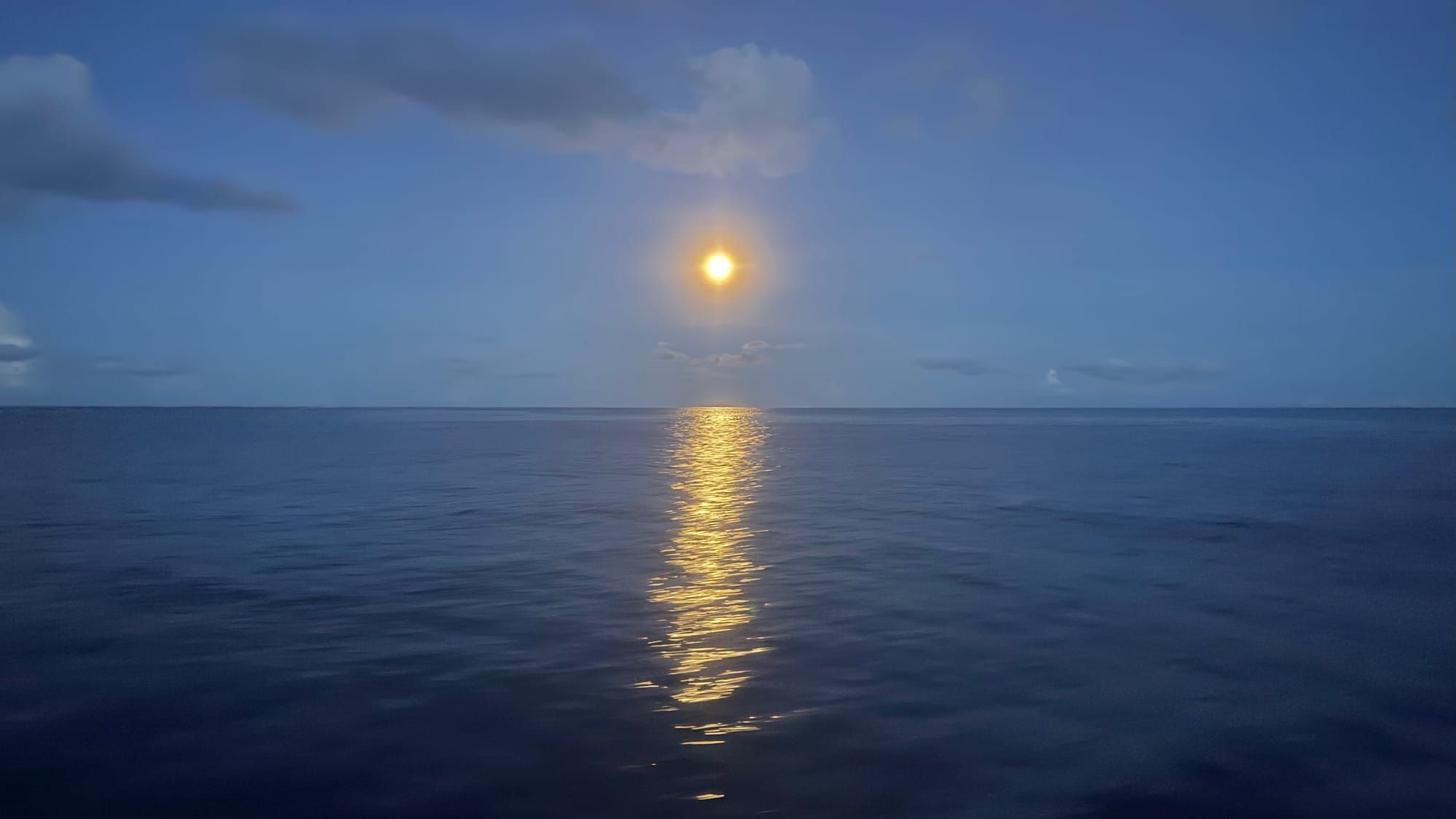
Since leaving the Marshall Islands, conditions have been remarkably benign. We have spent much of the passage on a beam reach in 10–20 knots of wind and relatively gentle seas. Naturally, we still complain that the boat is not averaging 200 nautical miles per day and moves too much, but by any reasonable standard it has been a pleasant passage.
As I write this, we are in the calm before the first significant North Pacific system.
We are working to bring the engine back online before joining the conveyor belt of depressions that should carry us toward Dutch Harbor. The approaching cold front may bring gusts approaching 40 knots, but it appears relatively short-lived. If the forecasts hold, we should cover the remaining 2,000 nautical miles in roughly ten days.
It is not a route many sailors recommend.
On AIS, we saw a handful of sailboats between New Zealand and New Caledonia. One near Vanuatu. North of the Marshall Islands we encountered a Chinese fishing vessel and a container ship. Not a single sailboat.
When clearing customs in Majuro, an officer told us they see roughly ten sailboats a year. We were surprised because it seems to be a wonderful place to explore; we wished we could have stayed longer.
So we are crossing the Pacific well off the beaten path.
We may discover flaws in this strategy before reaching Alaska. Offshore sailing has a way of exposing bad assumptions.
But so far, the route has behaved remarkably close to what the climatology predicted.
It may not be the route most people choose.
It may simply be the route that fits the season.
Related Posts
 Jean Peccoud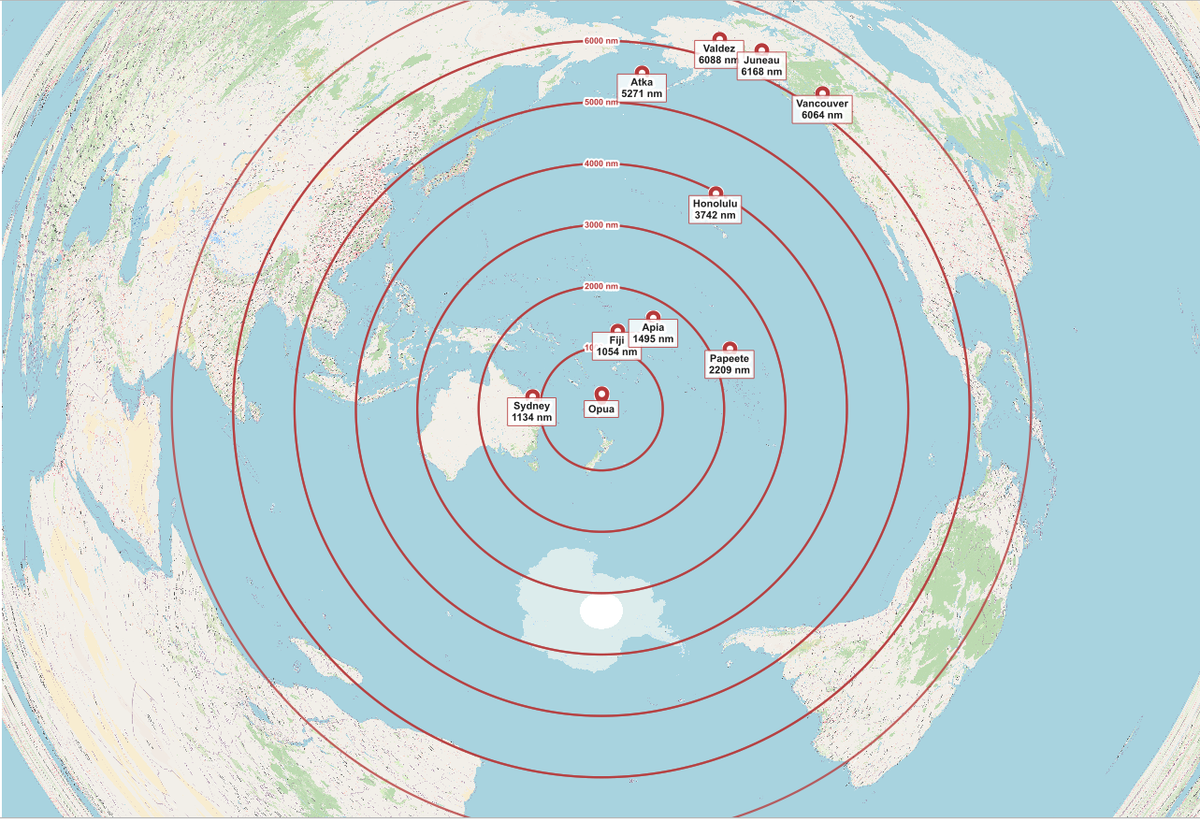
 Jean Peccoud
See Also
 Weather Routing Inc.