Traveling Light
Moving aboard a sailboat meant deciding what truly needed to come along. The harder question was what parts of a previous life I was still carrying.

Adak weighs between 17 and 30 tons, depending on how you count. She is not a light way to move through the world. But she is also finite. Space is constrained. Everything that comes aboard displaces something else.
Each object raises the same question: does it need to be there?
The question sounds practical. It isn't.
When I was running a lab, I learned to keep a lean inventory by introducing certainty into operations. Every drawer, every test tube had a barcode. Every chemical had its label. The key was deciding not just what experiments we would run, but which ones we wouldn't. Exclusion created order. Certainty made leanness possible.
A boat works differently. A large part of what we carry isn't driven by what we know — it's driven by what we don't. We take food for longer than the expected passage. The first aid kit has 150 items, most of which we hope to never use. We carry spare parts in case something breaks, supplies we may not find wherever we go. The inventory expands to absorb the uncertainty ahead. And uncertainty, if you let it, looks infinite. An overloaded boat starts to look like an anxious boat.
The connection between accumulation and anxiety extends beyond boats.
Until recently, I lived in a house in Colorado. About 2,000 square feet. A convenient and comfortable place to raise children. But at some point the children moved out, and I stayed. The house started to feel like an oversized storage unit in which I happened to sleep.
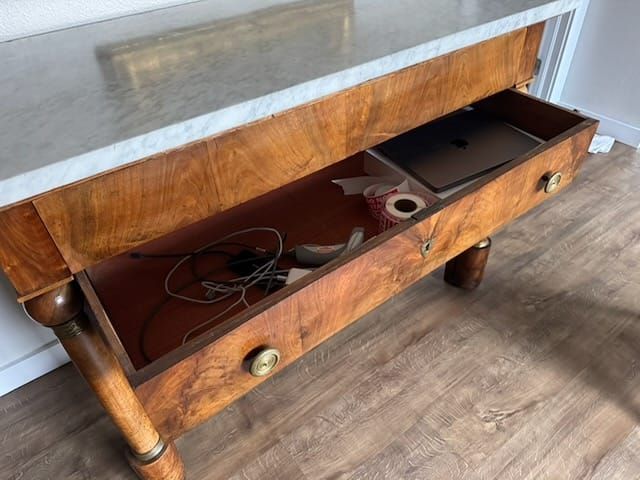
Everything in it felt needed. Not functionally — emotionally. The objects told the story of my life. Old clothes that no longer fit. Boxes of letters from my mother, my sister, former girlfriends. Shelves of books I had read and shelves of books I intended to. Furniture shipped from France because it felt like a filial obligation to carry certain things from one generation to the next. My children's elementary school drawings.
The easiest thing would have been to keep going. Replace the aging television. Rebuild the guest rooms for when the children return with partners and, eventually, children of their own. Maintain the momentum of a previous life by continuing to invest in it. The illusion of continuity.
But continuity had become a burden. The wind had shifted. A different phase of life was beginning whether I accepted it or not. That's when the idea of Ice Frontiers crystallized — and with it, the boat.
Planning to move aboard called for confronting what was in the house. Over three months, I fought with every object. I tried to sell things at prices that reflected my emotional distress more than their market value. I came to terms with the fact that most things had no market value at all. I was grateful, eventually, when someone would take something for free.
I filled a 95-gallon recycling bin with letters from people I loved. Then another with books.
The letters were the hardest. Not because I wanted to read them again — I didn't. They were no longer relevant as text. But releasing them meant acknowledging that those phases of my life were over. It was grief, precise and specific. Mourning a childhood. Mourning earlier versions of myself. My heart sank. I shed a few tears. I felt guilt.
But something clarified too.
The man those letters helped make was already there. Intact. The letters had done their work. Keeping them would have been clinging to scaffolding after the building is standing. The identity I feared losing turned out not to be stored in the objects at all. It was more durable than that.
I started wondering whether accumulation is less an expression of identity than a hedge against losing it. Whether we surround ourselves with evidence because we don’t fully trust that we’ve become who we are. The objects become proof we keep demanding of ourselves.
Letting go requires believing the proof is already in you. Which is terrifying. Until it isn't.
Leonard Cohen called his final album You Want It Darker. But the last song he released before his death was called Traveling Light. He was not talking about luggage. He was talking about the emotional weight accumulated over a life — the attachments, the versions of himself he'd outgrown. At the end, he was learning to let them go. To trust that what remained was enough.
I am not at the end of anything. But I recognize the gesture.
I still have a storage unit with a few boxes I haven't resolved. I am still working out how much air travel my obligations require. These are honest asterisks. But the thread is thinning.
What I found unexpected was the gratification. Not the satisfaction of efficiency or virtue — something more like relief. The relief of no longer defending a life I had already left.
The sustainability conversation tends to stay in the mode of calorie restriction. Reduce the footprint while keeping the lifestyle intact. But lifestyle is where the conversation should probably begin.
The tiny house movement understands this. So does van life, when it's honest with itself. The form is less important than the question underneath: did you actually put down the previous life, or did you add a more photogenic one on top of it?
There is a larger version of the same question. The societal models we inhabit — how we house ourselves, how we move, what we consider a normal life — were built for a different phase. A phase of expansion, of accumulation, of growth as an unambiguous good. That phase, like the one I lived in Colorado, may already be over whether we accept it or not. We are perhaps in the position of a civilization standing in an oversized house, surrounded by objects that once made sense, wondering what the next phase actually calls for.
That question is not about sacrifice. It turned out not to be about sacrifice for me either. It was about finding out what remained when the scaffolding came down.
Releasing what we no longer are turns out to be lighter than carrying it. Cohen knew this. I'm starting to.
Related Posts
 Jean Peccoud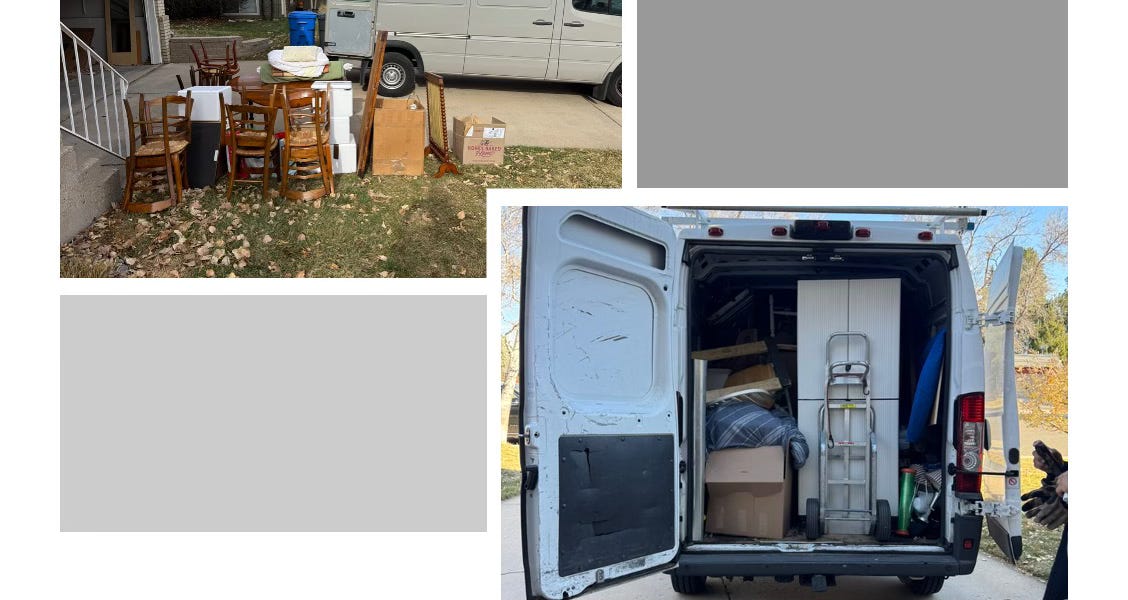
 Jean Peccoud