
The Cameron Peak Fire
The roots of Ice Frontiers (Part III)
The Loss
In 2020, climate change became very personal
The Cameron Peak Fire started near Cameron Pass, about forty miles west of Fort Collins, where I lived. It ignited on August 13, 2020, and was declared 100% contained on December 2—nearly four months later.
At first, it felt like a distant wilderness annoyance. The fire was eighty miles away by road, a three-hour drive. Not something we needed to worry about.
That illusion didn’t last.
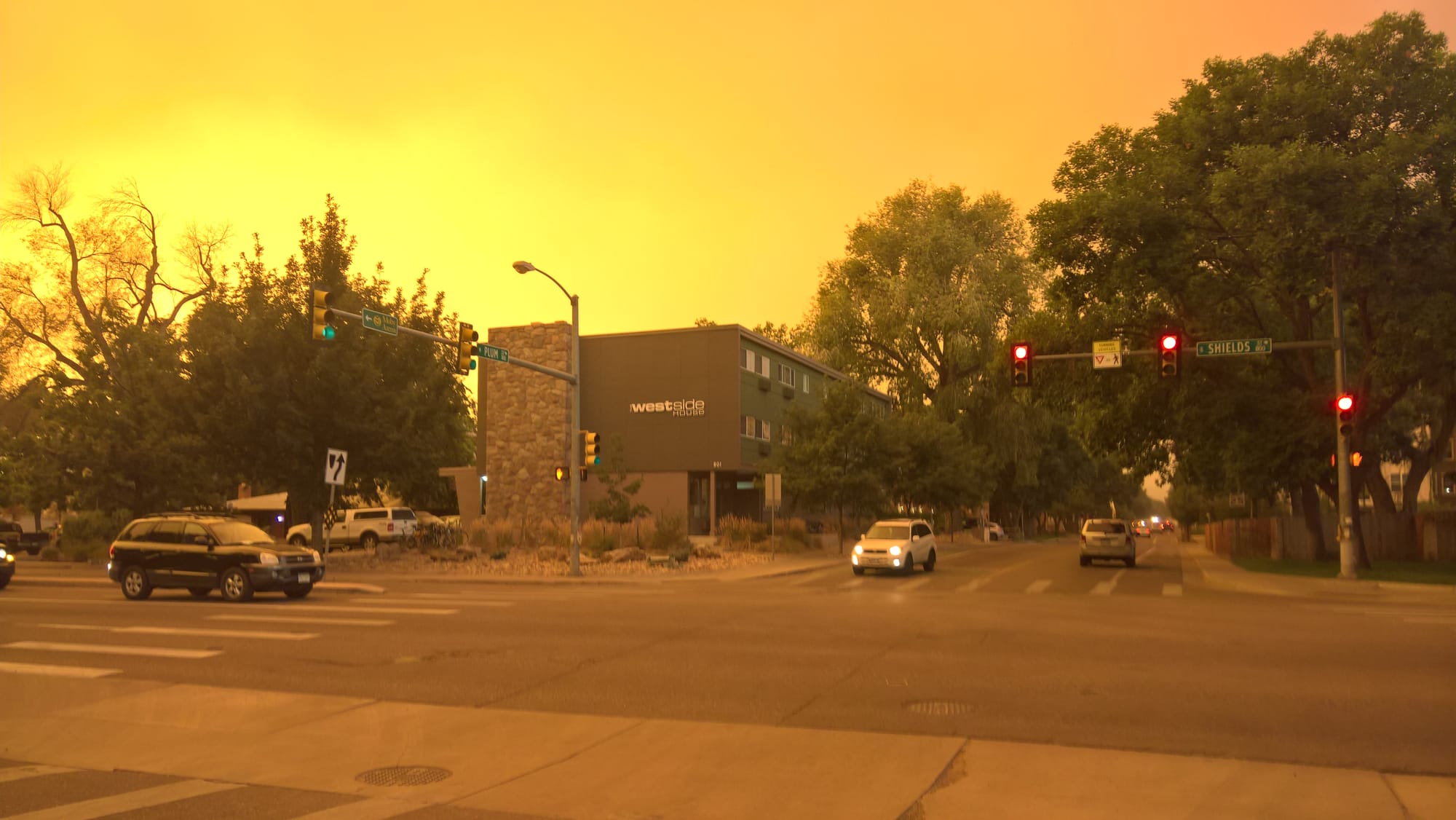
The sky turned an apocalyptic orange. Cars were coated in ash. Breathing became difficult; my throat burned when I went for a run. This was my first exposure to a wildfire of this scale. Initially, I assumed firefighters would contain it in a matter of days, as they often do in France. I quickly learned that this was not the same scale of problem.
It became clear that the fire was largely out of control. Firefighters weren’t stopping it—they were defending houses.
Days turned into weeks, weeks into months. Early snowfalls in September failed to extinguish it. By October, it had become the largest wildfire in Colorado history. Toward the end of the month, it made a rapid push toward Fort Collins, forcing evacuations on the outskirts of town. I remember wondering how long it would be before the city itself would have to evacuate.
That never happened. But the fear and the uncertainty stayed with me.
Mourning
The burn scar spans much of the Poudre River Canyon, a stunning and beloved recreation area just north of Rocky Mountain National Park. “The Poudre” is one of Colorado’s best-kept secrets—rich with hiking, skiing, fishing, and whitewater.
Driving through the canyon after the fire was heartbreaking. Most of the burned trees were still standing—ghosts of a forest that no longer existed.
For years afterward, I drove through that canyon again and again. I found myself glancing sideways at the slopes, curious and slightly repulsed, the way one looks at the site of a car crash. I felt a mix of survivor guilt, misplaced curiosity, and grief.
During those years, I was careful not to hike in the burned areas. It wasn’t entirely conscious. The idea crossed my mind, but I couldn’t face the loss, so I looked elsewhere.
Avoiding the scar wasn’t simple. The burn wasn’t uniform. In some places, everything was reduced to ash. In others, trees were partially burned. Elsewhere, the fire seemed to skim the canopy, touching some trees while sparing many others.
Complicating the mourning was the forest’s condition before the fire. The mountain pine beetle had already devastated large areas; in some places, more than half the trees were dead before the flames arrived.
I was grieving something that had already been changing, already been dying. The loss was real—but hard to define.
Renewal
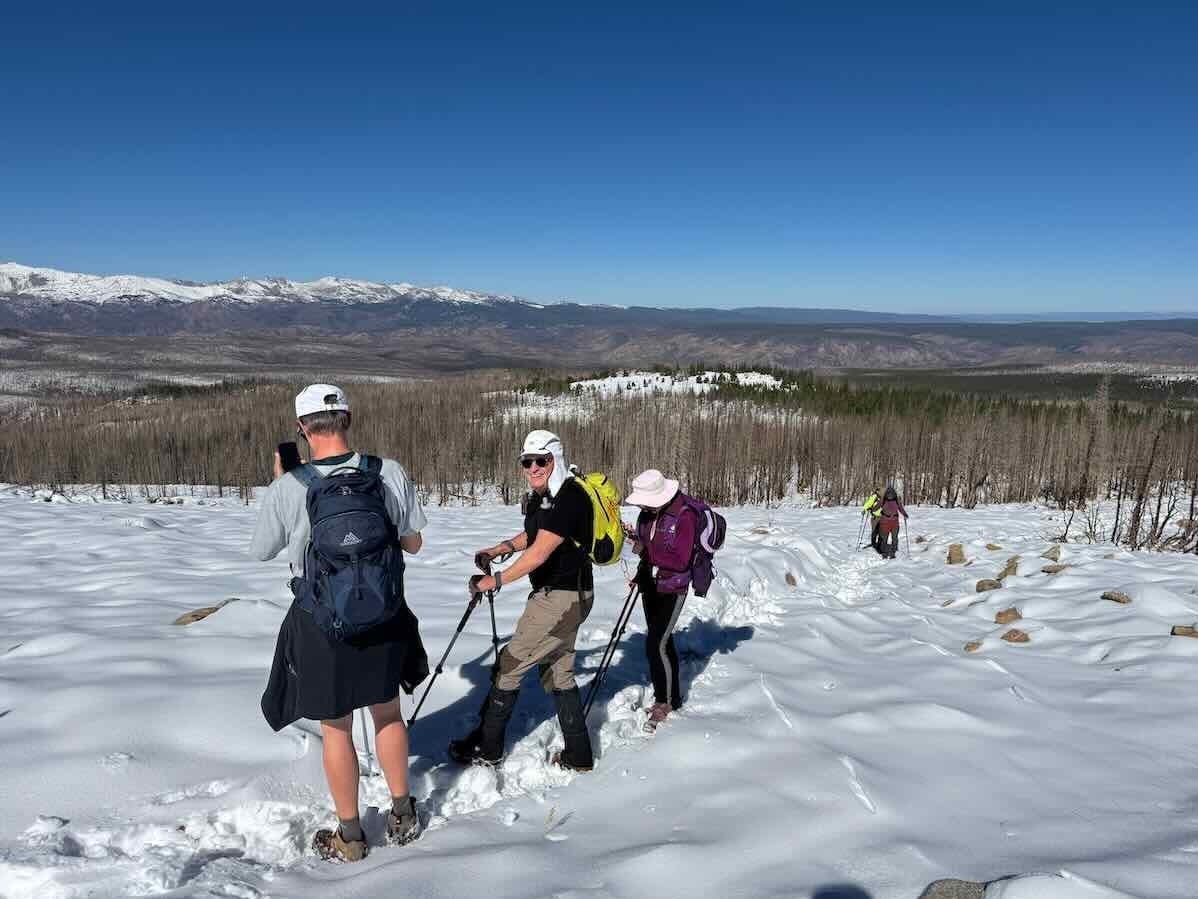
In September 2025, I joined a Colorado Mountain Club hike that crossed the Cameron Peak burn scar.
I had to confront the canyon as it now was—not as I remembered it. And it wasn’t as bleak as I had expected. A light early snow made the landscape feel clean, almost hopeful. The openness surprised me. Where dense forest once stood, light now reached the ground.
Looking more closely, I noticed young aspens emerging beside blackened trunks. The growth was slow and modest, but unmistakably alive. Something was happening.
For the first time, I wondered what the new forest might become. I became open to the idea that aspens—rather than a dense stand of aging pine—might create something different, perhaps even more interesting, more beautiful.
A burn scar is a kind of frontier. It marks the boundary between the known and the unknown. On one side lies a forest we learned to love—a forest we prefer to imagine as stable, a reassuring constant while everything else in our lives changes. On the other side is what looks like a death zone, a landscape stripped bare.
We exist at that boundary. We cannot romanticize loss, nor rush toward optimism. We have to linger where certainty breaks down—long enough to see that the forest we loved was already changing, and that the burned landscape is not as empty as it first appears. Then loss becomes a place of learning rather than denial. By witnessing how ecosystems adapt at their edges, we may learn how to face our own transitions with more honesty, humility, and resilience.
Related Posts
- Chasing Ice Roots of Ice Frontiers (Part I)
- Willy de Roos Roots of Ice Frontiers (Part II)