
Meet Rosemary
A custom aluminum expedition boat from the Joubert-Nivelt / Meta lineage, closely aligned with the Ice Frontiers mission.

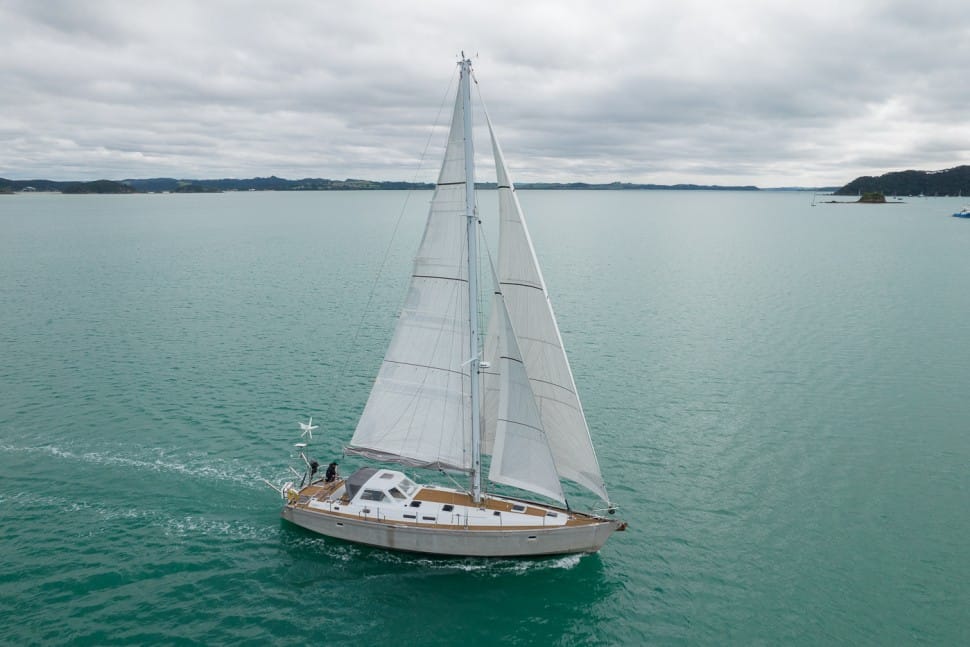
After months of looking for an expedition boat, I didn’t so much find Rosemary as I think she found me. At some point, I stopped looking past her as she kept telling me: I am here. Pay attention.
She wasn’t the newest candidate on the list. She wasn’t the most aggressively marketed. She didn’t arrive wrapped in a narrative designed to sell adventure. Instead, she stood quietly at the intersection of design, history, and intent where Ice Frontiers stands — and she refused to let go.
Her name is Rosemary.
A Legacy Boat
Rosemary comes from a lineage of naval architecture and craftsmanship that is no longer being maintained in quite the same way.
She is a custom expedition sailing yacht designed by Joubert-Nivelt, one of the most influential French naval architecture studios of the late 20th century.
Founded in 1974 by Michel Joubert and Bernard Nivelt, the firm shaped an entire generation of offshore boats — from high-performance racers to serious cruising and expedition yachts. Over several decades, their designs led to tens of thousands of boats built worldwide.
Joubert-Nivelt’s reputation was never about spectacle. It was about balance: boats that sail well, survive hard use, and avoid unnecessary complexity. Their designs won major races, but just as importantly, they quietly accumulated miles in places where failure is not an option.
That philosophy matters here, because Rosemary belongs to the part of their portfolio that rarely gets glossy coverage: boats designed to go far, stay out for a long time, and come back intact.
Rosemary was built in 1997 by Chantier Meta, a historic French yard known for building rugged aluminum boats intended for long-distance and high-latitude sailing.
Meta’s reputation was forged through decades of work on expedition yachts and ocean-crossing vessels, including boats associated with figures like Bernard Moitessier. Their approach was pragmatic and uncompromising: strong structures, conservative engineering, and systems chosen for reliability rather than novelty.
The shipyard that built Rosemary entered liquidation in 2025. Boats like this are no longer being produced in quite the same way — not because the ideas failed, but because the economics around them changed.
The collaboration between Joubert-Nivelt and Meta to design mission-driven expedition boats is perhaps best illustrated by Fleur Australe, the yacht they designed for Philippe Poupon and Géraldine Danon. Together with their four children, the couple sailed more than 80,000 nautical miles, including passages through both the Arctic and Antarctic.
Design Choices That Reveal Intent
A defining feature of Meta’s work was its patented Strongall® aluminum construction method. Rosemary’s hull and deck are built from 11 mm aluminum plate — a thickness comparable to what is used on many modern expedition yachts today. This is not decorative strength; it is a structural margin.
At 53 ft (16.25 m) and with a displacement of roughly 17 tonnes, Rosemary sits in the moderate displacement range. She is solid without becoming a floating bunker — designed to carry stores, fuel, and equipment without becoming fragile or overloaded. Her proportions reflect a boat meant to remain predictable as conditions deteriorate.
Many expedition yachts emphasize versatility through variable-draft keels and complex mechanisms. Rosemary does not.
She carries a fixed fin keel, welded directly to the hull, with a draft of 2.5 m. This is a deliberate choice. It favors structural simplicity, upwind performance, and long-term reliability over access to shallow anchorages. Fewer moving parts mean fewer things to fail when help is far away.
Insulation details are not extensively documented, but Rosemary appears to rely on closed-cell polyurethane foam sprayed directly onto the aluminum hull and deck — a method favored for aluminum boats operating in cold or humid environments. By eliminating voids and condensation pathways, this approach improves both thermal comfort and structural longevity.
Heating is redundant, combining forced-air diesel heat with a stove-type heater. Again, nothing flashy — just systems chosen so that no single failure becomes a crisis.
Rosemary is fitted with a 150 hp John Deere diesel engine, which is on the upper end of the power range for a boat of this size. That power is not about speed. It is about authority — the ability to motor into heavy seas, maneuver decisively in confined or hostile conditions, and leave when weather windows close.
Fuel capacity is approximately 3,000 liters. At a cruising burn rate of roughly 8 liters per hour at 8 knots — about 1 liter per nautical mile — Rosemary’s range under power alone is sufficient to cross an ocean with reserves.
That kind of autonomy is not a luxury in high-latitude or remote sailing. It is what turns plans into options rather than traps.
A Boat That Was Understood
Rosemary is not a theoretical expedition boat. She has already operated in demanding waters, including high-latitude environments such as Greenland. Eventually, she found her way to New Zealand — a place where offshore competence is assumed rather than advertised.
Her recent owners were part of New Zealand’s racing world — families known for representing their country in events such as the America’s Cup and the Whitbread Round the World Race. No names are needed here. What matters is the culture: Rosemary was recognized by sailors with very high standards as a legible boat—a boat whose design clearly aligns with its intent.
Not surprisingly, the upgrades and care she has received reflect that mindset.
Distance Matters
Because I am planning Arctic expeditions, I initially focused on the French and Northern European boat markets. From there, bringing the boat home is straightforward. Going to Svalbard from Norway is a short hop.
Going to Svalbard from New Zealand is not.
At first, I dismissed Rosemary. Yes, she was a remarkable boat, but I wasn’t even sure how to approach her. Visiting for surveys, managing a transaction twenty time zones away, and eventually bringing her home all seemed overwhelming. But she stayed with me.
Her fundamentals — her lineage, her design, her construction, her autonomy, her restraint — are so closely aligned with the Ice Frontiers project that I could not ignore her. If Ice Frontiers is about a journey, perhaps distance itself becomes part of the narrative. Perhaps the journey was not meant to start in Brittany.
Over time, it felt less like Rosemary’s location was an inconvenience and more like an invitation: to go deeper, to sail halfway around the world, to build miles and offshore endurance, and to approach high-latitude waters from a different angle.
Once I saw that alignment, she became worthy of my effort and attention. I found credible solutions to the challenges she represents.
Tomorrow, I am headed to New Zealand to meet her.
I am curious.
I think she is worth the trip.