Learning to Say Mayday
To register my boat under the UK flag, I had to earn the right to press the red distress button on a marine VHF radio. Learning to say “Mayday” turned into a reflection on autonomy, communication systems, and the psychological difficulty of asking for help — whether in the air or at sea.

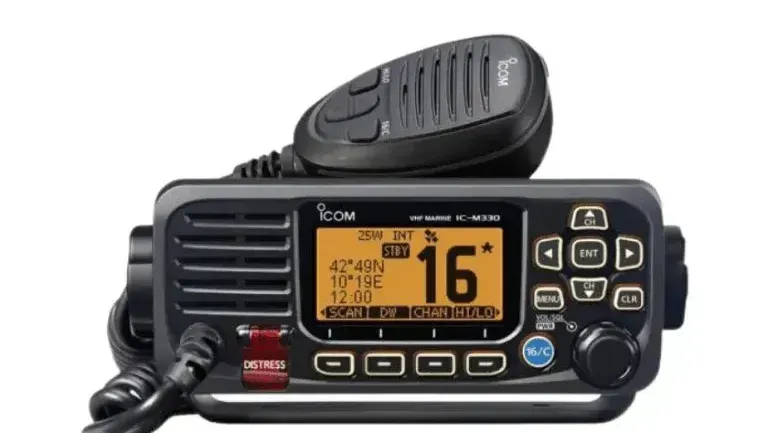
The distress button on a marine VHF radio sits under a small plastic flap. You have to lift it deliberately before you can press it. The design is simple and almost symbolic: you cannot trigger a distress alert by accident. You must mean it.
I needed to earn the right to press that button.
When I decided to register my boat under the UK flag, the administrative steps quickly led to a practical requirement. The vessel needed a ship radio license. To obtain one, it needed an MMSI number. And to be listed as the operator, I needed a recognized certificate. In the UK, that means the Short Range Certificate (SRC) issued under the Royal Yachting Association.
This was not optional. If I wanted the boat properly documented and compliant, I had to insert myself into the system.
Finding a place to do the training turned out to be harder than I expected. I looked in New Zealand, where the boat is currently located. I looked in the United States, where I live and did some of my sailing training. I explored online options. Many providers run courses irregularly. Some require a minimum number of students.
In the end, the only provider I could find offering regularly scheduled sessions was SeaRegs Training in Plymouth. So I flew to the United Kingdom to take a one-day VHF course. I then took advantage of the trip to add other trainings during the week (more on this later).
The content itself was straightforward but dense. We covered the basics of VHF operation: channel structure, transmission discipline, and standard marine phraseology. We practiced distress, urgency, and safety calls — the hierarchy of “Mayday,” “Pan-Pan,” and “Sécurité.” We learned how Digital Selective Calling (DSC) works: how an MMSI links your vessel to a digital distress alert that can automatically transmit your identity and position. We reviewed radiocommunication safety equipment, including EPIRBs and PLBs, and how alerts propagate through systems that ultimately connect to authorities such as HM Coastguard.
None of it was conceptually difficult. But it forced me to compare this world with another one I know well: aviation.
In aviation, communication is centralized. Pilots operate inside a structured network overseen by regulators like the Federal Aviation Administration. You talk to air traffic control. You are assigned a frequency. There is always someone listening. You can fly from the East Coast to the West Coast, including over deserts and mountains, and you are never out of radio communication range. Communication is continuous and supervised. While you can still conduct some flights without radio, pilots are encouraged to take advantage of the support infrastructure. Radio communication keeps you safe. Radio discipline is embedded in pilot training and licensing. There is no separate VHF certificate because the radio is inseparable from the system itself.
Marine communication is different. It is distributed. There is no controller monitoring routine traffic. Vessels speak to each other directly. Channel 16 is open to all. Outside of coastal areas, you may not be within range of anyone at all. The system assumes autonomy. It assumes isolation. Participation in radio communication is voluntary, never structurally required.
From an aviation perspective, marine radio can feel inefficient. Vessel names are repeated multiple times. Identifiers are redundant: vessel name, call sign, MMSI. “Over” and “out” persist in places where aviation long ago adopted tighter phraseology. But what looks like inefficiency may be robustness. Marine communication must tolerate thick accents, weak signals, emotional stress, and a wide range of operator experience. Redundancy is not elegance; it is error tolerance.
There is also a structural difference in how VHF is used. Aviation relies heavily on VHF because altitude dramatically extends radio range. At several thousand feet, line-of-sight can stretch for hundreds of miles. You are almost always inside someone’s listening horizon. At sea level, VHF is short-range — often limited to a few tens of nautical miles. Offshore, it quickly becomes irrelevant.
Modern offshore sailors compensate with layered communication systems. Satellite networks like Iridium Communications provide global voice and data coverage. Starlink has transformed connectivity at sea, allowing near-continuous broadband far from shore. EPIRBs and PLBs transmit automated distress signals through international satellite constellations. Marine communication is no longer singular; it is multifaceted. Local analog VHF, digital distress signaling, and satellite redundancy coexist. Today, mariners must leverage the complementarity of different communication networks far more than they need to optimize a single channel such as VHF radio.
Today, mariners have many ways of getting the help they may need. And yet, despite the technology, the most difficult part of emergency communication remains human.
Years ago, I experienced an engine failure in an aircraft. The procedure was clear: maintain control, identify a landing site, run the checklist. I was already in contact with air traffic control. The radio was active. Help was structurally present. And still, in the cognitive narrowing that comes with task saturation, I forgot to declare an emergency. I was so focused on flying the airplane that I never said the words.
Fortunately, I landed the plane safely. I did not get hurt. The plane was not damaged, and most importantly, nobody else was hurt. If I had declared an emergency, I might have received priority access to a runway. I would also have notified other planes in the area that I had very little control over my aircraft. Declaring an emergency was not about getting me on the ground safely — that remains the responsibility of the pilot. It would have limited the risk I created for others sharing the same airspace.
It took me some time to understand what happened during that flight. The way it unfolded surprised me afterward. The system was there. The frequency was open. The phrase was familiar. I simply did not think to use it. Or perhaps I did not want to say the words publicly. I did not want to broadcast my vulnerability.
At sea, the threshold can be even higher. No one may be listening unless you speak. The decision to say “Mayday” is not merely procedural; it is psychological. It is an admission that you cannot solve the problem alone. It is a shift from autonomy to interdependence.
The plastic flap over the distress button embodies that threshold. It prevents accidental activation. But it also makes the act conscious. You must lift it. You must choose. The difficulty is not learning the correct sequence of words. It is recognizing the moment when pride, denial, or optimism must give way to clarity.
Learning to say Mayday is not about mastering a radio. It is about understanding that, in aviation or at sea, technology can only help if we are willing to use it. The systems differ — centralized in the air, distributed on the water, increasingly layered with satellites — but the human hesitation is the same.
Calling for help is never just technical. It is an act of judgment. And sometimes, the hardest part is simply deciding to speak.
Related posts
 Jean Peccoud
 Jean Peccoud
See also